

Which Is The Best Memory Foam Mattress? A Clear, Honest Guide For Real Sleepers
If you are searching “which is the best memory foam mattress excnconsoles” there is a good chance you feel overwhelmed, a little confused, and maybe more than a little tired. Between big brand claims, conflicting reviews, and technical jargon, it can start to feel like you need a degree in materials science just to get a good night’s sleep. You are not alone in that feeling, and you are not “bad at shopping” for feeling stuck. The mattress world has simply become too noisy.
Memory foam can be wonderful, but it is not one size fits all. The “best” mattress for a 120 pound side sleeper with hip pain is very different from the best choice for a 230 pound stomach sleeper who runs hot. Choosing poorly can mean waking up sore, tossing and turning, or feeling trapped in a too soft bed that you cannot comfortably move in. Over years, sleeping on the wrong surface can contribute to back pain and fragmented sleep, which many clinics now connect with mood, focus, and metabolic health.
Here at Sleepology, my role is to bridge the gap between lab specs and real bodies in real bedrooms. In this guide we will unpack what actually makes a memory foam mattress good, who it suits, how body weight and sleep position change the “right answer,” and how to tell if a bed in front of you is likely to work for you. I will also point you to specific mattress options from Sleepology that match different needs and budgets, and I will be candid about when you might be better off in a hybrid instead of pure foam.
By the time you finish reading, my goal is that you feel the way my in store clients do when we find “their” bed: relieved, confident, and already imagining their first truly restful night.
What A “Best” Memory Foam Mattress Really Has To Do For You
When people ask me which is the best memory foam mattress, they are rarely asking about foam density curves. What they mean is, “Which mattress will let me fall asleep quickly, stay asleep, and wake up without pain.” To answer that honestly, we need to translate sleep science into everyday language and then connect it to what memory foam actually does.
According to the Sleep Foundation, most healthy adults need 7 to 9 hours of sleep per night, and sleep quality is shaped heavily by comfort, spinal alignment, and motion disturbance, especially in people who share a bed. Clinical groups such as the Mayo Clinic also note that chronic pain and insomnia reinforce each other, which is part of why people with back or joint pain become so passionate about the right mattress. A good memory foam mattress should support all three pillars at once: pressure relief, alignment, and stability.
Pressure relief is where memory foam shines. The foam responds slowly to weight and heat, so it fills in the curves of your shoulders, hips, and lumbar area instead of pushing back sharply. This is why side sleepers often feel almost instant “ahh” when they try the right foam bed. In fact, early research into viscoelastic foam, which later became “memory foam,” came out of pressure relief work funded by NASA for pilots and astronauts.
Spinal alignment is the quieter but equally important half of the equation. If your hips drop lower than your shoulders on a soft mattress, or if your shoulder cannot sink far enough so your neck bends, your brain may never fully drop into the deepest, most restorative stages of sleep. A review in the Journal of Chiropractic Medicine found that medium firm surfaces often support alignment better than very soft ones, especially for back and stomach sleepers. Translating that to memory foam means you want a comfort layer that hugs you, paired with a support core that quietly holds your spine in its natural curve.
The third piece is stability and motion isolation. One reason couples gravitate toward memory foam is how quietly it absorbs movement. Where coils can bounce energy across the bed, good quality foam tends to dampen it. That lets one partner roll over or get up in the night without waking the other, which quickly adds up to higher sleep efficiency for both of you.
When you put these pieces together, the “best” memory foam mattress for you will be the one that gives you enough contouring at your pressure points, keeps your spine neutral for your body type and sleep style, and isolates motion enough for your living situation, all at a firmness level your nervous system can fully relax into.
> “I had read every list of ‘top 10 memory foam mattresses’ and still woke up sore. Mia reframed it for me around alignment and weight, not brand names. We ended up choosing a slightly firmer hybrid instead of an ultra plush foam, and it has been night and day. My fitness tracker shows I’m getting about an hour more deep sleep per night.” > – Carla J., November
How Your Sleep Position And Body Weight Change The “Best” Mattress
If I could put one sign on every mattress website, it would say: “There is no best mattress, there is only the best mattress for this body and this sleeper.” Your sleeping position and body weight change how deeply you compress foam, which areas need extra cushioning, and where you most need support. This is why you can read glowing reviews of the exact mattress that made your back hurt.
From a clinical perspective, alignment means keeping the natural curves of your spine relatively straight from the back view and gently S shaped from the side view. The Cleveland Clinic often explains spinal health in terms of “neutral spine,” and that is precisely what we try to preserve in every sleep position. Foam needs to allow certain parts of you to sink more, and resist other parts from sinking too far.
Let’s break that down by position. Side sleepers concentrate their body weight on a smaller area, mainly the shoulder and hip on the bottom side. This increases pressure in those joints, which is why a too firm mattress can leave side sleepers with numb arms or aching hips. Memory foam is excellent here because it redistributes that pressure, but only if the support core underneath stops you from bowing in the middle.
Back sleepers spread their weight more evenly, but the lumbar curve still needs support. If the foam under your lower back collapses, your spine can settle into extension, which may aggravate lower back pain. Here, a medium to medium firm feel with moderate contouring tends to work better than ultra plush.
Stomach sleepers are the most alignment sensitive group. Sleeping face down already asks your neck to rotate, so you want to avoid adding lumbar strain. That means your hips must not sink much more than your ribcage. Pure memory foam that feels dreamy for a petite side sleeper can be a disaster for a heavier stomach sleeper.
Body weight plays into all of this by changing how deeply you compress the same materials. Someone under 130 pounds may barely dent a firm foam, feeling it as hard and unyielding, while someone over 220 pounds might sink fast into that same mattress and describe it as “too soft.”
Best Memory Foam Feel For Side Sleepers
For most side sleepers, the best memory foam mattress has a medium or medium soft feel with a comfort layer thick enough to let the shoulder and hip nestle in without bottoming out. That often means at least 2 to 3 inches of pressure relieving foam in the upper layers.
A typical pattern I see is a side sleeper buying a mattress that feels “luxuriously plush” in the store, only to find that after a few nights their spine is sagging in the middle. If you are around 150 pounds or less, a medium feel might be soft enough once your body heat warms the foam. If you are closer to 200 pounds, you may genuinely need a plusher top, but only if it sits over a firmer, higher density core.
For example, many of my side sleeping clients do extremely well on medium to medium soft hybrids like the Sealy Posturepedic Elite Medium Mattress – Brenham II Euro Pillow Top. Although it is technically a hybrid, its quilted Euro top and comfort foams give you that “memory foam hug,” while the coil core quietly holds your spine in a straighter line than an all foam bed of the same plushness would.
If you are a side sleeper with sensitive shoulders, look for phrases like “zoned support” or “zoned coils.” These designs often ease up under the shoulders but firm up under the lumbar area. Combined with a memory foam surface, they can give you pressure relief where you want it and reinforcement where you need it.
> “I’m a 135 pound side sleeper and had convinced myself I needed the softest foam out there. Mia had me lie on a medium pillow top over firmer support, and it was the first time my shoulder stopped throbbing. We chose the Brenham II and I noticed a difference by night three.” > – Jenna S., October
Best Memory Foam Feel For Back Sleepers
Back sleepers are often the most flexible group, which can be both a blessing and a curse. They can be comfortable on a wider range of firmness levels, but that also means it is easier to get fooled by a bed that feels nice at first and reveals its weaknesses a month in.
Most back sleepers do best on a medium firm surface that lets the heavier parts of the body settle slightly without losing the natural inward curve of the lower back. A study referenced by sleep researchers found that medium firm mattresses were associated with less back pain than either very firm or very soft options, which aligns with what I see in the showroom.
If you are a dedicated back sleeper under about 200 pounds, consider a balanced feel with moderate contour and a clearly supportive base. You might love a mattress like the Sealy Posturepedic Medium Mattress – Medina II Euro Pillow Top, which combines pressure relieving foams near the surface with more assertive support underneath. It gives you enough hug to relax your back muscles but enough pushback to keep your hips from drifting.
Heavier back sleepers, or those with chronic lumbar issues, may be better served by a firmer feel with only gentle contouring. In some cases, a memory foam hybrid with targeted center support, such as the Sealy Posturepedic Plus Extra Firm Mattress – Paterson II, offers a safer long term foundation. You can always soften the surface slightly with a high quality topper if needed, but it is much harder to make an overly soft core more supportive.
Best Memory Foam Feel For Stomach Sleepers
If you primarily sleep on your stomach, memory foam can either be your best friend or your worst enemy. The wrong foam will allow your pelvis to sink, arching your lower back and compressing facet joints. Over time, that can turn a simple mattress mistake into a real back problem.
For most stomach sleepers, the “best” mattress will feel firmer than they expect when they first lie down. I generally target a firm or firm leaning medium firm. The idea is to keep your hips lifted on the same plane as your shoulders, while still giving enough cushion to your ribcage and knees that you do not feel like you are sleeping on the floor.
This is where many of my clients end up happier on a memory foam hybrid. A model such as the Sealy Posturepedic Pro Firm Hybrid Mattress – Dupont II uses conforming foams above resilient coils. You get some of that motion isolation and gentle contour of foam, but the coil system resists deep sink under your pelvis much more effectively than foam alone.
If you are a lighter stomach sleeper, you may get away with a touch more plushness, but I still advise erring on the side of support and fine tuning comfort with your pillow choice and maybe a thin topper. Stomach sleepers also tend to benefit from pillows on the flatter side to reduce neck extension.
Memory Foam vs Hybrid: When “The Best” Is Not Pure Foam

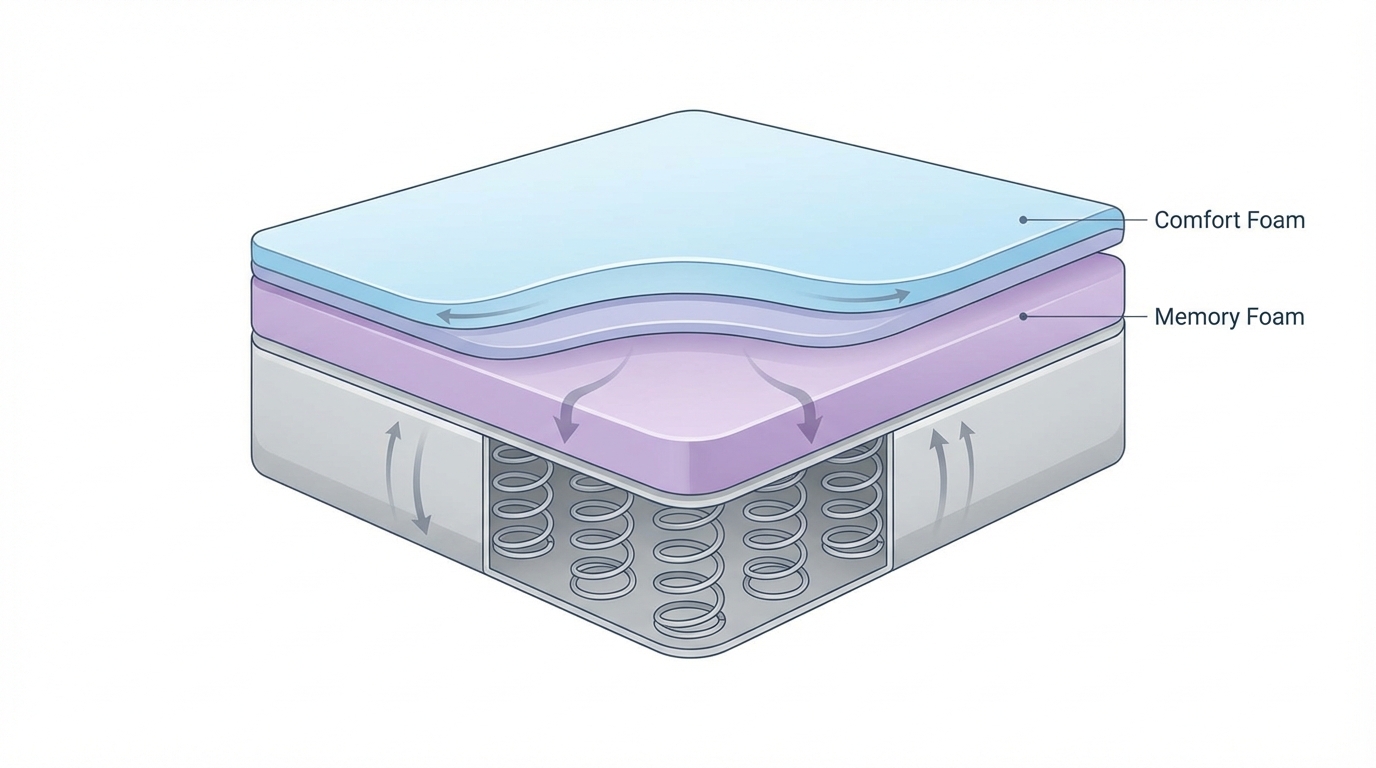
A lot of the “best memory foam mattress” lists you see online implicitly assume that the ideal mattress is an all foam construction. In practice, many sleepers get better results from what I call memory foam forward hybrids: beds that put contouring foam in the comfort layers, but rely on coils for deep support.
The reason comes back to physics. Foam is excellent at absorbing force and conforming to shape, but it is not naturally great at long span structural support unless it is very dense, which then makes it hotter and less responsive. Coils, on the other hand, are excellent at bearing weight and maintaining shape but can bounce too much and create pressure points if not balanced with the right comfort materials on top.
Hybrids blend these strengths. The top layer or two can be true memory foam, giving you the slow response pressure relief you are seeking. The coil core underneath can be zoned, reinforced at the edges, and tuned to a specific firmness, which allows better spinal alignment across a wider range of body types. Several independent testing organizations, including Consumer Reports, have noted that hybrids now perform extremely well for durability and support.
If you have tried all foam beds and either run hot, feel stuck, or notice your back aching after a few weeks, a hybrid with high quality comfort foams is very likely to serve you better. For instance, the Sealy Posturepedic Elite Soft Hybrid Mattress – Brenham II is a good option for those who love a plush contour but need the underlying coil strength to keep their spine happier.
All foam can still be a beautiful choice for lighter side sleepers, people in smaller spaces who need easier maneuvering, and those who prioritize maximum motion isolation. The key is not to chase a label, but to ask: does this specific construction give my body what it needs.
> “I was convinced pure memory foam was the only way to go because my sister swore by hers. I’m 80 pounds heavier than she is and mostly sleep on my stomach. Mia had me try a firm hybrid with a cushy foam top and it was like my back immediately relaxed. I still get that gentle ‘hug’ but no more sinking hips.” > – Daniel K., December
Key Features That Separate Great Memory Foam From “Just Okay”
Once you know your sleep position and weight needs, the next question is how to tell whether a particular mattress is well built. There are a few core features that I pay close attention to, whether I am evaluating new models for Sleepology or helping a guest compare two beds on the floor.
Foam Density, Thickness, And Layer Design
In plain language, foam density is how much material is packed into a given volume. Higher density memory foams tend to be more durable and can provide more even pressure relief, but they can also feel heavier and retain more heat if not designed carefully. Many experts recommend at least medium density foams for primary comfort layers in adult mattresses, especially for people over about 180 pounds.
Layer thickness matters too. A single thin layer of memory foam over inexpensive polyfoam can feel pleasantly soft at first and then quickly “bottom out,” leaving you effectively sleeping on the core. On the other hand, stacking too much soft foam without a proper transition layer can make you feel swallowed and destabilized. In our Sleepology test lab, the sweet spot for many sleepers is around 2 to 4 inches of comfort foam, sometimes in more than one layer, with a clearly firmer transition or support layer underneath.
When you are reading about a mattress online, look for clear descriptions of each layer’s function. If all you see is vague language like “plush comfort foam” and “supportive base,” without any indication of thickness or material type, that is usually a sign the manufacturer is cutting corners.
Temperature Regulation And Breathability
Traditional memory foam got a reputation for sleeping hot, and there was truth in that. The earliest foams were dense and closed cell, meaning they trapped heat more easily. Modern foams have improved a great deal. Many use open cell structures, gel, graphite, copper, or phase change materials to dissipate heat. Independent reviews, such as those from Sleep Foundation and Wirecutter, have noted that some newer foams now perform similarly to hybrids for temperature, especially when paired with breathable covers.
The marketing around cooling can get out of hand, so here is how I simplify it with clients. First, pay attention to your own tendencies. If you are a very hot sleeper, I will almost always guide you toward either a foam hybrid or at least a foam bed with well documented cooling tech and a breathable, non quilted cover. If you run neutral or cool, most modern medium density foams with a breathable cover will likely be fine.
Second, do not rely solely on the phrase “cooling.” Look for explanations of how the mattress manages temperature. Does it use a ventilated foam? Are there cut channels in the transition layers? Is the cover a natural breathable fiber like cotton or Tencel, or a tightly knit synthetic that might trap warmth? These are more meaningful clues than a blue swirl in a product photo.
Motion Isolation, Edge Support, And Ease Of Movement
Motion isolation is one of memory foam’s greatest strengths, and most all foam beds do quite well at it. Where I see more variation is in edge support and ease of movement.
Edge support influences how secure you feel sitting or lying near the perimeter. It matters for couples who want to use the full width of the mattress and for anyone who has mobility issues and relies on the bed edge as a stable platform to get in and out. All foam mattresses often have weaker edges than hybrids, although some use higher density foam rails to strengthen the perimeter.
Ease of movement is about how quickly the foam responds as you shift positions. If you are a combination sleeper or have joint issues that make it hard to push yourself up, very slow, sticky foams can be frustrating. On the other hand, if you crave that “nestled in” feeling and do not move much once you fall asleep, a slower response can feel more secure.
Testing organizations like Sleepopolis now routinely rate mattresses on both edge support and responsiveness, and those scores can help you predict how a given model will feel beyond the first 30 seconds of lying on it.
A Simple Checklist: Is This Memory Foam Mattress A Good Fit For Me?
At this point, you have a sense of what your body needs and what makes a foam mattress structurally sound. To bring it together, here is a short checklist you can mentally run through when you look at a specific bed. This is one of the tools I use with guests who like concrete steps.
After you have read the basic specs and maybe tried the mattress in person, ask yourself:
- Does the firmness match my sleep position and weight, or am I talking myself into it because of a sale or a brand name?
- When I lie in my usual position for at least 10 minutes, does my spine feel neutral and supported, especially through the lower back and hips?
- Are my shoulders and hips cushioned enough that I do not feel sharp pressure or tingling after a few minutes?
- If I share the bed, can my partner roll or get up without jolting me awake, at least based on store testing?
- Do I feel overly hot or “stuck” in one spot, or can I change positions without fighting the foam?
- Is the edge strong enough that I feel secure sitting or lying near the side?
If you answer yes to all or almost all of these, and the construction details look honest and robust, you are very likely looking at a good match. If you find yourself saying “Well, I hope my back will adjust” or “Maybe it will soften up later,” that is usually your body trying to tell you it is not quite right.
Remember, most quality mattresses now include a home trial period. Many direct to consumer brands are in the 90 to 365 night range. Use that time like a true test window, not an extended return deadline. Keep a simple note on your phone about how you feel in the morning, and if persistent pain or poor sleep shows up, take it seriously.
How Sleepology’s Mattresses Fit Common Memory Foam Profiles
One of the benefits of working with a curated retailer like Sleepology instead of a giant marketplace is that we have already filtered out a lot of mediocre products. I will briefly map a few of our popular Sealy Posturepedic models to the profiles we have discussed, so you can see real world examples.
For side sleepers who want that classic cushioned feel without sacrificing support, the Sealy Posturepedic Soft Mattress – Medina II Euro Pillow Top combines generous surface softness with a supportive coil core. It is a nice option for lighter to average weight side sleepers who wake with sore shoulders or hips.
For combination sleepers who change positions and share a bed, the Sealy Posturepedic Pro Soft Mattress – Dupont II Euro Pillow Top is a versatile hybrid. The foams up top deliver pressure relief similar to memory foam, while the Pro support system under the surface maintains good alignment through a range of positions.
For those who truly need a firm, stable feel, such as heavier back or stomach sleepers, the Sealy Posturepedic Elite Extra Firm Mattress – Brenham II is one of our most supportive options. You can always add a thin, quality topper if you crave a hint more plushness, but starting with a solid core is crucial if alignment is your top priority.
Finally, if you have identified strongly as a side sleeper and want to see several curated options, exploring our Best Side Sleeper Mattress Collection can be a helpful next step. We group models there that pair contouring comfort layers with the right support profiles for typical side sleeping needs.
When To Rethink Memory Foam Altogether
Although I love memory foam and hybrids that incorporate it, I will never say it is right for everyone. There are a few situations where, in my experience and in line with what many sleep experts report, you may be happier long term choosing a different feel.
If you have significant mobility issues or advanced arthritis, the slow, enveloping feel of classic memory foam can sometimes make it harder to reposition comfortably. In those cases, a more responsive latex or latex hybrid can give you pressure relief with a slightly springier surface that assists you in moving.
If you are a very hot sleeper in a warm climate, and you have tried multiple “cooling” foams without success, consider shifting to a more breathable build. Innerspring or hybrid designs with minimal foam and substantial airflow can make a noticeable difference. The American Academy of Sleep Medicine often emphasizes cooler sleep environments for insomnia, and your mattress can be part of that equation.
If you strongly prefer a buoyant, on top of the bed feel with significant bounce, you may simply never love the slow sink of memory foam. In that case, forcing yourself into foam because everyone online says it is “best” will likely end with frustration. A good mattress is one your nervous system relaxes on, not one that fits a trend.
The real sign it may be time to rethink is your own sleep and pain pattern. If you are giving a well chosen foam mattress a fair trial and still wake more uncomfortable than you did on your old bed, it is not a moral failure to say, “This material is not for me.”
How To Use Reviews, Lab Tests, And Expert Lists Without Getting Lost
You have probably noticed that many authoritative sites, including Sleep Foundation, Wirecutter, Sleepopolis, Forbes, and NapLab, publish their own “best memory foam mattress” rankings. These can be valuable starting points, and many of us behind the scenes know and respect each other’s work. We also all test through slightly different lenses.
Where we all tend to agree is on core principles: medium to medium firm often helps with back pain, higher quality foams and thoughtful layer design last longer, and cooling features are most important for hot sleepers. Where lists diverge is usually at the level of tradeoffs. One reviewer might prioritize motion isolation above edge support, another might value maximal pressure relief even at the cost of slower response.
To use these resources without getting overwhelmed, I recommend starting with one or two that match your own priorities. If you hate being jostled by a partner, look at tests that quantify motion transfer. If you are a heavier stomach sleeper, look for commentary from larger testers or specific mention of support for higher weight ranges.
Then, cross check your short list with a trusted retailer’s offerings and, ideally, in person testing. Remember that you are not buying a score, you are buying how it will feel to lie on that mattress for the next decade. Use expert lists as filters, not final answers.
Bringing It All Together: Your Path To The “Best” Mattress For You
At this point you may be thinking, “So the answer to which is the best memory foam mattress excnconsoles is: it depends.” And you are right, but “it depends” does not mean “you are on your own.”
You now know that the three non negotiables are pressure relief, spinal alignment, and stability. You understand that your sleep position and body weight heavily influence the firmness and structure that will deliver those things. You have a sense of when a hybrid might quietly outperform an all foam bed for your situation, and how to read beyond marketing language to understand what a given mattress is really made of.
Most importantly, you have permission to trust your body. If a mattress that is supposed to be “number one” leaves you waking up stiff or overheated, it is not the best mattress for you, regardless of how many awards it has collected.
At Sleepology, our job is to shorten that journey. Whether you are browsing online or visiting one of our locations, you can lean on curated collections for back sleepers, stomach sleepers, and side sleepers, and you can always reach out for one on one guidance. The right mattress is not a luxury. It is a very practical foundation for how you feel and function every day.
If you would like help narrowing down specific models based on your height, weight, health background, and bedroom environment, my team and I are only a conversation away. You deserve to sleep in a bed that supports the life you are trying to live.
Frequently Asked Questions
How long do memory foam mattresses typically last?
Most quality memory foam mattresses last around 6 to 8 years with nightly use, although higher density foams and well designed hybrids can stay comfortable longer if cared for properly. Organizations like Sleep Foundation often cite a 7 year average lifespan for foam beds, which matches what I see with my own customers. Rotating the mattress a few times per year, using a supportive base, and keeping pets and kids from jumping on it can all extend its life.
Are memory foam mattresses good for back pain?
They can be, but only if the firmness and support are matched to your body. Research on back pain and mattresses often points to medium firm surfaces as helpful, not because of magic, but because they tend to preserve neutral spinal alignment while still allowing muscles to relax. Memory foam is excellent at easing pressure around sore joints and muscles, which many back pain sufferers appreciate, but it must be paired with a support core that keeps your hips and shoulders from sagging. For many people with back pain, a memory foam hybrid or a firmer foam bed with a small amount of contour is a safer choice than an ultra plush all foam mattress.
Do all memory foam beds sleep hot?
Not anymore. Early generations of memory foam were notorious for trapping heat, but modern designs have improved significantly. Many now use open cell constructions, gel infusions, graphite, or phase change fabrics in the cover to move heat away from your body. Independent testing by groups like Sleepopolis and Wirecutter has shown that some all foam models now stay within a few degrees of room temperature across the night. That said, if you are a very hot sleeper, you are still more likely to be comfortable on a breathable hybrid or a foam bed that clearly prioritizes airflow in its design.
Can I put a memory foam mattress on a box spring?
In most cases, you should not use a traditional box spring under a memory foam mattress. Box springs are designed to work with innerspring beds and have flexible internal coils that can allow a foam mattress to sag between them. Many manufacturers and organizations such as Sleep Foundation recommend a solid or slatted platform with slats spaced closely enough that the mattress is fully supported. Using an improper base can not only affect comfort and alignment, it can also void your mattress warranty, so it is worth checking the brand’s specific foundation guidelines.
What firmness should I choose for my memory foam mattress?
A good starting point is to match firmness to your primary sleep position and weight. Side sleepers under about 200 pounds often do well in the medium to medium soft range. Back sleepers usually fall into medium firm, with lighter bodies leaning slightly softer and heavier bodies slightly firmer. Stomach sleepers almost always need firm or at least firm leaning medium firm to keep their hips elevated. If you are a combination sleeper, think about the position you spend the most time in and the one where you tend to wake with discomfort, and let that guide you. When in doubt, choose the slightly firmer option and adjust surface plushness with bedding, rather than the reverse.
Are memory foam mattresses safe? What about off gassing?
Most reputable memory foam mattresses sold in the United States today are CertiPUR US certified, meaning the foams are made without certain harmful chemicals and meet limits for emissions of volatile organic compounds. You may still notice a mild “new mattress smell” when you first unbox one, especially bed in a box models, but research suggests that for certified foams this is mainly a nuisance odor, not a health hazard, and it usually dissipates over a few days in a well ventilated room. If you are highly sensitive to smells or have respiratory issues, you may want to unbox the mattress in a spare room, open windows, and wait until the scent dissipates before sleeping on it.
What if I choose the wrong memory foam mattress?
First, do not panic. With most modern mattresses, you have a generous trial period and are not locked into a painful mistake. If you realize after several weeks that a bed is too soft, too firm, too hot, or simply not easing your pain, reach out to the retailer within the trial window. At Sleepology, our team will work with you to troubleshoot whether an adjustment in base, pillows, or bedding might help, and if not, to help you select a better suited model. Paying attention early and being willing to pivot is far better than trying to “tough it out” for years on a bed that is not serving your body.