

When To Replace Your Mattress: A Practical Guide To Better Sleep And Smarter Spending
You know that feeling when you wake up and cannot quite tell if you slept badly, or if your body is simply getting older. Maybe your back feels tight, your shoulders are a little sore, or you are oddly more tired after eight hours in bed than you were before you went to sleep. It is very common to wonder whether the problem is stress, age, or your mattress, and it can be surprisingly hard to tell. You are not imagining it, and you are not being picky. Your mattress really can quietly slip past its prime while you adapt to “just okay” sleep.
This question of when to replace a mattress matters more than most people realize. According to the Sleep Foundation, most adults need 7 to 9 hours of sleep a night, and sleep quality affects everything from mood and focus to blood sugar and heart health. When your mattress is worn out, your body has to work harder all night to find support, which means less deep, restorative sleep and more micro awakenings that you might not remember but your body certainly feels. A mattress is not a luxury item. It is part of your basic health toolkit.
You also do not want to replace a mattress too early and waste money, or too late and quietly pay the price in pain, fatigue, and chiropractor visits. Most sources, including the Sleep Foundation and Mayo Clinic, agree that the typical lifespan for many mattresses falls between about 7 and 10 years, but that range is only a starting point. Your body, your sleep habits, your mattress type, and how well you care for it all change the real answer.
Here, you will get a clear, honest way to decide if your bed is still serving you, or if it is time to say goodbye. You will learn how long different mattress materials typically last, the concrete signs that your body and your bed are giving you, how to separate “mattress problem” from “something else problem,” and how to plan your next mattress so you do not end up repeating the cycle in a few short years. My goal is that you will finish feeling informed, relieved, and ready to make a confident decision, whether that means squeezing a couple more good years out of your current mattress or starting fresh with something that actually fits your life now.
How Long Do Mattresses Really Last?
The most common rule of thumb you will hear is that mattresses should be replaced about every 7 to 10 years. That range is a useful starting point, but it is also a little like saying cars last 5 to 15 years. It is technically true, but it hides a lot of important detail. Some high quality mattresses genuinely stay supportive and comfortable for well over a decade, while budget beds, especially those made with low density foams, can be tired in as little as 3 to 5 years, especially under heavier use.
Reputable organizations like the Sleep Foundation and Consumer Reports have both found that material and construction are the single biggest drivers of lifespan. Innerspring mattresses with basic interconnected coils tend to wear out faster, often around 5 to 7 years. Pocketed coil hybrids with higher quality steel and better edge support usually stretch closer to that 8 to 10 year mark. High density memory foam and natural latex can surpass 10 years when well cared for, with some latex designs performing comfortably into year 12 and beyond.
Usage patterns also play a role. A queen mattress used nightly by a couple plus a large dog will age differently from a full mattress used in a guest room twice a month. Weight and body distribution matter because they change how much pressure the materials experience night after night. If you or your partner are in a higher weight range, or one of you tends to sleep in exactly the same spot every night, it is not unusual to see body impressions or softening earlier than the generic lifespan chart would suggest.
Finally, care habits either stretch or shrink those years. Rotating one-sided mattresses regularly, keeping them protected from spills and sweat, using a supportive foundation, and maintaining reasonable bedroom humidity all slow down material breakdown. There is a meaningful difference between a 9 year old mattress that has been protected and supported properly and a 5 year old mattress that has absorbed years of moisture and been sitting on a sagging frame. The age on the calendar is one factor, but it is never the whole answer.
“Mia asked about our mattress age, how often we rotated it, and who slept on it before she even suggested replacing it. Turned out our 6 year old bed was already done, but I appreciated that she helped us get clear on why, instead of just saying ‘time for a new one.’ We upgraded to a Sealy Posturepedic Plus Medium Mattress – Paterson II Euro Pillow Top and my lower back finally stopped barking at me every morning.” – Lauren P., November
Mattress Lifespan By Type: What You Can Realistically Expect
Understanding how long different mattress types tend to last can give you context before you panic about a dip or a bit of softening. This is also useful if you are starting to plan your next mattress and want to choose something that gives you the best balance of comfort, support, and longevity.
Innerspring Mattresses
Traditional innerspring mattresses rely on metal coils for support, often with a relatively thin layer of foam or fiber on top for cushioning. The quality and design of those coils matter more than almost anything else for lifespan. Open coil systems, where the springs are wired together in a continuous grid, are more affordable but tend to transfer more motion and wear out faster, sometimes in as little as 5 to 6 years of nightly use. Pocketed coil systems, where each spring is wrapped in fabric, hold up better and usually land closer to 7 to 9 years.
The Sleep Foundation notes that many innerspring mattresses begin to lose their supportive feel around the 5.5 to 6.5 year mark on average, especially under heavier sleepers or couples. Over time you may notice more noise, more motion transfer, and a “rolling to the middle” sensation as the coils lose tension. Rotating the mattress and pairing it with a strong, non sagging foundation helps, but there is a natural limit to how long tempered steel can bounce back once it has been compressed thousands of nights in a row.
The upside is that innerspring beds often feel responsive and easy to move on, and they are usually more budget friendly upfront. If you choose this type again, aim for a higher coil count, stronger edge support, and individually wrapped coils, especially if you want to stretch to the upper end of that expected lifespan. Many of the hybrid models at Sleepology use pocketed coils precisely because they offer better long term support than simpler innerspring cores.
Memory Foam And Other All Foam Mattresses
All foam mattresses, including memory foam and polyfoam designs, have become incredibly popular, and for good reason. They can provide excellent contouring, pressure relief, and motion isolation. From a lifespan standpoint, density matters. Higher density foams, especially in the support core, tend to resist body impressions and sagging more effectively than lower density foams. According to the Sleep Foundation and several foam manufacturers, a well built memory foam mattress can last up to about 8 to 10 years when rotated and protected properly.
Over time, foam materials gradually lose some of their resiliency. You may notice that the comfort layers feel softer than they did in year one, or that you sink in a bit more slowly and deeply. If you start waking with more stiffness or it becomes harder to change positions because you feel “stuck,” that is often a sign the foam is no longer bouncing back as it should. That change can happen earlier for higher weight sleepers or in hot, humid climates where foam breaks down faster.
A high quality hybrid sometimes offers a middle path here, pairing the contouring of memory foam with the long term structure of coils. For example, a sleeper who likes the hugged feel of foam but wants stronger alignment might choose a supportive hybrid like the Sealy Posturepedic Plus Firm Mattress – Paterson II Euro Pillow Top, which combines a reinforced coil unit with targeted comfort foams to spread pressure without sacrificing spinal support.
Hybrid Mattresses
Hybrid mattresses combine coil support cores with thicker foam comfort systems, and in 2026, they are one of the most popular mattress categories. The best designs take the strengths of both materials and offset some of their weaknesses. A strong pocketed coil base gives long term structure, airflow, and edge support, while the foam or latex comfort layers handle pressure relief and fine tuned feel.
Because hybrids distribute stress through both the coil unit and the foam above, many quality models offer a realistic lifespan of 8 to 10 years, sometimes longer if built with higher density foams or latex. They also tend to show more gradual aging. You may notice a bit of softening in the top layers or a subtle change in support, rather than dramatic dips or sudden coil failure. Regular rotation helps spread wear where couples sleep in the same spots every night.
At Sleepology, we often steer combination sleepers or couples with different preferences toward hybrids because they tend to age more gracefully across a range of body types. Plush pillow top hybrids like the Sealy Posturepedic Elite Soft Mattress – Albany II Euro Pillow Top let side sleepers sink in at the shoulders while the coils still keep the spine more level, which reduces the risk that you will slowly develop pressure related aches as the mattress gets older.
Latex Mattresses
Natural latex is something of a longevity champion. Multiple independent tests, and real world use, show that high quality latex layers can retain their support and elasticity for 10 to 15 years or more. Latex is naturally resilient, meaning it springs back quickly and resists the permanent body impressions that can plague lower density foams. It also tends to sleep cooler and is naturally resistant to dust mites and mold, as highlighted in educational pieces from organizations like the Sleep Foundation and various latex manufacturers.
There are differences here too. Natural latex generally outperforms synthetic latex blends in both durability and temperature regulation. The way the latex is manufactured, as well as the thickness and layering strategy, also affect how it feels and wears. Latex mattresses typically cost more upfront, but the extended functional lifespan can make that investment reasonable over time, especially if your goal is to avoid replacing your mattress again in 6 or 7 years.
Whether you are sleeping on innerspring, foam, hybrid, or latex right now, it helps to anchor your expectations. If your basic innerspring is 9 years old and starting to squeak and sag, that is not you being fussy. It is the product reaching the end of what it was realistically designed to do. On the other hand, if a 3 year old quality hybrid already has deep body impressions, it is worth looking at support, usage, or potential warranty coverage.
Age Is Only One Piece: How Your Body Tells You It Is Time

Calendar age is the easiest factor to check, but your body often gives you more important information about when to replace a mattress. When patients show up at clinics like Mayo Clinic or Cleveland Clinic with chronic back or neck pain, sleep quality and sleep surface are often part of the conversation. A mattress that no longer supports you adequately can exacerbate or even contribute to pain patterns that you might otherwise be able to manage.
One of the clearest signals is how you feel in the first 30 to 60 minutes after waking. If you go to bed fairly comfortable and wake up stiff through the low back, hips, between the shoulder blades, or at the front of the shoulders, that is often a sign of poor overnight support or pressure distribution. This is particularly true if the stiffness improves as you move around for an hour and your body “warms up.” Good support keeps the spine closer to neutral alignment, so muscles and joints have a chance to actually rest.
Another clue is whether you sleep better somewhere else. Many people tell me they get their best sleep in certain hotel beds or at a vacation rental, but chalk it up to being relaxed. Environment absolutely matters, but if you consistently fall asleep faster, move less, and wake up more refreshed on other mattresses, it is worth asking whether your home mattress is quietly limiting your sleep depth. When that contrast is strong, the problem is rarely “just stress.”
Pay attention as well to how hard you have to work to find a comfortable position. If you are constantly “softening the landing” with extra pillows under your knees, between your legs, or under your ribcage because you feel pressure points, the underlying mattress may not be doing enough. A good mattress still benefits from smart pillow use and sleep posture, but it should not require acrobatics just to make side sleeping tolerable for your shoulders or stomach sleeping livable for your low back.
“I thought my back pain was from sitting at a desk all day. Mia had me do a little experiment where I tracked my pain on nights I slept on our old mattress versus weekends at my sister’s. It was night and day. We ended up choosing a Sealy Posturepedic Elite Medium Mattress – Brenham II Euro Pillow Top because I am a mixed side and back sleeper, and within a week my morning pain went from a 7 to a 2. I wish I had done it years earlier.” – Jacob R., October
Ten Clear Signs You Should Replace Your Mattress
If you are the type who likes a checklist to validate your instincts, there are several practical, research backed signs that your mattress is ready to be replaced. You do not need to check every box. Hitting even a few of these consistently is usually enough to justify looking seriously at a new bed.
1. Your Mattress Is 7–10 Years Old Or More
Age is still a useful first filter. If your mattress is approaching or past the 7 to 10 year mark, and you are noticing any combination of sagging, pain, or sleep disruption, it becomes more likely that the mattress is a meaningful part of the problem. Healthline and the Sleep Foundation both highlight that after about 7 years, many mattresses begin to lose their original support characteristics, especially in frequently used areas. If you are in a heavier body, sleep with a partner, or your mattress was budget oriented to begin with, you may feel that decline closer to year 5 or 6.
That does not mean a 10 year old mattress that still feels supportive absolutely must be replaced that second. It does mean you should evaluate it more critically. Consider your body now compared with a decade ago. Have you gained or lost significant weight, had injuries, gone through pregnancy, or developed new conditions like arthritis. Your needs may have changed even if your mattress has not, and at a certain point the benefits of replacing it outweigh the comfort of the familiar.
2. You See Visible Sagging Or Deep Body Impressions
Take a moment to look at your mattress with all the bedding removed. Do you see dips where you normally lie, ridges between the sides of a couple, or a general crater effect in the middle. You can even lay a straight edge or long broom handle across the surface to get a clearer view. If there are impressions deeper than about an inch or so, many manufacturers would consider that significant wear, and your spine certainly will feel it at night as your heavier areas sink more deeply.
Sagging is not just a cosmetic issue. Research into sleep ergonomics shows that spinal alignment plays a big role in back pain. When your pelvis or shoulders sink far deeper than the rest of your body, your muscles spend the night subtly working to stabilize you instead of fully relaxing. Over time, that extra work can contribute to chronic low back or hip pain, especially in side sleepers. If your mattress “hammocks” under you or you roll toward the middle without wanting to, it is probably time to replace it.
3. You Wake With New Or Worsening Aches And Pains
It is normal to have some ups and downs with pain, especially if you are active or have an existing condition. What we pay attention to is trend. If you are consistently waking with more pain now than you did a year ago, and that pain is centered in areas that bear weight on the mattress, like the neck, shoulders, low back, and hips, your sleep surface should be on the suspect list. According to Mayo Clinic, chronic poor sleep and poor support can both aggravate musculoskeletal pain and make it harder for tissues to repair.
Different problems can indicate different mismatches. If you are a side sleeper with shoulder and outer hip pain, your mattress may be too firm or too worn out in the upper comfort layers, forcing your joints to take too much pressure. If you are a stomach sleeper with low back pain, your pelvis may be sinking too far into the bed. In both cases, replacing the mattress with something that better matches your sleep position makes more sense than piling on temporary fixes. For example, a stomach sleeper who has worn out a too soft mattress might move to a more supportive option from our Best Mattresses For Stomach Sleepers collection, where firmness and proper spinal alignment are prioritized.
4. You Toss, Turn, Or Wake Frequently Through The Night
No mattress can fix all sleep problems. Caffeine, stress, light exposure, and medical issues all affect sleep continuity. That said, if you notice you have become a much more restless sleeper over the last couple of years, it is reasonable to investigate your mattress. A worn out or poorly matched mattress increases the number of times your body signals “this position is uncomfortable,” which leads you to toss, turn, and partially wake.
Sleep researchers call these micro arousals, and you may not remember them, but they break up your time in deep and REM sleep, which are the stages most associated with feeling restored. If you are doing the right things in terms of bedtime routine and screen use, and your room is relatively quiet and dark, but you still wake feeling like you have been lightly wrestling all night, your mattress could be fueling that restlessness.
5. You Sleep Better On Other Beds
This is one of my favorite practical tests because it uses your own body as the lab. When you travel, stay with family, or even nap on a good quality sofa, pay attention to how you feel upon waking. Are you more refreshed. Do you feel fewer pressure points. Is it easier to fall asleep and stay asleep. Even one or two nights on a different mattress can be revealing.
If your sleep noticeably improves on other surfaces, it is unlikely that your mid back pain or frequent awakenings are purely about stress. Instead, they are probably at least partially related to how your home mattress interacts with your body. That comparison can give you confidence that replacing the mattress is not a frivolous purchase but a targeted adjustment to something that is clearly underperforming.
6. You Notice Noisy Coils Or A Creaky Foundation
Noises are not just annoying. They often signal structural fatigue. If you hear springs squeak every time you change position, or you can feel individual coils, your innerspring or hybrid mattress may be nearing the end of its useful life. Healthline notes that squeaks can originate from either the mattress coils or the box spring or frame. It is worth double checking your foundation first, since sometimes tightening bolts or replacing an old box spring solves the issue.
If the sound clearly comes from within the mattress itself, especially if accompanied by new soft spots or sagging, that is a strong indicator that internal components are breaking down. Once coils are losing tension or bending, there is no way to restore their original support. Continuing to sleep on a failing support system often means more motion transfer, more misalignment, and more irritation for both your body and your nervous system.
7. Your Allergies Or Asthma Are Worse At Night
Mattresses naturally accumulate dust mites, skin cells, sweat, and environmental particles over time. According to allergy guidance from organizations like the American Academy of Allergy, Asthma & Immunology, dust mite allergens are a common trigger for nighttime congestion, sneezing, and itchy eyes. Older, unprotected mattresses are especially prone to high allergen loads, and in humid environments, they can also harbor mold or mildew.
If your allergy or asthma symptoms are consistently worse at night or first thing in the morning, even when pollen counts are low, your mattress and pillows should be on your radar. Using a high quality, washable mattress protector and washing bedding weekly in hot water helps, but at a certain age, replacement becomes the more hygienic choice. When you do replace your mattress, pairing it with breathable protectors and fresh bedding from our Pillows, Sheets, Toppers, Protectors collection will help you start with a cleaner slate and keep things that way.
8. There Are Persistent Odors Or Stains
Life happens in bed. Spills, sweat, occasional accidents from kids or pets, and years of humidity all add up. Some yellowing of foam or fabric over time is normal and not necessarily a reason to panic. Strong, persistent odors are another story. A musty smell that lingers even after washing your bedding and airing the room often suggests deeper moisture, bacterial growth, or even mold inside the mattress.
Beyond comfort, this is a health question. Breathing in those byproducts for eight hours a night is not ideal for your lungs or sinuses. At that point, replacing the mattress is safer than trying to mask the smell or rely on surface cleaners. When you do get a new mattress, using a breathable, waterproof protector from day one is an inexpensive way to protect that investment from turns in life that involve red wine, toddlers, or pets with muddy paws.
9. Your Body Or Life Has Changed, But Your Mattress Has Not
You are not the same sleeper you were 5, 10, or 15 years ago. Weight gain or loss, injuries, surgery, pregnancy, menopause, and aging joints all change what your body needs to feel supported and comfortable. A mattress that was perfect when you were a 28 year old back sleeper may not work for you as a 42 year old with a cranky hip who has become a side sleeper.
This is where trying to “push through” with a mismatched mattress often backfires. If, for example, you have developed osteoarthritis in your shoulders and hips, you may benefit from a bit more cushioning on top of a supportive core. Side sleepers in that situation often do well with a slightly plusher pillow top hybrid such as the Sealy Posturepedic Pro Soft Mattress – Dupont II Euro Pillow Top, which cradles joints while still keeping the spine supported by its coil system. It is okay for your mattress to evolve with you. In fact, it should.
10. You Feel Your Partner’s Every Move
If you share a bed, your mattress has to manage two bodies, two movement patterns, and often two different heat profiles. Over time, older innerspring designs in particular tend to transfer more and more motion as coils loosen and middle support fades. If you are waking up every time your partner turns over or gets out of bed, or you find yourselves rolling into a dip in the center together, your mattress is not doing its job well.
Modern pocketed coil and foam designs significantly reduce motion transfer. Upgrading to something built with motion control in mind can be transformative for couples who are tiptoeing through the night trying not to wake each other. I often see partners who thought they were “light sleepers” discover that they sleep much more deeply once their mattress stops broadcasting every little wiggle across the surface.
“We had no idea how much our old mattress was affecting both of us until Mia asked how often we woke each other up at night. We replaced it with a Sealy Posturepedic Plus Soft Hybrid Mattress – Paterson II, and I can finally get out of bed at 5 a.m. for work without my wife glaring at me. Our only regret is waiting until year 11 to make the switch.” – Daniel S., December
A Quick Self Check: Is It Really The Mattress?
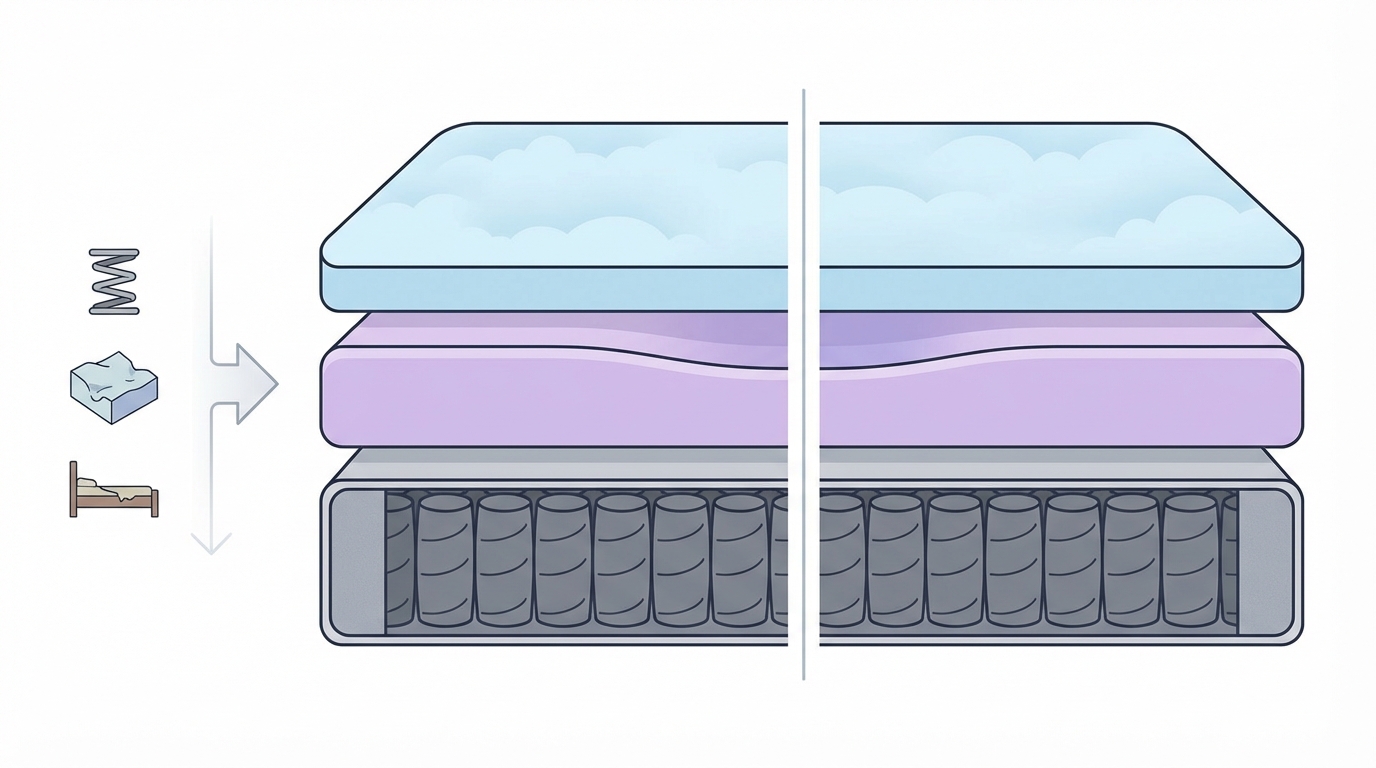
Before you commit to replacing your mattress, it is worth pausing for a structured self check. Poor sleep and pain can come from many sources. You want to be as confident as possible that the mattress is a primary contributor, or at least a meaningful one, before you invest in something new.
Start by looking at patterns. Has your pain or fatigue increased gradually over the same years your mattress has aged, or did it appear suddenly after an injury, new medication, or major life stress. If your symptoms started after a clear non mattress event, it is still possible that your bed is making things worse, but a conversation with your healthcare provider should be part of the plan. Organizations like Cleveland Clinic remind patients that chronic pain and poor sleep often feed into each other in both directions.
Next, evaluate your sleep hygiene. Are you on your phone or laptop in bed for an hour before trying to sleep. Is your bedroom too warm, bright, or noisy. The American Academy of Sleep Medicine emphasizes that temperature, light exposure, and pre bed activities influence sleep onset and maintenance quite strongly. If your habits are chaotic, improving them may be the lowest hanging fruit, and a new mattress will work best in that improved environment.
Then do a couple of simple experiments. Try sleeping with an extra pillow between your knees if you are a side sleeper, or under your pelvis if you are a stomach sleeper. If this dramatically reduces your pain overnight, that is a sign that alignment is part of the issue, and your mattress is not adequately supporting your natural curves. Also, if possible, sleep for at least two nights in a row on a different good quality mattress, such as a guest bed or at a trusted family member’s house, and compare your symptoms. If you are notably better, your home mattress is a likely culprit.
Finally, look at your foundation or base. A high quality mattress sitting on a sagging, cracked, or unsupported base cannot perform properly. Make sure your frame has solid center support for queen sizes and above, especially if you use an older box spring. Upgrading to a sturdy platform or an adjustable base with good lumbar support not only improves comfort now but also extends the life of a new mattress later. Rule out a cheap fix before you assume the mattress itself is the only problem.
How To Extend The Life Of Your Next Mattress
Once you decide to replace your mattress, it is worth treating the new one like the long term investment it is. Simple habits can give you more good years before you have to ask this same question again. Think of this as the “care and feeding” section for your future sleep.
The first habit is protection. A breathable, waterproof mattress protector is one of the best returns on investment you can make. It keeps sweat, skin oils, spills, and allergens from soaking into the comfort layers where they can break down foams and encourage bacterial growth. The key is choosing a protector that does its job without making the bed feel plasticky or hot. Many of the protectors in Sleepology’s Pillows, Sheets, Toppers, Protectors collection are designed to balance protection with airflow so you do not trade durability for discomfort.
Rotation matters too. Most modern mattresses are one sided, meaning you should not flip them over, but rotating head to foot every 3 to 6 months spreads out wear in the top layers and reduces the chance of deep impressions forming where you always lie. Set a reminder on your calendar for the same weekends you might already use for seasonal closet clean outs. If you are heavier or share the bed with a partner, err toward more frequent rotation.
Your base or foundation is the unsung hero. A sagging metal frame or cracked box spring lets the mattress sink in the middle, which accelerates material breakdown and undermines spinal alignment. Choose a base that provides consistent support all the way under the mattress, with a center support beam for larger sizes. If you are considering an adjustable base, look for models that are compatible with your chosen mattress and provide even support in both flat and elevated positions, which can be especially helpful for sleepers with reflux or snoring.
Cleanliness and environment round out the picture. Vacuum the surface of your mattress a few times a year to remove dust. Wash bedding weekly to keep allergens under control. Maintain good bedroom ventilation and moderate humidity to discourage mold and mildew. If you live in a very humid climate, a dehumidifier during the muggiest months can help not only your mattress, but your overall sleep environment and respiratory health.
To keep these maintenance steps easy to remember, you can think in terms of a simple ongoing checklist:
- Rotate your mattress every 3 to 6 months, head to foot, following the manufacturer’s recommendations
- Use a breathable, waterproof mattress protector from day one, and wash it regularly
- Support the mattress on a sturdy base or adjustable frame with proper center support
- Wash sheets and pillowcases weekly, and duvet covers at least monthly, in hot water when possible
- Vacuum the mattress surface several times a year to remove dust and debris
- Keep bedroom humidity moderate, and allow air circulation around the mattress edges
- Keep pets off the bed if possible, especially if they bring dirt, moisture, or allergens with them
These habits do not have to be perfect. Even doing most of them most of the time can add a couple of solid, comfortable years to your mattress’s life. Think of it as taking your mattress in for regular “oil changes” instead of driving it hard until something breaks.
Choosing A Replacement: Matching Mattress To Sleeper
When it is time to replace a mattress, the goal is not only to get something new. It is to get something that is specifically better for you. One of the common mistakes I see is people replacing a worn out but fundamentally mismatched mattress with a newer version of essentially the same thing. A little reflection before you shop will help you avoid that trap.
Start With Sleep Position And Body Type
Your dominant sleep position is one of the most important factors in choosing firmness and construction. Side sleepers generally need more pressure relief at the shoulders and hips so that those joints can sink in without twisting the spine. Back sleepers typically do best with a medium to medium firm feel that allows the lumbar curve to be supported without creating pressure. Stomach sleepers often need a firmer, more supportive surface to keep the pelvis from sinking and overextending the low back.
Body weight and shape modify those guidelines. Heavier sleepers compress materials more deeply, so they often benefit from firmer feels and higher density foams or stronger coil systems that will not bottom out as quickly. Lighter sleepers may perceive medium mattresses as firmer and may prefer softer comfort layers to get enough contouring. This is one reason Sleepology curates collections like The Best Mattresses For Back Sleepers and The Best Mattresses For Stomach Sleepers, which consider both position and support needs.
If you are a combination sleeper, spending substantial time on two positions, a quality medium to medium firm hybrid is often a great compromise. For example, a mattress like the Sealy Posturepedic Pro Medium Mattress – Dupont II Euro Pillow Top blends a responsive coil support core with enough cushioning on top that side sleeping still feels gentle on the joints, while back sleeping maintains good alignment.
Consider Health Conditions And Sensitivities
If you live with chronic pain, arthritis, sciatica, or other conditions, a thoughtful mattress choice can meaningfully improve your daily comfort. For spinal issues, the key is even support and neutral alignment. Overly soft mattresses that let your torso sink or very firm ones that create pressure points can both aggravate symptoms. Many patients working with physical therapists or spine specialists are advised to choose a medium firm, supportive mattress with some cushioning, a category where well made hybrids excel.
For allergy or asthma sufferers, choosing materials that minimize allergen buildup and off gassing is important. Many people do well with mattresses built from higher quality foams and breathable covers, combined with zippered, washable encasements and protectors. If you have a history of sensitivities to certain chemicals or are concerned about volatile organic compounds, seeking out mattresses that have independent certifications for low emissions can offer extra peace of mind. Cleveland Clinic and similar institutions often remind patients that cleaner air and fewer irritants in the bedroom support better sleep and symptom control.
If you snore, have mild sleep apnea, or struggle with reflux, an adjustable base that can gently elevate your upper body may be more helpful than any specific mattress feel. Pairing a compatible mattress with an adjustable base from Sleepology’s Adjustable Bed Frame and Base collection lets you experiment with positions that open your airway and reduce nighttime symptoms. Always discuss diagnosed sleep apnea with your healthcare team, but do not underestimate how much your sleep surface and position can complement medical treatment.
Balance Comfort, Longevity, And Budget
A common concern is how to balance the desire for long lasting quality with the realities of budget. The cheapest option in the short term is rarely the best value in the long term, especially if it is breaking down in under five years and quietly costing you in pain and lost productivity. On the other hand, you do not need the most expensive mattress on the showroom floor to get excellent support and decent lifespan.
Focus on the core elements that matter most for durability. In hybrids and innersprings, that means a strong, well built coil system with good edge support. In foam and latex beds, that means higher density support cores and comfort layers that are thick enough to do their job. Look for clear specifications, not just marketing terms like “luxury” or “ultra premium.” A well designed mid range mattress that suits your sleep style often outperforms a plush, heavily marketed model that has lots of low density foam on top.
It can also be useful to think of the cost per night over the realistic life of the mattress. If a solid $1,600 hybrid genuinely gives you 9 comfortable years, that works out to under 50 cents a night for something you use more than any other piece of furniture. When you frame it that way, investing enough to get the right fit and quality starts to feel less like a splurge and more like a common sense decision.
Comparison Table: Mattress Types And Replacement Timing
When you are weighing whether to replace your current mattress and what to choose next, it helps to see the main options side by side. Use this table as a quick reference, knowing that real world performance will still depend on specific brands, models, and how you care for the bed.
| Mattress Type | Typical Lifespan (Years) | Key Strengths | Common Replacement Triggers |
|---|---|---|---|
| Basic Innerspring | 5–7 | Responsive feel, often lower initial cost | Sagging, squeaks, poor motion isolation |
| Pocketed Coil / Hybrid | 8–10 | Balance of support and pressure relief, good airflow | Gradual softening, impressions in comfort layers |
| Memory Foam (All Foam) | 7–10 | Strong contouring and motion isolation | Deep body impressions, feeling “stuck,” overheating |
| Natural Latex | 10–15+ | Very durable, responsive, cooler, resistant to dust mites | Budget, changing comfort preference, not failure |
If your current mattress is a basic innerspring that is already 8 years old and showing visible sagging, you are well into the window where replacement makes sense. If you are on a 6 year old high quality latex mattress that still feels supportive but your body has changed, you may choose to keep it but modify the feel with a topper, or you might decide that a new mattress is appropriate, not because it has failed, but because your needs have evolved.
Putting It All Together: A Simple Framework For Your Decision

At this point, you have a lot of pieces. To make them more usable, you can think of your “when to replace” decision in three parts: age, performance, and you. Treat each part like a traffic light.
Age is the first light. Under about 5 years for a well built mattress, the age light is usually green, and I encourage people to look more closely at sleep hygiene, pillows, and foundation before blaming the mattress. Between roughly 5 and 8 years, you are in the yellow zone, where it makes sense to start watching for signs of decline. Beyond 8 to 10 years, especially for traditional innersprings and hybrids, the age light is leaning red, and staying on a clearly underperforming mattress becomes harder to justify.
Performance is the second light. If your mattress is relatively flat, quiet, and comfortable to lie on, you sleep through the night, and you wake without unusual stiffness, that is green. If there are modest indentations, occasional squeaks, or you notice you sleep better on some other beds, that is yellow. If there is significant sagging, deep body impressions, frequent noise, or visible damage, that is red, regardless of age. A 4 year old mattress with major sagging is doing you no favors simply because it is young.
You are the third light. If your health, weight, and sleep position are all about the same as when you bought the mattress, and you feel generally well rested, that is green. If you have had some changes, like mild weight gain, minor aches, or a shift in position, and you are not sure whether the mattress is keeping up, that is yellow. If you are dealing with chronic pain, major life changes, or clearly worse sleep, and experiments show you feel better on other beds, that is red.
When two or more lights are red, replacing your mattress is usually the wisest option. When everything is green, keep caring for your bed and enjoy it. When you are mostly yellow, it is time for closer observation, small experiments, and perhaps a visit to a trusted store like Sleepology to feel newer models and see what your body responds to now. Either way, you are no longer guessing. You are using a thoughtful, structured approach that respects both your budget and your health.
Conclusion: When “Good Enough” Is Not Good Enough Anymore
You deserve more than “I guess I slept okay.” If your mattress has quietly aged out of its role or simply never matched your body in the first place, you do not have to keep putting up with stiff mornings, restless nights, or that sinking feeling that your bed is working against you. Recognizing the signs of a mattress past its prime is not about being picky. It is about respecting that you spend roughly a third of your life on that surface and that your sleep quality shapes the other two thirds.
By now, you know that there is no single magic age where every mattress “expires.” What matters is the combination of years in service, observable wear, and how your body actually feels. Age gives you context. Sagging, noise, pain, allergies, and disrupted sleep give you evidence. Your changing body and life give you permission to choose something that fits who you are now, not who you were ten years ago. When those pieces line up, replacing your mattress stops being a maybe and becomes a practical, even kind, decision.
If you are leaning toward replacement and want help translating all of this into an actual mattress that supports your sleep, you do not have to figure it out alone. Sleepology’s role is to bridge the gap between sleep science and real life, helping you match things like firmness, coil design, and foam density to your sleep position, health needs, and budget. Whether you end up loving a softer pillow top like the Sealy Posturepedic Plus Soft Mattress – Paterson II, a balanced medium hybrid, or a firmer option from our back and stomach sleeper collections, the goal is the same: a mattress that quietly does its job so you can get back to living your life feeling rested.
Frequently Asked Questions
How often should you realistically replace your mattress?
Most people should plan to replace a primary mattress about every 7 to 10 years, but that is a range, not a rule set in stone. Innerspring beds with basic coils may need replacement closer to the 5 to 7 year mark, while high quality hybrids, dense memory foam, and natural latex can stay comfortable and supportive closer to 10 years or more. Pay attention to how you feel, not just the calendar. If there is sagging, pain, or sleep disruption, replacement can make sense even earlier. If a well cared for mattress still feels supportive at 10 years and your body is happy, you do not have to replace it on principle.
What are the strongest signs that my mattress is causing my back pain?
The biggest clues are timing and pattern. If you go to bed relatively comfortable and consistently wake with mid or low back stiffness that improves over the first hour of your day, that strongly suggests your mattress is not supporting your spine well. Visible sagging or a sensation of rolling into a dip under your hips is another red flag. If your pain is less pronounced when you sleep on a different, flatter mattress or a supportive guest bed, that comparison adds weight to the case that your own mattress is a major contributor.
Is it okay to put off replacing a mattress if I just add a topper?
Toppers can be helpful in certain situations, but they are not a cure all. If your mattress is fundamentally sagging or the support core is failing, adding a plush topper often just masks the problem briefly while your spine continues to collapse toward the middle. Toppers are best used to fine tune firmness when the underlying support is still sound, for example, softening a slightly too firm but structurally solid mattress for a side sleeper. If there are deep impressions, noisy coils, or clear alignment issues, it is usually safer and more effective to replace the mattress itself.
Do I need a new box spring or base when I buy a new mattress?
Often, yes. A new mattress on an old, sagging, or incompatible base cannot perform as designed, and in some cases it can even void your warranty. If your current box spring creaks, sags, or is more than 8 to 10 years old, it is wise to replace it. For modern hybrids and foam mattresses, a solid platform or slatted base with close spacing and a center support beam is usually best. If you decide to invest in an adjustable base, double check compatibility with the mattress model you choose and aim for a base that supports your sleep goals, whether that is easing reflux, reducing snoring, or simply relaxing in a zero gravity position.
Can a better mattress really improve my sleep, or is it mostly marketing?
A mattress is not a magic wand, but it is one of the core tools that support good sleep. Research from sources like the Sleep Foundation and various sleep labs has shown that people often report better sleep quality, less pain, and reduced nighttime awakenings when they move from an old, unsupportive mattress to a new, well matched one. A good mattress helps keep your spine aligned, reduces pressure points that might otherwise wake you, and creates a more stable surface if you sleep with a partner. You still need healthy sleep habits, but if your current bed is clearly underperforming, upgrading is much more than a cosmetic change.
Are expensive mattresses always better or longer lasting?
Not necessarily. Higher price tags sometimes reflect better materials, more robust coil systems, or high quality latex, all of which can improve lifespan and performance. They can also reflect branding, heavy marketing, or unnecessary extras that do not actually translate to better sleep. A sensible approach is to focus on the construction details that matter, like coil type and gauge, foam density, and cover quality, rather than being swayed by luxury language alone. A thoughtfully built mid range mattress that suits your body and sleep style often offers excellent value and durability without requiring you to overspend.
How can I tell if a mattress I am testing in the store will still feel good years from now?
In the store, you are feeling mostly the comfort layers, not the long term durability of the support core. To project into the future, look beyond the first impression. Ask about the type of coils or support foam, the density of memory foam layers, and any reinforcement in high stress zones like the center third of the bed. Lie in your normal sleep position for at least 10 to 15 minutes, paying attention to whether your shoulders and hips feel cushioned but not swallowed. A Sleepologist at Sleepology can help you translate those sensations into real world expectations based on years of watching how similar constructions hold up over time.