

What Is the Size of a Full Size Mattress, Really? Your Complete, No‑Stress Guide
You would think a simple question like “what is the size of a full size mattress?” would have a simple answer. Yet once you start Googling, you are hit with charts, specialty sizes, and a lot of conflicting advice about who a full bed is actually good for. If you are standing in your bedroom with a tape measure in one hand and your phone in the other, you are not alone. I talk to people every week who feel stuck between twin and queen, wondering if a full is enough space or an expensive mistake.
Mattress size is not just a number on a tag. The right size affects how deeply you sleep, how comfortable you feel sharing a bed, and how usable your bedroom is day to day. According to the Sleep Foundation, adults who get enough high quality sleep have better mood, blood pressure, and daytime focus, and mattress comfort and space are key pieces of that puzzle. When you misjudge your size, you can end up with years of cramped, restless nights or a room that feels overpowered by too much bed.
Here, we will unpack exactly how big a full mattress is, how it compares to other sizes, and how to know whether it truly fits your body, your room, and your budget. You will see real world scenarios, from studio apartments and teen rooms to couples deciding between “cozy” and “crowded.” Along the way, I will point to specific mattresses, foundations, and accessories from Sleepology that match what you need, so you can move from confusion to clarity without spending hours cross‑referencing charts.
By the end, you will know when a full size mattress is the smart choice, when it is too much of a compromise, and how to set one up so it feels like a thoughtfully designed sleep system, not just a bare rectangle on the floor. You deserve calm, confident decisions around sleep, and that starts with understanding the basics better than the marketing.
Full Size Mattress Dimensions: The Exact Numbers That Matter
The first thing to clear up is the actual measurement. In the United States, a standard full size mattress is typically 54 inches wide and 75 inches long. Some manufacturers round slightly in their charts, but when you measure a full from seam to seam, 54 by 75 inches is the size you will see in showrooms and on most specification labels. This size is also called a “double,” which can be confusing, since many people assume “double” automatically means “for two adults.”
Those 54 inches of width translate into practical personal space. If two adults share a full, and if you divide the width in half, each person effectively gets about 27 inches. For comparison, a standard crib mattress is about 28 inches wide. Many couples realize as soon as they do that math that “double” is more of a historical term than a reflection of modern sleep preferences. On the other hand, a single sleeper going from a twin (38 inches wide) to a full gains 16 extra inches to move, which can feel luxurious in a small room.
Length is equally important. At 75 inches long, a full mattress fits people up to about 5 feet 9 inches comfortably, possibly 5 feet 10 inches if you do not mind your feet close to the edge. Taller sleepers usually do better on longer sizes like queen, king, or twin XL, which are 80 inches long. The Cleveland Clinic notes that neutral spinal alignment during sleep supports back health, and hanging your feet off the end of the bed encourages curling or twisting that can throw that alignment off over time.
The other dimension that affects real life fit is thickness, even though it is not part of the “full” label. Many modern full mattresses fall between 10 and 14 inches tall. For example, a hybrid design like the Sealy Posturepedic Elite Soft Hybrid Mattress – Brenham II in full size combines substantial foam layers and coils, which affects how high you sit and how deep of a fitted sheet you need. We will come back to depth when we talk about choosing bedding that actually stays in place.
“I had been sleeping on a twin forever because my bedroom is small, and I thought that was my only option. Mia walked me through the real measurements, and we realized a full would fit if I rearranged the furniture. I ended up with a full hybrid mattress and it feels like I gained an entire bed’s worth of space without moving apartments.” – Jordan P., November
Who Is a Full Size Mattress Really Best For?
A full mattress can be a fantastic fit, but only for the right sleeper and situation. In my twenty years helping people choose mattresses, full size tends to shine for solo sleepers who want more shoulder and leg room but still need to keep the room feeling open. Think young adults in their first apartment, older kids and teens who are outgrowing a twin, or adults in city spaces where every square foot has a job.
For a single adult of average height, a full often feels “just right” when the priority is balancing comfort and floor space. You have enough width to sleep on your back or side without feeling hemmed in by the edges, but you are not committing the entire room to the bed. The American Academy of Sleep Medicine points out that consistent, comfortable sleep environments help maintain healthy sleep schedules, and part of that consistency is feeling that your bedroom layout works for your life, not just your mattress.
Full size is also very popular for guest rooms. Guests usually accept a slightly cozier bed, and the smaller footprint leaves space for a dresser, luggage stand, or desk. In homes where the guest room doubles as an office, a full mattress is often the only size that allows both functions to coexist. In those scenarios, I often recommend a supportive but broadly comfortable feel, like the Sealy Posturepedic Plus Medium Mattress – Paterson II Euro Pillow Top in full, because it works for a wide range of body types and sleep positions.
Where full size becomes dicey is for long term, everyday use by two adults. Historically, full beds were the default for couples, but our expectations around personal space have changed. Research from organizations like the Sleep Foundation highlights that fragmented or disturbed sleep, including from partner movement, can impair next day alertness and mood. If each partner has less than 30 inches of width, there is very little buffer when one person shifts or stretches, so motion transfer and elbow “negotiations” are common.
There are exceptions. Some couples genuinely like a snug sleeping experience, or they regularly sleep apart and only occasionally share a full bed. In those cases, a full can work if both people are smaller framed, have similar sleep schedules, and mostly sleep on their backs. For many others, it becomes a nightly reminder that a queen or king would have been wiser. We will talk through those comparisons in detail shortly so you can decide with your eyes open, not your fingers crossed.
“My partner and I tried to make a full work in our old place and we were constantly waking each other up. When we moved, Mia helped us see why the size was the real issue. We upgraded to a queen and passed the full into the guest room instead. Now our guests rave about how comfortable it is, and we finally have breathing room in our own bed.” – Alicia R., October
Full Size vs Other Mattress Sizes: How They Really Compare

Once you know a full mattress is 54 by 75 inches, the next question is how that actually compares to the other “usual suspects.” The raw numbers are helpful, but what really matters is the feel and function. Below is a simple visual comparison of the standard U.S. sizes most people choose between, along with who they tend to fit best.
| Mattress size | Dimensions (W x L) in inches | Typical best fit | Notes on space and comfort |
|---|---|---|---|
| Twin | 38 x 75 | Kids, lighter adults in small rooms | Narrow, good for tight spaces or bunk beds |
| Twin XL | 38 x 80 | Teens, tall solo sleepers, dorms | Same width as twin, extra leg room |
| Full (Double) | 54 x 75 | Solo adults, teens, guest rooms | Much wider than twin, length still 75 inches |
| Queen | 60 x 80 | Most couples, spacious solo sleepers | Added width and length, most popular size |
| King | 76 x 80 | Couples who want maximum space | Each person gets twin width, needs a large room |
Compared to a twin, a full gives you a striking upgrade: 16 more inches of width. People who toss and turn or who like to sleep in a gentle starfish shape feel this difference immediately. Compared to a twin XL, you are trading 5 inches of length for that extra width. So if you are taller than about 5 feet 9 inches, a full may feel a bit short, and a twin XL or queen might be a better call from a leg room standpoint.
The queen is the natural “next step up” from a full. It adds 6 inches of width and 5 inches of length, which does not sound like much on paper but feels dramatically roomier, especially for couples. With 60 inches across, each partner has about 30 inches of their own space. Consumer Reports often uses queen as the reference size in mattress testing because it reflects what most adults choose for primary bedrooms. Full, by contrast, tends to live in smaller rooms or as an intentional compromise.
A king mattress is in a different league. At 76 inches wide, it is essentially the width of two twin XL mattresses placed side by side. That gives each partner the same width as if they slept alone on a twin, plus all the benefits of a shared bed. For sleepers with restless legs, big dogs, or kids who visit in the night, the extra surface can protect sleep quality. The trade off, of course, is that kings require more room, more expensive bedding, and usually a slightly larger budget. If you are sure you need that space, Sleepology has a curated collection of king sized mattresses that balance support, cooling, and value in that footprint.
When you see the comparisons side by side, the “personality” of full size comes into focus. It is no longer the automatic default for couples, and it is no longer just a “big twin.” Instead, it is a strategic middle ground, ideal when you want notably more width than a twin, do not need the extra length of a queen, and want to keep furniture arrangement options open.
Will a Full Size Mattress Fit Your Bedroom?
Knowing if a full mattress fits your room is not just a matter of asking “Will it squeeze in?” It is about how the room feels and functions after the bed goes in. Interior designers and ergonomics experts typically suggest leaving at least 24 to 30 inches of clear walking space on the sides and foot of the bed so you can move comfortably, make the bed easily, and open drawers or doors without contortions.
A full mattress itself occupies 4.5 by 6.25 feet of floor space. Once you add a frame and perhaps a headboard or footboard, you can expect your total footprint to be roughly 58 to 60 inches wide and 79 to 83 inches long, depending on the design. So in a 10 by 10 foot room, a full size bed leaves reasonable space on at least two sides for nightstands, a dresser, or a desk. In a 9 by 10 foot room, you will still make it work, although you may end up pushing the bed against a wall or choosing streamlined furniture.
Ceiling height and window placement matter too. A tall headboard on a full bed under a low window can make the room feel cramped, where the same mattress with a lower profile platform and no footboard can feel airy. When couples visit the showroom with measurements, I will often sketch a quick floor plan on paper and help them visualize where doors swing and where natural light falls. You can do the same at home with painter’s tape on the floor matching that 54 by 75 inch rectangle.
If you are using a traditional foundation or box spring, factor that footprint into your planning. A low profile option like the Sealy Mattress Base Boxspring Foundation, low profile 5 inch height can keep the overall bed height comfortable, especially if you choose a thicker full mattress. This is especially important if anyone using the bed has hip, knee, or mobility concerns, because an overly tall sleep surface can be difficult to get in and out of, something Mayo Clinic flags as a fall risk consideration for older adults.
The good news is that full size tends to be one of the most forgiving mattresses to live with from a layout perspective. In tight rooms where a queen swallows all the floor space, a full can restore balance. In lofts or studios where you want the bed to feel intentional without dominating the living area, the proportions often look just right. Taking a few minutes with a tape measure before you order saves you the headache of wrestling a too‑large or too‑small bed into place on delivery day.
“I almost ordered a queen for my daughter’s room because ‘that’s what everyone gets.’ Mia asked me to measure the space and walk through where the closet and desk would go. Once I taped off a queen and then a full on the floor, the choice was obvious. The full gave her room to move and still feels grown up, and I did not have to return anything.” – Denise M., December
Is a Full Size Mattress Big Enough for Couples?
This is probably the most emotionally charged question around full size mattresses, because it sits at the intersection of space, budget, and relationship dynamics. Technically, yes, a full mattress can hold two adults. The real question is whether it will allow both of you to sleep through the night comfortably for years, not just survive a weekend.
Each partner gets about 27 inches of width on a full. To put that in perspective, many office chairs are around 19 to 21 inches wide, and the average adult shoulder width can be 16 to 20 inches depending on body size. That leaves very little buffer when someone rolls, stretches, or pulls their knees up. If either of you is a light sleeper, tall, broad shouldered, or someone who changes positions frequently, you will almost certainly feel each other every time you move.
Sleep researchers often stress that sleep deprivation compounds. One bad night is manageable; months of partial sleep loss affect mood, appetite, and even blood pressure. The American Heart Association recognizes sleep duration and quality as contributors to cardiovascular health, which is one reason I nudge couples to err on the side of space when budgets and rooms allow. Being chronically cramped is a hidden cost that does not show up on the price tag.
That said, there are situations where a full works for two. Younger couples, especially in small apartments, may use a full as a transitional bed for a few years, planning to upgrade later. If you are both petite, usually fall asleep quickly, and truly like to sleep close, a full can feel intimate rather than restrictive. In those cases, choosing a mattress with very good motion isolation, such as a pocketed coil hybrid or quality memory foam, helps a lot. A model like the Sealy Posturepedic Elite Soft Mattress – Albany II Euro Pillow Top in full gives each partner contouring and support, which reduces the urge to toss and turn.
The other wrinkle is future proofing. Maybe it is just you in the full bed today, but you know your partner will move in within a year or two, or you are planning for a growing teenager who sometimes has a friend sleep over. In those cases, I usually suggest going straight to a queen if the room can handle it, rather than buying a full and then feeling pressured to replace it sooner than you expected. Thinking two or three years ahead can save you from paying twice for the same problem.
Matching a Full Size Mattress to Your Body and Sleep Style
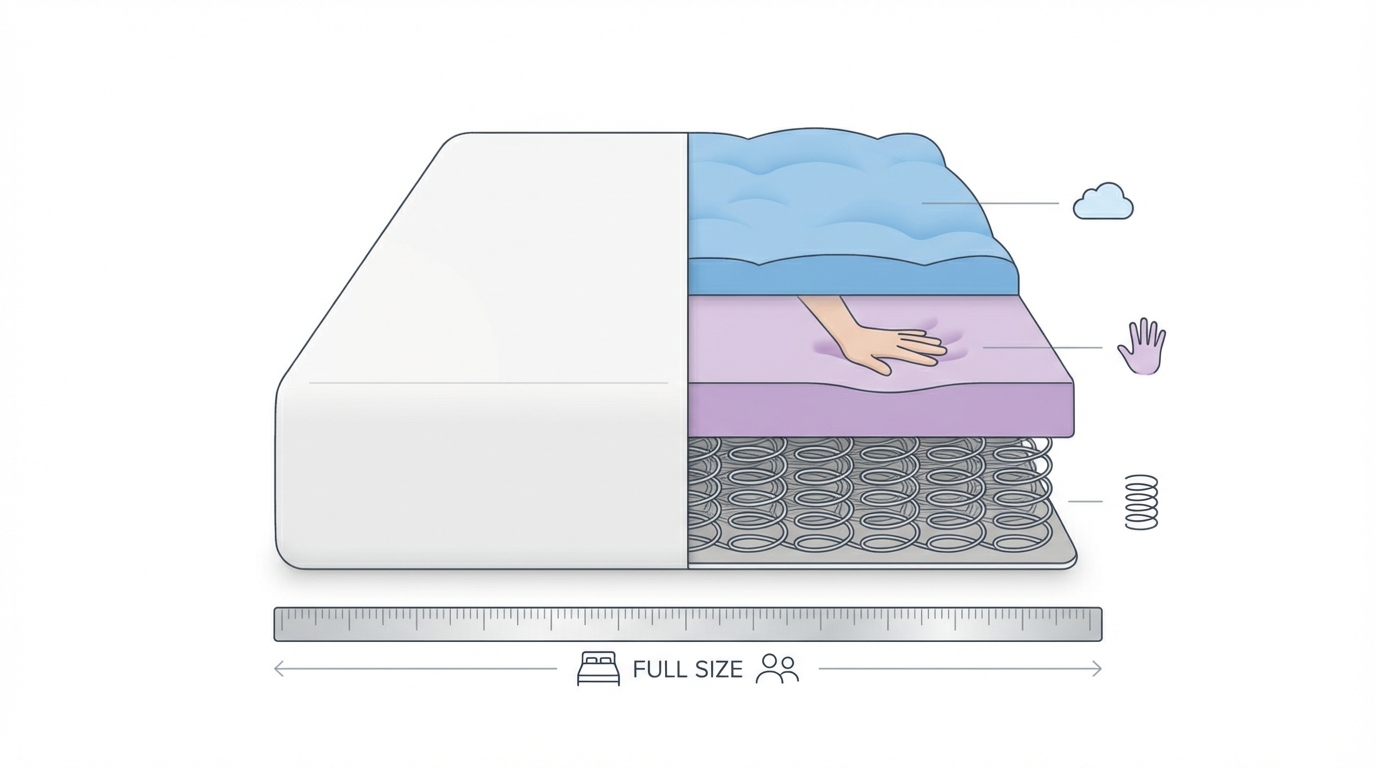
Once you are comfortable that a full mattress fits both your room and your household, the next layer is how it fits your body and the way you sleep. The exact same full size can feel like a dream to one person and a nightly irritation to another, purely because of height, weight distribution, and sleep position.
Height is the easiest variable to start with. At 75 inches long, a full bed ideal range is generally sleepers up to around 5 feet 9 inches. If you are taller, your feet may hover near or over the edge when you lie fully extended on your back. Many taller sleepers instinctively slide down or bend their knees to compensate, which can change how their lower back is supported. Over time, that posture can exacerbate aches, especially if the mattress itself is too soft or too firm for their body. Taller teens or adults who want to keep the narrower width of a smaller bed often find a twin XL or queen more comfortable solely because of the additional length.
Body weight and shape change how much personal width feels comfortable. Someone who is narrower through the shoulders and hips may experience a full as generously sized, while a broader individual may feel that the edges are always just under them. The Mayo Clinic notes that side sleeping can help reduce snoring and acid reflux, but side sleepers typically need more horizontal room because their arms and knees tend to drift outward. If you are a side sleeper on the broader side, a full can work beautifully for solo sleep, but it is more marginal for two people.
Your dominant sleep position also plays a big role. Back and stomach sleepers typically take up less width but need more careful attention to mattress firmness and support. If your hips sink too far or not enough, your spine will arch or flatten in ways that cause morning stiffness. For back sleepers on a full bed, something in the medium to medium firm range, such as the Sealy Posturepedic Firm Mattress – Medina II, usually keeps the lower back supported without feeling like concrete. Side sleepers generally benefit from a bit more cushioning at the shoulders and hips, which is where a plush or pillow top full mattress can make a noticeable difference.
Combination sleepers, who change positions through the night, should pay attention to both the surface feel and the edge support of a full mattress. With only 54 inches of width, you are more likely to visit the edges frequently, especially if you tend to roll toward one side of the bed. A hybrid design like the Sealy Posturepedic Elite Medium Mattress – Brenham II Euro Pillow Top balances pressure relief and sturdy edge coils, so you can use the full surface without feeling like you might slide off.
The guideline I give people is simple: if you can lie in your most common sleep position on a full size demo mattress with your arms in their natural place and still see a few inches of space on both sides of you, then full is likely wide enough for you solo. If your hands, elbows, or knees are already flirting with the edge even while you are testing, that is a sign you may outgrow the size quickly.
Full Size Mattresses and Room Layout: Making the Most of Your Space
A full mattress can be the secret weapon in a cleverly designed small or medium sized bedroom. Instead of treating the bed as an immovable block, it helps to think of it as an anchor you can style around, especially when you want the room to serve more than one purpose. With 54 by 75 inches to work with, you have several layout strategies that do not feel possible with a queen or king.
One common configuration in square or nearly square rooms is to center the full bed on the main wall, then use narrower nightstands or floating shelves on each side. This keeps the bed feeling like the focal point while preserving enough clearance to move comfortably. In rectangular rooms, especially those with a desk or vanity, tucking the full against one wall longways can free up a generous open area for workspace or yoga mats, at the slight cost of only having easy access on one side.
For multiuse rooms such as guest room plus office, or teen bedroom plus gaming space, full size is often the maximum that still lets everything coexist. Placing the head of the bed against the shorter wall and the desk on the opposite wall helps define zones. A platform or storage bed also lets you reclaim space vertically with under bed drawers. Because a full mattress is lighter and more compact than a queen or king, lifting the corner to access storage is less of a chore.
Lighting and color choices can enhance the sense of space around a full bed. Wall mounted lamps rather than big table lamps, and lighter bedding colors, can keep the room from feeling crowded. Since you are working with a slightly smaller canvas, it is easier to splurge on one or two higher quality pieces, like a supportive full mattress and breathable bedding from a collection such as Sleepology’s pillows, sheets, toppers, and protectors, instead of filling a larger bed with lower quality textiles.
Do not forget about doors and drawers. Before you commit, open your closet, dresser, and bedroom door while imagining the full bed in place. Can everything swing or slide fully without bumping the future bed frame? If you are planning to add an adjustable bed frame and base, remember those bases have a similar footprint to the mattress but will also need a little breathing room at the head for clearance.
Ultimately, a full mattress gives you permission to design a room that feels intentionally cozy rather than accidentally cramped. Textures, layered lighting, and smart furniture choices can make a full bed look like a design choice made by a grownup, not a hand me down compromise from a dorm.
Choosing the Right Type of Full Mattress: Foam, Hybrid, or Innerspring?
Once the size is decided, your next big choice is type. Full size mattresses come in the same broad categories as queen and king: innerspring, memory foam, latex, and hybrids. The size does not dictate the material, but your body type, sleep position, and temperature preferences should.
Traditional innerspring mattresses use a coil support core with thinner comfort layers on top. They tend to sleep cooler and are easier to move around on, since the surface is a bit bouncier. In full size, innersprings can be a good choice for guest rooms where you want something durable and widely appealing. However, if the top layers are too thin or too firm, lighter side sleepers may feel more pressure on shoulders and hips.
Memory foam full mattresses are popular for solo sleepers who want strong contouring and motion isolation. Foam absorbs movement rather than transferring it, which is valuable in smaller sizes where you are closer to the edges and more likely to feel your own shifts. Foam can retain more heat, so if you live in a warm climate or run hot, look for gel infusions or breathable covers. Reputable models often reference testing by groups similar to Consumer Reports, who evaluate how well foams hold up over time.
Hybrid mattresses combine coils with thicker foam or latex comfort layers, offering a blend of bounce, support, and pressure relief. In a full size, hybrids tend to feel especially versatile. For example, the Sealy Posturepedic Elite Soft Hybrid Mattress – Brenham II in full gives a side sleeper deep cushioning at the shoulders while the coil system keeps the spine aligned and the edges supportive. This makes the entire 54 inch width usable, not just the center strip.
If you are a back sleeper or someone with a history of mild back discomfort, organizations like the American College of Physicians recommend medium firm mattresses for spinal support. That does not mean rock hard, but rather a mattress that lets your heavier areas sink in slightly without sagging. Many modern hybrids and updated innersprings in full size hit this sweet spot, and Sleepology’s curated collection for back sleepers is a good starting point if you prefer that sleep position.
No matter which type you choose, pay attention to edge support. In a full size bed, you will visit the edges more often simply because there is less central real estate. Strong perimeter coils or reinforced foam rails make getting out of bed easier and keep you feeling secure when you sit to tie your shoes or rest with your back against the headboard.
Bedding, Foundations, and Accessories for Full Size Mattresses
Getting the size right is only the beginning. The foundation and bedding you pair with your full mattress can make the difference between “fine” and “fantastic,” especially in terms of comfort, hygiene, and longevity. The good news is that full size is common enough that you have plenty of options, and you can prioritize quality where it counts.
Start from the bottom. Your full mattress will need either a solid platform, a slatted base with the correct spacing, or a compatible foundation. Manufacturers typically specify the support requirements, and following those is crucial to preserve your warranty and your mattress’s shape. A stable foundation such as the Sealy low profile boxspring foundation in full keeps your mattress flat and reduces sagging, which in turn helps maintain spinal alignment and comfort over time.
Protecting the mattress surface is your next layer. A well fitting mattress protector in full size shields against spills, sweat, and dust mites. The Asthma and Allergy Foundation of America notes that using impermeable covers on mattresses and pillows can reduce exposure to common allergens and improve respiratory comfort for sensitive sleepers. Look for protectors and sheets in full size that match both your mattress dimensions and depth, especially if you have a thicker or pillow top style.
Sheets, blankets, and duvets in full size are widely available, but not all are created equal. Because the surface area is smaller than a queen or king, upgrading to higher quality fabrics is often more affordable. Soft, breathable sets from a curated collection like Sleepology’s pillows, sheets, toppers, and protectors can noticeably change how cozy and cool your bed feels, even if you do not change the mattress itself. If your current full mattress is a bit too firm but still supportive, a quality topper can add cushioning at the shoulders and hips without the expense of replacing the whole bed.
Pillows and accessories round out the setup. A full bed is perfectly compatible with body pillows, wedge pillows, and other specialty supports that improve comfort and alignment. For example, a full length support option like The BodyPillow by Tempur-Pedic can help side sleepers maintain hip and shoulder alignment on a full mattress without feeling like they are fighting for space. For guests, a portable comfort bundle such as the Tempur-Pedic Mattress Topper and Travel/Guest Pillow bundle in full can turn a basic guest mattress into something noticeably more luxurious.
Finally, consider whether an adjustable base might benefit you. Full size adjustable bases exist, though they are less common than queen and king. If you snore, read or watch TV in bed, or have circulation concerns, being able to elevate your head or legs can make a big difference. If you think an adjustable base may be in your future, it is worth confirming compatibility while you shop, and browsing an adjustable bed frame and base collection for full or split solutions that match your space.
Common Mistakes People Make With Full Size Mattresses

After years of helping shoppers fix past purchases, I see the same full size mattress mistakes again and again. None of them are fatal, but all of them are avoidable with a little planning. If you are reading this before ordering, you are already ahead of the game.
One of the biggest missteps is treating full size as automatically “big enough” for a couple without actually testing or measuring. People often upgrade from a twin and think, “This feels huge compared to what I have,” only to realize a month later that the extra width is still not enough for two restless adults. Another related mistake is not considering height. If one partner is tall and you choose a full because of room size or budget, the shorter length can force cramped postures that aggravate back or knee pain over time.
A second common issue is underestimating the impact of room layout. Buyers sometimes assume that if a full mattress technically fits the floor dimensions, the room will be fine. Later, they discover closet doors that bump the bed or drawers that do not open all the way. A few minutes with layout tape or a scaled sketch can prevent that. Remember to factor in headboards, footboards, and any planned end of bed benches or trunks.
People also frequently mismatch their foundations and bedding. Using an old, sagging box spring under a new full mattress, or using fitted sheets that are too shallow for a tall pillow top, can make even an excellent mattress feel disappointing. Organizations like the Sleep Foundation emphasize that a supportive base and breathable bedding are part of a healthy sleep environment, not mere extras. Reusing what you already own is understandable, but it is worth checking compatibility and replacing worn out pieces that undermine your investment.
Finally, many buyers think in terms of the next six months instead of the next six to ten years. They choose a full because it feels like the cheapest solution now, without considering plans to move, share the bed, or repurpose it for a guest room later. Taking a moment to imagine leaving the mattress behind when you move or shifting it to a different room can help you decide if full is a long term asset or a short term bandage.
Summary and Next Steps: Making Your Full Size Decision With Confidence
A standard full size mattress measures 54 inches wide by 75 inches long, and it occupies a very particular sweet spot in the mattress world. It is significantly wider than a twin, but shorter and narrower than a queen. For solo sleepers, teens, and many guest rooms, that sweet spot can translate into nights of comfortable sleep and days spent in a room that still feels open and usable. For some couples and taller sleepers, the same dimensions can feel like a tight squeeze.
When you choose mattress size with intention, you are really choosing how your bedroom will function and how your body will feel every morning. A full mattress is an excellent choice if you are a single adult up to about 5 feet 9 inches tall, prefer a modest footprint, or are outfitting a flexible space like a home office guest room. Paired with an appropriate foundation, quality bedding, and the right comfort and support level for your body, a full can deliver the same restorative sleep that larger sizes promise.
If you are still wavering, this is exactly where talking to a knowledgeable guide can help. At Sleepology, we do this all day: we look at your room measurements, sleep habits, and long term plans and help you decide whether full size truly serves you or whether stepping up to a queen or king will save you from “if only” regrets later. From supportive models like the Medina II firm to plush hybrids like the Brenham II, there is a full size mattress that can match your needs. The key is choosing it armed with clarity, not guesswork.
Frequently Asked Questions
What is the exact size of a full size mattress in inches and feet?
A standard full size mattress in the United States measures 54 inches wide by 75 inches long. In feet, that comes to 4.5 feet wide and 6.25 feet long. When you add a typical bed frame, the total footprint is usually around 58 to 60 inches by 79 to 83 inches, depending on the style of the frame and whether you have a headboard or footboard. Knowing those real world dimensions helps you tape out the space in your bedroom to see how a full will actually sit in the room.
Is a full size mattress big enough for two adults every night?
A full mattress can physically accommodate two adults, but for many couples, it is not ideal for long term nightly use. Each partner ends up with about 27 inches of width, which is less space than a crib mattress offers and significantly tighter than the roughly 30 inches per person on a queen or 38 inches per person on a king. If both of you are smaller framed, usually sleep on your backs, and genuinely like to be close, a full might work. If either of you is tall, broad shouldered, a restless sleeper, or a light sleeper who wakes easily to movement, a queen or king is usually a better investment in your sleep quality.
What room size works best for a full size mattress?
A full size mattress is generally comfortable in rooms that are at least 9 by 10 feet, and it feels especially well balanced in 10 by 10 or 10 by 11 foot rooms. That gives you space to walk on at least two sides of the bed, open doors and drawers fully, and add essentials like a dresser or desk. In smaller rooms, you may need to push the bed against one wall or choose minimalist furniture. Before you buy, it helps to tape a 54 by 75 inch rectangle on the floor and walk around it to see how much clearance you will truly have.
What is the difference between a full and a queen size mattress?
The key differences between full and queen are both width and length. A queen mattress measures 60 inches wide by 80 inches long, while a full is 54 inches wide by 75 inches long. That means a queen gives you six extra inches of width and five extra inches of length. For solo sleepers, a full often feels generous enough, especially in smaller rooms. For couples or taller individuals, the added shoulder room and leg room of a queen usually translate into better sleep and less bumping into each other overnight.
How tall should a full size bed be off the ground?
There is no single “correct” height, but many people find a total bed height of around 24 to 26 inches, from floor to top of the mattress, to be most comfortable. This generally allows you to sit on the edge of the bed with your feet flat on the floor and your knees at a natural angle. If you choose a thicker full mattress, you may want a low profile foundation or frame to keep the total height manageable, especially for children, older adults, or anyone with hip or knee sensitivity.
What size bedding and accessories do I need for a full mattress?
You will want sheets, mattress protectors, and blankets that are specifically labeled “full” or “double,” since twin and queen sizes will not fit correctly. Pay attention not only to the mattress’s width and length but also to its thickness, because deep pocket fitted sheets may be necessary for taller or pillow top full mattresses. Standard pillows work well on a full bed, and you can comfortably fit one or two pillows per sleeper. If you use specialty supports such as a body pillow or wedge, just make sure they do not crowd the limited width you have, especially if two people will be sharing the bed.
When should I choose a full size mattress instead of a twin or queen?
Choose a full over a twin when you are a solo sleeper who wants significantly more elbow and leg space and your room can handle the slightly larger footprint. Full is also a great upgrade for teens and college students moving past childhood beds. Choose a full instead of a queen when your room is modest in size, you sleep alone or only occasionally share the bed, and you want extra open floor space for a desk, seating, or storage. If you expect to share the bed nightly with a partner or you are taller than about 5 feet 9 inches, a queen is usually the better long term choice.