

What Is The Most Comfortable Mattress? A Sleepologist’s Guide To Finding Your “Ahh, This Is It” Bed
If you are typing “what is the most comfortable mattress” into a search bar, there is a good chance your current bed is letting you down. Maybe you wake up stiff through your lower back, maybe you sleep better in hotels than at home, or maybe you are just tired of playing mattress roulette online and hoping the next box on your porch will finally feel right. It is frustrating, because comfort feels so personal, and most advice either throws a single “best mattress” at you or buries you in specs that do not connect to how you actually sleep.
Comfort is not a luxury detail. According to the Sleep Foundation, most adults need 7 to 9 hours of sleep per night, and sleep quality matters just as much as sleep quantity for mood, immune function, and long term health. When your mattress fights your natural posture or traps heat, your brain spends the night micro waking and readjusting instead of cycling smoothly through deep and REM stages. Over time that can show up as more pain, less patience, and slower recovery from everyday stress.
The good news is that “the most comfortable mattress” is not a unicorn. It is a match between your body, your sleep position, and a specific style of mattress construction. Once you understand how those pieces fit together, you can stop chasing brand names and start evaluating any mattress you see, in store or online, through a much clearer lens. That is what we are going to do here, step by step, using both sleep science and two decades of hands on mattress fitting at Sleepology.
You will learn how sleep experts define comfort, how to translate your aches, habits, and preferences into firmness and materials, and how different mattress types really feel once the marketing language is stripped away. You will also see how some of Sleepology’s curated options, from contouring foams to plush pillow tops like the Sealy Posturepedic Elite Medium Brenham II Euro Pillow Top, map to specific comfort needs. By the end, you should feel not only more informed, but also much more confident that you can recognize your own “most comfortable mattress” when you lie on it or read a spec sheet.
What “Comfortable” Really Means For A Mattress
Comfort sounds subjective, and there is always a personal element, but in the sleep world we can break it into a few repeatable factors. When researchers and testing labs evaluate mattresses, they look at pressure relief, spinal alignment, temperature regulation, motion isolation, responsiveness, edge support, and durability. The “most comfortable” mattresses tend to score well across all of these for a particular type of sleeper.
Pressure relief is usually the first thing people notice. A comfortable mattress lets your shoulders, hips, and knees sink just enough that you do not feel sharp pressure in those joints. Pressure mapping studies in sleep labs show that softer, more contouring materials like memory foam and certain hybrid comfort layers can significantly reduce peak pressure on side sleepers’ hips and shoulders compared with very firm innerspring designs. That is why so many people describe a comfortable bed as one they “melt into” without feeling swallowed.
Spinal alignment is the second pillar. The Mayo Clinic notes that poor sleep posture can aggravate existing back and neck pain, while neutral alignment often eases it over time. In simple terms, if you looked at your spine from the side while you are on your mattress, it should form a gentle S curve, not a hammock shape or a rigid board. Comfortable mattresses keep your heavier areas supported so they do not sag while letting your lighter curves settle in. This balance is where firmness, your body weight, and your sleep position all intersect.
Temperature and movement matter as well. Many people wake up not because of pain, but because they are hot or because a partner is tossing and turning. The Cleveland Clinic points out that a cooler sleep environment supports deeper sleep, and materials differ a lot here. Traditional solid memory foam tends to hold more heat, while coils and more open cell foams allow more airflow. Similarly, all foam beds tend to isolate motion most effectively, which is why couples so often gravitate toward them, even if they sacrifice a bit of bounce.
Durability and edge support do not always show up on day one, but they have a huge say in whether a mattress feels comfortable in year three. A bed that sags a couple of inches under your hips will not keep your spine aligned, and a mattress with a collapsing edge can make the usable surface feel smaller and make it harder to get in and out of bed comfortably. Long term tests from consumer organizations like Consumer Reports consistently find that higher density foams and well made coil systems hold their shape better, which is why comfort is never just about the top inch of plushness.
“I thought ‘comfortable’ just meant soft, so I bought the squishiest mattress I could find. Within a month my lower back was killing me. When I came into Sleepology, Mia watched how I sat, stood, and lay down, then sent me to a medium hybrid I never would have picked. It still feels cushy, but my back finally stopped screaming at me.” – Andrea L., November
The Three Big Inputs: Body, Position, And Preferences
Before getting lost in foam types and coil counts, it helps to clarify three very personal variables: your body type, your primary sleep position, and your comfort preferences. When these line up with the right mattress design, comfort tends to follow.
Your Body Type And Why It Changes Comfort
Body weight and weight distribution change how any mattress feels. Most testing organizations use a 130 to 230 pound “average” range to calibrate their firmness scales. If you are much lighter than that, a mattress that is advertised as medium firm might feel quite firm because you do not sink in enough to engage the softer comfort layers. If you are heavier, especially over 230 pounds, the same mattress can feel softer, because you sink through those layers and interact more strongly with deeper support foams or coils.
For lighter individuals, comfort often means choosing mattresses on the softer side of the spectrum, especially for side sleeping, so the top layers can contour and prevent pressure points. For heavier individuals, comfort usually requires more robust support with thicker comfort stacks so you get cushioning without “bottoming out.” Heavier sleepers also tend to be more sensitive to long term sagging, so build quality becomes a direct comfort issue, not just a longevity concern.
Where you carry your weight matters too. Someone with broader shoulders but narrower hips may find many standard mattresses too firm on top, while a person with more weight through the midsection may need extra lumbar support to keep the hips from sinking. This is where zoned support systems, which use slightly firmer materials under the middle third of the body, can make a mattress feel noticeably more comfortable to a wider range of people.
How Sleep Position Shapes Your Ideal Feel
Your primary sleep position is your next major clue. Sleep physicians often group people into side, back, stomach, and combination sleepers, because each position loads the body in a different way. Side sleeping puts most of your weight into a small area around the hips and shoulders, so comfortable mattresses for side sleepers usually have more contouring and a slightly softer overall feel. The Sleep Foundation notes that softer to medium mattresses tend to work best for most side sleepers, especially if they are under or around 200 pounds.
Back sleepers typically need a bit more firmness. The goal is to let the pelvis settle slightly while keeping it from dipping so far that the lower back is arched. Many back sleepers land in the medium to medium firm range, which is one reason so many “universal comfort” mattresses are tuned there. Comfortable mattresses for back sleepers usually combine a gently conforming surface with a very stable support core. Collections like The Best Mattresses For Back Sleepers at Sleepology are built around this pressure relief plus support equation.
Stomach sleepers are the most demanding from a comfort and health standpoint. Because your weight is concentrated through the pelvis with your spine already in extension, a mattress that is too soft will let your hips sink, pulling your lower back into a deep curve. Most spine specialists recommend firmer beds for stomach sleepers to reduce this strain, and the Best Mattresses For Stomach Sleepers category exists largely to address that. Comfort here may feel a bit firmer on day one, but your back will thank you.
Combination sleepers move through multiple positions through the night, which means they need versatility. For these folks, comfort often means a medium feel with good responsiveness so they can change positions easily, plus decent pressure relief for side sleeping. Hybrids and responsive foams are frequent winners here, especially where couples with different positions have to share one bed.
Personal Preferences That Still Matter
Finally, there are your preferences. These might be shaped by past beds you loved or hated, or by how your nervous system responds to different sensations. Some people cannot stand the slow “hug” of traditional memory foam and want to feel more on top of the mattress. Others crave that cradled feeling and find very buoyant beds almost jarring. Neither is wrong, but they do point you toward different materials.
Temperature sensitivity is another personal dimension. If you tend to sleep warm, you may prioritize airflow and cooling covers even if it means giving up a little contour. If you are always cold, you might prefer a closer conforming foam that holds warmth a bit more. Studies in journals like Sleep Medicine Reviews highlight that even small changes in skin temperature can influence sleep onset and depth, so listening to your body on this point is part of finding true comfort.
You should also be honest about how much motion you or your partner create. If you share the bed with someone who tosses or gets up often, a very bouncy, highly connected coil mattress that otherwise feels great might still not be the most comfortable in real life because of all the sleep disruption. On the other hand, if you value an “elevated” feel for ease of movement, too much absorption can make a mattress feel flat and dead.
“My husband is a furnace and a flipper, and I am always cold and glued to my side. Mia walked us through why we kept compromising and still ending up uncomfortable. She put us on a medium hybrid with better motion isolation and a breathable pillow top, similar to the Sealy Posturepedic Plus Medium Paterson II Euro Pillow Top. For the first time in years we both slept through the night.” – Dana R., October
How Mattress Types Feel: Finding Your Comfort Family

Once you know your body type, position, and preferences, the next step is matching them to a broad type of mattress. Testing labs and retailers usually group mattresses into foam, hybrid, innerspring, and latex, with some niche options beyond that. Each category has a different comfort personality.
Foam Mattresses: Deep Contour And Motion Isolation
All foam mattresses are built entirely from foam layers without metal coils. Within that, you will see memory foam, polyfoam, and specialty foams. Memory foam is known for its slow response and close contouring, while polyfoam can be tuned to feel anything from bouncy to dense and supportive. The best foam mattresses stack these layers to create a surface that gently hugs your body while a firmer base prevents bottoming out.
Foam mattresses excel in pressure relief. This is why so many people with shoulder or hip sensitivity find them immediately more comfortable than thin pillow top innersprings. They also tend to be outstanding for motion isolation. If your idea of the most comfortable mattress includes not feeling your partner’s every move, a well built foam design is hard to beat. The trade off is that some foams, especially dense traditional memory foams, can retain warmth and feel less breathable than hybrids or latex.
If you like the idea of a foam bed, but worry about support, focusing on quality and construction is key. Collections like The Best Foam Mattresses at Sleepology are curated to meet certain minimum support and density standards so you are not just getting something soft, you are getting something that will stay comfortable past year one. Pairing a foam mattress with breathable sheets and a lighter comforter can also help keep the temperature in a comfortable range.
Hybrid Mattresses: Balancing Hug And Lift
Hybrid mattresses combine coil support cores with substantial comfort layers of foam or latex on top. When done right, you get some of the contour and pressure relief benefits of foam along with the support, airflow, and ease of movement of coils. Many of the most consistently high scoring mattresses in independent tests are hybrids for exactly this reason. They can be tuned to work for a wider variety of bodies and positions.
Comfort on a hybrid has a lot to do with coil design and the thickness and firmness of the comfort layers. Pocketed coils, which are individually wrapped rather than tied together, allow for more targeted support and better motion isolation. Sleep research groups that test hybrids often note that zoned coil systems, firmer under the hips and softer under the shoulders, are particularly effective for spinal alignment, especially in back and side sleepers.
A hybrid like the Sealy Posturepedic Elite Medium Brenham II Euro Pillow Top gives a good example. The Euro pillow top provides initial plushness, while the underlying Posturepedic coil system supplies sturdy support and better edge reinforcement. For many people asking “what is the most comfortable mattress,” a medium hybrid in this style ends up winning because it checks so many boxes at once.
Innerspring Mattresses: Classic Feel, Modern Upgrades
Innerspring mattresses are the traditional coil beds many of us grew up on. Older models often had thin foam layers and very connected coils, which translated to bouncy but sometimes pokey and noisy sleep. Modern innersprings have evolved. Many now use pocketed coils and thicker tops, blurring the line with hybrids. The difference often comes down to how substantial the comfort layers are.
A comfortable innerspring today tends to feel buoyant and supportive, with a bit more firmness at the surface compared with many foam beds. For stomach and some back sleepers, that can be ideal, especially if they dislike sinking in. Innersprings also breathe very well, which is a comfort plus for hot sleepers. The trade off is generally a bit more motion transfer and sometimes less pressure relief for side sleepers unless the pillow top is generous and well made.
For people who want that classic, elevated hotel bed feel, premium innerspring based designs like the Sealy Posturepedic Elite Extra Firm Brenham II can feel incredibly comfortable, especially in firmer configurations for back and stomach sleepers. The key is to test whether the top has enough cushioning to keep your joints happy while still delivering that firm underlying support.
Latex Mattresses: Buoyant, Cool, And Responsive
Latex mattresses use foam made from rubber tree sap (natural latex) or synthetic blends. Natural latex has a very distinct comfort profile: it is highly responsive, gently conforming without the slow sink of memory foam, and tends to sleep cooler because of its open cell structure. Latex is also naturally resistant to dust mites and mold, which the American Academy of Allergy, Asthma & Immunology notes can be helpful for some allergy prone sleepers.
Latex comfort is often described as “buoyant.” You feel cushioned, but very much on top of the bed, with easy movement and considerable support. For combination sleepers and many heavier sleepers, that mix can be ideal. Latex is also one of the more durable materials, maintaining its feel for many years, which translates to consistent comfort over time.
The main drawbacks are cost and weight. High quality natural latex mattresses tend to be more expensive upfront, and they are heavy to move. If environmental impact and resilience are part of your comfort equation, though, latex is worth a close look.
Firmness: The Most Misunderstood Piece Of Comfort
People often equate “comfortable” with “soft,” but for most bodies that is not actually true, especially beyond the first week. Instead, comfort usually lives somewhere between plush and firm, in a range that supports neutral alignment while giving you enough pressure relief for your position.
Understanding The Firmness Spectrum
Most brands describe firmness on a soft to firm verbal scale, or occasionally on a 1 to 10 scale where 1 is ultra plush and 10 is rock hard. Testing organizations often find that the sweet spot for many sleepers falls between about 4 and 7 on that 10 point scale, with lighter side sleepers favoring the lower end and heavier back or stomach sleepers gravitating toward the higher end.
Rather than fixating on a number, it helps to think of firmness as “how far do my heavier areas sink before they are supported.” On a very soft mattress, your hips and shoulders will sink deeply; this may feel delicious at first, but if your midsection drops out of alignment, you may wake up stiff or sore. On a very firm mattress, you may feel well supported, but you will likely notice pressure under bony areas and may have trouble relaxing fully into sleep.
For average weight side sleepers, a medium soft to medium mattress often provides the right mix. For average weight back sleepers, medium to medium firm is usually more comfortable over time. Stomach sleepers and heavier bodies often find medium firm to firm most comfortable. A curated option like the Sealy Posturepedic Plus Firm Paterson II Euro Pillow Top exists for exactly that intersection: enough plushness to avoid a board like feel, with underlying firmness that keeps the spine straight.
The Role Of Zoned And Layered Support
It is not just overall firmness that affects comfort. How firmness is distributed through the mattress matters too. Zoned support systems use slightly firmer materials under the hips and lower back while allowing more give under the shoulders and legs. Research in ergonomics has shown that this kind of differential support can reduce spinal deviation, especially for side and back sleepers, which often translates to less morning discomfort.
Layering gives manufacturers another lever. A mattress might have a softer top inch or two for initial plushness, a slightly firmer middle layer to control sinkage, and a very firm base layer for structural support. When this is done well, a bed can feel comfortably cushioned on top while still keeping your body in a healthy posture. When it is done poorly, you can feel like you sink through the top quickly and hit a hard plateau, which rarely feels comfortable.
Because of that, two mattresses both described as “medium firm” can feel very different. One might be more “plush on top, firm underneath,” another “evenly firm throughout.” This is where working with a sleep specialist or paying attention to detailed reviews can make a real difference in predicting your own comfort.
Comfort For Different Sleep Positions
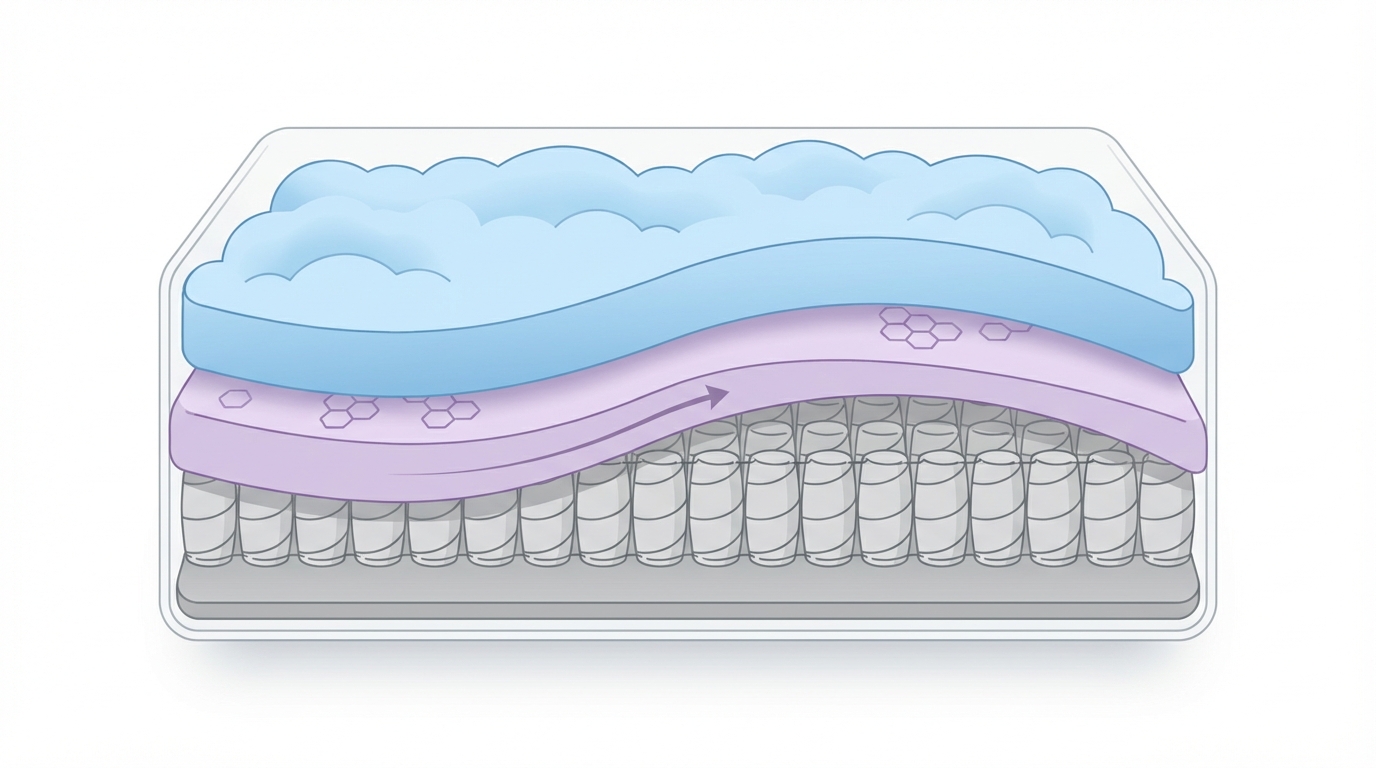
Now let us pull these elements together for specific sleeping styles. When someone asks me “what is the most comfortable mattress for me,” this is usually where our conversation lands.
Side Sleepers: Cushion The Curves
Side sleeping is the most common position, and it is generally healthy for the spine and airway. The main comfort challenge is pressure buildup at the shoulder and hip, especially on the side you favor. A comfortable mattress for side sleepers should let those areas sink enough that your spine runs in a straight line from neck to tail when viewed from behind, while still holding your waist and lower back in gentle support.
Most side sleepers find medium soft to medium feels most comfortable, depending on weight. Softer foams or plush pillow tops over a supportive core work well here. Hybrid designs with thicker comfort layers are often excellent, because the coils support alignment while the top cradles. If you are lighter, a very firm bed will likely feel like it is “poking” your shoulder all night. If you are heavier, you may still prefer a mattress that is labeled medium firm, because your extra sink turns it into a comfortable medium in practice.
This is also the group that benefits most from quality pillows and toppers. If your mattress is close but just a bit too firm, a contouring topper from a collection like Pillows, Sheets, Toppers, Protectors can add just enough pressure relief to make the setup feel truly comfortable without sacrificing underlying support.
Back Sleepers: Balanced Support And Gentle Give
Back sleepers need their mattress to support the natural S curve of the spine. That means enough give under the shoulders and hips to avoid a rigid plank feeling, but not so much that the pelvis sinks deeper than the chest. The American Academy of Orthopaedic Surgeons notes that maintaining neutral alignment during sleep can help reduce lower back pain, and mattress design is a big part of that.
Most back sleepers do well on medium to medium firm mattresses. All foam designs with a slightly firmer core and moderately plush top work nicely for lighter and average weight individuals; hybrids or firmer foams are usually more comfortable for heavier back sleepers. Zoned support is often a plus in this group, because reinforcing the lumbar area can give a very reassuring, “held” feeling.
Mattresses like the Sealy Posturepedic Medium Medina II Euro Pillow Top are built with this balance in mind: a cushioned surface for comfort with a coil system tuned to keep the lumbar region from falling behind. Many people who have tried overly plush beds and felt worse often find this kind of feel surprisingly comfortable within a night or two.
Stomach Sleepers: Firm Enough To Protect Your Back
Stomach sleeping is the most challenging position for comfort and spinal health. When you lie on your front, your head is usually turned to one side and your lower back is pushed into extension. If the mattress is too soft under your hips, your pelvis sinks and that curve is exaggerated, often leading to lower back pain and even tingling or numbness over time.
For that reason, most experts, including the Sleep Foundation and many spine specialists, recommend a firmer mattress for stomach sleepers, typically in the medium firm to firm range. A supportive innerspring or hybrid is often more comfortable here than a very plush all foam bed. Some stomach sleepers even find benefit in extra firm mattresses, as long as they are paired with the right pillow height to avoid neck strain.
Comfort in this context may not feel cloud like. Instead, it feels like waking up without that familiar ache across the low back or hips. Many stomach sleepers are surprised to find that a model like the Sealy Posturepedic Elite Extra Firm Brenham II eventually feels more comfortable than much softer beds they have tried, precisely because it keeps their spine in a safer zone.
Combination Sleepers: Versatility And Responsiveness
Combination sleepers move between positions through the night. For them, the most comfortable mattress is one that does not force their body to fight the surface each time they roll. They need decent pressure relief for side sleeping, enough support for back or stomach time, and enough responsiveness that they can turn easily without feeling stuck.
Medium hybrids and responsive foams typically shine here. A mattress that would be “perfect” for a strict side sleeper might feel too soft and enveloping for all night combination use, while one dialed in for a strict stomach sleeper may feel too firm on the side. Aim for the middle: moderately plush top, strong support core, and good motion response. This is also the group that tends to appreciate pillow tops that are quilted but not marshmallow soft.
Special Comfort Situations: Pain, Heat, And Partners
Real life comfort has to hold up under messy realities: chronic pain, hot flashes, pregnancy, bed sharing, and all the other things that make perfect lab scenarios a bit beside the point. Here is how to think about some of the most common complicating factors.
If You Wake Up With Pain Or Stiffness
If you regularly wake with back, shoulder, or hip pain that eases as you move around, your mattress is a prime suspect. The Arthritis Foundation points out that pressure relieving mattresses can reduce pain for people with arthritis and other joint issues by decreasing compressive forces overnight. Comfort for you may mean a slightly softer top layer than standard, as long as your spine is still well supported overall.
For back pain, a medium firm mattress has shown advantages in several clinical trials over very soft or very firm options, offering both spinal support and enough cushioning to allow muscles to relax. Hybrid designs with zoned lumbar support are particularly promising. If your pain is more in the shoulders or hips, especially as a side sleeper, lean softer in the comfort layers or consider a high quality topper paired with a supportive base.
Keep in mind that no mattress can diagnose or treat underlying medical conditions. If your pain is severe, persistent, or accompanied by neurological symptoms, it is important to speak with a healthcare professional. The mattress conversation then becomes part of a broader comfort and management plan.
If You Sleep Hot
Thermoregulation is a core part of comfortable sleep. According to research published in the journal Sleep, your core temperature naturally drops as you fall asleep, and an environment that traps heat can blunt that drop and fragment sleep. If you often wake sweaty or kick off covers in the night, prioritize breathable materials and cooling features.
Hybrids and innersprings generally sleep cooler than solid foam, simply because air can circulate more freely through the coil system. Within foam beds, open cell foams, gel infusions, and breathable covers can help, though they do not fully erase all heat retention in dense memory foams. Latex is another good choice for hot sleepers because of its open structure and natural temperature neutrality.
Pairing your mattress with breathable bedding from a collection like Pillows, Sheets, Toppers, Protectors can also make a meaningful difference. Lightweight, natural fiber sheets and a less insulating comforter or blanket can help your whole setup feel more comfortable if heat is your main complaint.
If You Share The Bed
Sharing a bed introduces motion transfer and competing comfort needs. The most comfortable mattress for couples is often one that neither partner would have chosen alone but that satisfies the core requirements of both. Foam and many hybrids do a better job than classic innersprings of absorbing movement so one partner turning over does not rock the whole bed.
If your preferred firmness levels are dramatically different, consider compromises around the middle, or explore options that feel slightly different on each side, such as using different toppers. In some cases, a medium hybrid base with tailored comfort layers on top for each partner becomes the most comfortable shared solution.
Edge support is also more important for couples, because it determines how much of the mattress surface is truly usable. Comfort here is about not feeling like you are rolling off if you move toward the edge, which can be a particular issue on softer all foam beds without reinforced rails.
“We went through three ‘bed in a box’ mattresses because every one felt great to me for about two weeks, then my husband would start complaining about his hips or how hot he was. At Sleepology they had us try a few different setups, including a firmer coil mattress with a plush Euro top like the Sealy Posturepedic Elite Soft Albany II Euro Pillow Top. It was the first time neither of us felt like we were giving something up.” – Marcus T., December
Comparing Common “Most Comfortable” Mattress Types
Sometimes it helps to see comfort differences side by side. Here is a simple comparison of how three popular mattress types usually feel to real sleepers.
| Mattress Type | Typical Comfort Feel | Best Fit For |
|---|---|---|
| All Foam (including memory foam) | Deep contour around shoulders and hips, strong pressure relief, very good motion isolation, can feel warmer | Side sleepers, people with joint pain, couples sensitive to movement, lighter to average weight sleepers |
| Hybrid (coils + foam or latex) | Mix of cushioning and noticeable support, moderate contour with some bounce, better airflow, versatile feel | Most back and combination sleepers, many side sleepers, couples wanting balance of motion control and ease of movement |
| Firm Innerspring / Coil with Euro or Pillow Top | Buoyant, elevated feel with less sink, strong support and edge stability, high airflow, more motion transfer | Back and stomach sleepers, heavier individuals, hot sleepers, those who dislike deep hugging foams |
No table can capture every nuance, but using this as a starting point keeps you oriented. If you are a hot, combination sleeper sharing the bed with a restless partner, for instance, you might instinctively look at the hybrid column and ask, “Which of these blends pressure relief, support, and cooling for us?” That is very different from asking “Which brand is ‘best’,” and usually far more productive for your comfort.
A Simple Checklist For Testing Mattress Comfort

When you are actually lying on a mattress, in a store or during an at home trial, comfort testing becomes practical. Here is a quick checklist you can mentally run through to stress test how comfortable the bed truly is for you.
Spend at least 5 to 10 minutes in your primary sleep position. Let your body settle and your muscles relax. Pay attention to whether any area starts to feel pressured or numb. Switch through your secondary positions if you are a combination sleeper, noticing how easily you can roll and whether support feels consistent.
Take note of your lower back and neck. In a supportive, comfortable position, your lower back should feel gently filled in, not arched away from the surface or sagging deeply. Your neck should feel neutral on your pillow, without strain. If you feel like you are constantly adjusting your pillow or trying to “tuck” your pelvis, the mattress may not be truly comfortable, even if the top feels nice initially.
Check heat and surface feel. You may not be on the bed long enough to fully judge temperature, but you can often tell whether the surface feels immediately warm or clammy. A comfortable mattress should feel neutral or slightly cool to start and not trap your body in one hot imprint.
Finally, notice how you feel when you get up. Do you have to push hard because you have sunk deeply, or do you feel nicely “launched” by the surface? Are any joints talking to you? Sometimes the truest sign of mattress comfort is how your body responds to that very first minute of standing and walking away.
Conclusion: Your “Most Comfortable Mattress” Is A Match, Not A Myth
There is no single mattress that wins the title of “most comfortable” for everyone, and that is actually good news. It means if you have been uncomfortable on highly rated beds, there is nothing wrong with you, you were just in the wrong match. Comfort lives where your body type, sleep position, preferences, and a mattress’s design intersect. When those pieces click, sleep tends to deepen, pain often eases, and your bedroom starts to feel like a refuge again.
If you take nothing else from this guide, take this: start with you, not the mattress. Clarify how you sleep, where you hurt, how you react to heat and movement, and what has and has not worked in the past. Then use that profile to choose a likely mattress family, whether that is a plush foam, a balanced hybrid, or a supportive pillow top. From there, details like firmness, zoning, and cooling features can be tuned to your comfort sweet spot.
At Sleepology, my favorite part of the job is watching someone’s whole posture change when they lie on a bed that finally fits them. Shoulders drop, breath slows, and you can see a bit of hope return. If you would like help translating everything we have covered here into specific options, our curated collections for back sleepers, stomach sleepers, and foam mattresses are a good next stop, and you are always welcome to reach out for personal guidance. Comfort is not a guessing game when you have a clear map and an experienced guide.
Frequently Asked Questions
What is the single most comfortable mattress for most people?
Most independent testing organizations often land on a medium to medium firm hybrid, with coils for support and foam comfort layers, as the most broadly comfortable type for a wide range of sleepers. That said, there is no single model that is best for everyone. Side sleepers with sensitive joints may find a slightly softer foam or plusher hybrid more comfortable, while stomach sleepers often need firmer beds. The “most comfortable” mattress for most people is usually a well made medium hybrid, adjusted softer or firmer based on your body weight and position.
How do I know if a mattress that feels soft in the store will still be comfortable long term?
Initial softness can be misleading. A mattress that feels like a cloud for five minutes may let your hips and shoulders sink too far over several hours, leading to pain. To judge long term comfort, pay attention to how well your spine is aligned, whether your lower back feels supported, and how thick and dense the support layers are. Higher density foams and quality coil systems tend to maintain their feel better, which is why looking beyond the top inch of plushness is important. Trial periods are also helpful; truly comfortable mattresses stay that way beyond the first week.
What is the most comfortable mattress type for back pain?
For many people with non specific mechanical back pain, studies and clinical experience point toward medium firm mattresses as a good starting point because they blend support and cushioning. Hybrids with zoned lumbar support or firmer all foam beds with a pressure relieving top layer are often the most comfortable setups. If your pain is more concentrated in the upper back or shoulders, you may need more contour in the top layer, whereas lower back pain often needs more reinforcement under the pelvis. It is always wise to discuss severe or chronic pain with a healthcare provider, then use mattress selection as part of a broader strategy.
Are memory foam mattresses the most comfortable option?
Memory foam mattresses can be extremely comfortable for the right sleeper, especially side sleepers and people with joint pain, because they excel at pressure relief and motion isolation. However, some people dislike the slow, sinking feel or find them too warm. Others, particularly heavier individuals or stomach sleepers, may not get enough support from lower quality memory foam designs. Hybrids and latex can be just as comfortable, or even more so, for these groups. The key is matching the material to your body and preferences rather than assuming memory foam is always best.
How firm should my mattress be if I share it with a partner who has different needs?
When partners have different firmness preferences, the most comfortable shared mattress is usually somewhere in the middle, often in the medium range, combined with thoughtful layering. For example, a medium hybrid with a slightly plusher Euro top can feel soft enough for a lighter side sleeper while still supportive enough for a heavier or back sleeping partner. You can also fine tune with different toppers or pillows on each side. Prioritize motion isolation and edge support as well, since a comfortable shared bed needs to minimize disturbances and maximize usable space.
Can a mattress topper make an uncomfortable mattress truly comfortable?
A high quality topper can meaningfully change surface feel, especially if the underlying mattress is supportive but too firm or slightly uneven. Adding a contouring foam topper can improve pressure relief for side sleepers, for instance, and sometimes provide a cost effective comfort upgrade. However, a topper cannot fix a sagging or structurally unsound mattress. If your bed dips deeply under your hips or has coils you can feel, comfort will still be compromised. In that case, it is better to replace the mattress and then, if needed, fine tune with a topper from a quality collection.
How long should a comfortable mattress last before it stops feeling good?
On average, many mattresses remain comfortably supportive for about 7 to 10 years, though this varies by material quality, body weight, and how hard the bed is used. Higher density foams and robust coil systems generally hold comfort longer, while very inexpensive, low density foam beds may feel less comfortable after only a few years. If you notice new morning pain, visible sagging, or that you are sleeping better on hotel or guest beds, your mattress may no longer be providing the comfort and support it once did, even if it looks fine at a glance.