

What Are The Measurements Of A Queen Size Mattress? A Complete, No‑Stress Guide
If you are trying to figure out whether a queen mattress will really fit your room, your bed frame, and your life, you are not alone. A lot of people hear that queen is the "most popular size," but that does not tell you whether it will actually work for your body, your partner, or your floor plan. You might be picturing bumping shins on the corner, fighting for blanket space, or trying to squeeze a new mattress up a narrow staircase. All of that comes down to one simple thing: understanding the actual measurements of a queen mattress and how those measurements play out in real homes.
Mattress sizing sounds straightforward, yet there are small details that can cause big frustrations later. A few inches in width can be the difference between feeling comfortably cocooned next to a partner and waking up every night because someone ended up on the edge. A few inches in length can matter a lot if you or your partner are tall. Room size, furniture layout, and even your sleep position all connect back to the dimensions printed on the mattress tag.
Here, you will get clear, specific answers about queen mattress measurements, how they compare to other sizes, and what those numbers mean in practical terms. You will learn how queen size works for couples, single sleepers, kids and pets, how to measure your room and frame correctly, and how to choose the right type of queen for your sleep style. You will also see where queen shines, where it falls short, and when it might be worth moving up or down a size. By the end, you should feel confident deciding if queen is truly your "just right" size and, if it is, how to pick one that will keep you comfortable for years.
Queen Mattress Measurements: The Exact Numbers That Matter
A standard queen size mattress measures 60 inches wide by 80 inches long. In everyday terms, that is 5 feet across and 6 feet 8 inches from head to toe. If you put a tape measure on the floor and outline that rectangle with painter's tape, you will see the footprint you are working with. That 60 by 80 inch measurement is consistent across most major mattress brands in the United States, which is why queen is such a reliable choice for frames and bedding.
Those 20 square feet of surface area are what make queen so versatile. It offers noticeably more elbow room than a full mattress, which is 54 by 75 inches, yet it does not dominate a typical bedroom the way a king can. According to many retailer and consumer surveys, queen remains the most commonly purchased mattress size because it strikes a sensible balance between space and practicality for couples and solo sleepers. Industry organizations and retailers often point to queen as the "default" master bedroom size because it fits comfortably in a 10 by 10 foot room while leaving wall and walking space.
Thickness is where numbers start to vary. Queens can range from about 8 inches on the slim side to 16 inches or more in tall, plush pillow tops. The height will not change your room layout much, but it will affect how high you sit when you get in and out of bed and whether fitted sheets stay on easily. The Sleep Foundation notes that ideal bed height from floor to top of the mattress is usually around 24 to 25 inches for easy entry and exit, especially for older adults or those with joint pain. Using the queen length and width with this height guideline will help you check that your chosen mattress, plus frame, will be comfortable to use every day rather than just look nice.
Manufacturing tolerances are another subtle factor behind those measurements. Most brands allow for a variance of about 1 inch in width or length from the stated dimensions because of fabric stretch, quilting loft, and how the mattress settles after unpacking. That is normal and usually does not cause fit issues for standard frames or fitted sheets. If you are working with a tight custom frame or built in platform, though, it is smart to check the product specs for the exact as-manufactured measurements and allow a little breathing room.
“I had always heard that a queen was 60 by 80, but I never realized how much that mattered until Mia walked me through taping it out on my bedroom floor. Once I saw the footprint, it was clear a king would have been way too tight. The queen we ended up with fits perfectly, and I avoided a very expensive mistake.” – Dana R., November
How A Queen Mattress Compares To Other Mattress Sizes
Once you have those 60 by 80 inch numbers in your head, it becomes easier to see how queen fits into the wider mattress size family. Comparison is important because many shoppers waver between full and queen, or queen and king, and the differences can look minor on a size chart but feel major in real life. Thinking in inches per person and total room footprint helps you see what you are gaining or giving up.
A full mattress is 54 inches wide by 75 inches long, so when you move up to a queen you gain 6 inches of width and 5 inches of length. That extra half foot of width can feel dramatic if you share a bed. Two people on a full each get about 27 inches of personal space, which is narrower than a typical crib mattress. On a queen, each partner gets 30 inches, closer to a standard twin. For a single sleeper, the difference often shows up as less time sleeping near the edge and more ability to sprawl or change positions without feeling constrained.
Comparing queen to king shows the other side of the equation. A standard king measures 76 inches wide by 80 inches long. That means a king gives couples 16 extra inches of width, or about 38 inches per person. That is why many people who toss and turn, co sleep with a child, or simply like more distance between them and their partner end up on a king. On the other hand, the room needs to be ready. Where queen works well in a 10 by 10 foot room, a king usually needs a room closer to 12 by 12 feet or more to allow walking space and furniture without feeling crowded.
If you or your partner are tall, the comparison with twin XL and California king may also be relevant. A queen has the same length as a twin XL, which is also 80 inches. Sleep experts often suggest that taller adults choose mattresses at least 6 inches longer than their height to avoid hanging off the end. So if someone in the household is above about 6 feet 2 inches, that extended 80 inch length can be a real comfort advantage over shorter twin or full sizes. For those well over that height, a California king, at 72 by 84 inches, can offer a little extra foot room, although queen often remains the more space savvy choice for the overall home.
To pull those comparisons together in a way that is easy to visualize, it helps to see the major sizes side by side.
| Mattress size | Width x length (inches) | Typical best fit |
|---|---|---|
| Full | 54 x 75 | Solo adults in smaller rooms, older kids or teens |
| Queen | 60 x 80 | Most couples, solo adults who want extra space, guest rooms |
| King | 76 x 80 | Couples who want maximum width or co sleep with a child or pet |
| California King | 72 x 84 | Tall couples, those prioritizing extra length over width |
Many people also ask about "Olympic queen" or split queen options. These are specialty variations that keep the 80 inch length while changing the width or construction. An Olympic queen is typically 66 by 80 inches, six inches wider than standard. A split queen maintains overall queen dimensions, but the mattress is built as two separate sections side by side, making it easier to move and pair with adjustable bases. These alternatives can be helpful if you love the queen footprint but have specific space or mobility needs.
“I was convinced we needed a king because we have a big dog who sleeps on the bed. After comparing measurements and thinking about our 11 by 11 foot room, Mia gently suggested trying a queen first. She recommended a model with stronger edge support, and it honestly feels huge for us, without overwhelming the room.” – Victor M., October
Will A Queen Mattress Fit Your Bedroom Comfortably?

Knowing the measurements of a queen size mattress is one thing, but the real question is whether that 60 by 80 inch rectangle will actually work in your space. Many people measure only the wall they want the bed against and forget to account for walking paths, nightstands, doors, and dressers. That is where queen sizing mistakes often happen. The goal is not just to get the mattress through the door, but to create a bedroom that feels calm and uncluttered enough to support good sleep.
As a starting point, a queen mattress tends to fit best in bedrooms that are at least 10 by 10 feet. That size allows around 24 inches of walking space on either side of the bed in a simple layout, which is the rough minimum for moving comfortably. Organizations like the Sleep Foundation and home design experts often suggest aiming for 24 to 36 inches of clearance around the bed, which lines up well with the idea that your bedroom should function as a soothing, easy to navigate space, not an obstacle course. If your room is smaller than 10 by 10, you can still make a queen work, but it may require compromises on other furniture.
One practical method I use with clients is the painter's tape test. After measuring your room's length and width, mark out a 60 by 80 inch rectangle where you think the mattress will go. Step in and out from each side, open the door, and imagine where a dresser or nightstand would sit. If you are constantly having to turn sideways or bumping into the taped corners, the room may be better suited to a full, or you may need to rethink the furniture arrangement. This simple exercise often reveals layout challenges that are not obvious on paper.
You will also want to think about circulation beyond the bed itself. For example, can closet doors swing open easily with a queen in place, or will they catch on the mattress? Does a queen block access to windows you like to open for fresh air? Will there still be a clear path to walk to the bathroom at night without turning sideways? The Cleveland Clinic often talks about keeping bedrooms free of clutter to support healthy sleep, and a mattress that is just a little too large for the room can quickly become a form of clutter all on its own.
If you find that a queen technically fits but leaves the room feeling tight, there are ways to make it work more gracefully. Choosing a lower profile bed frame instead of a bulky sleigh bed, for example, can help reclaim visual space. Using slim, wall mounted shelves as nightstands can maintain bedside storage without consuming floor area. In many homes, queen becomes the sweet spot when you pair thoughtful furniture choices with those core 60 by 80 inch mattress measurements.
Is A Queen Size Mattress Right For One Sleeper Or Two?
Even if a queen fits your room, you still need it to fit your life. One of the most common questions I hear is whether a queen is "big enough" for two people, especially if there are different body sizes, sleep positions, or pets involved. There is no single correct answer, but looking closely at how people actually use a queen for solo and partnered sleep can reveal a lot.
For single adults, a queen is often a comfort and flexibility upgrade more than a strict necessity. Instead of being limited to full or twin width, you get the freedom to sprawl on your side, sleep diagonally, or share the bed with a pet without consistently ending up on the edge. Research shared by groups like the Sleep Foundation and various academic sleep labs suggests that perceived personal space in bed can affect how easy it feels to fall and stay asleep. That does not mean everyone needs the largest bed possible, but it does mean that if you constantly feel pinned to the edge of a narrower mattress, upgrading to queen can be a quality of life improvement.
For couples, a queen can be a very workable size when you are mindful of sleep habits. On a queen, each partner gets about 30 inches of personal width, which is a little narrower than a standard twin but still adequate for many pairs. If both of you are average height and tend to sleep on your backs or sides without starfish style sprawling, queen often feels comfortably cozy rather than cramped. This is one reason so many primary bedrooms in apartments and smaller homes are designed around queen.
Where couples sometimes struggle on a queen is when sleep styles or body sizes are very different. If one partner is much taller or broader, or if one person sleeps hot and likes to spread out while the other prefers staying still and tucked in, that 60 inch width can start to feel contentious. In those situations, I often recommend paying special attention to mattress construction. For example, a queen with strong motion isolation and reinforced edge support, such as the Sealy Posturepedic Plus Medium Mattress – Paterson II Euro Pillow Top, can help each partner feel like they have a solid, usable zone without rolling toward the center.
Another factor is what I call the "nighttime guest factor." If you regularly have a young child or a big dog join you for part of the night, queen may start to feel small more often than not. That does not mean queen cannot work, but you will want to be realistic about how many bodies are actually in the bed at 2 a.m. and whether that fits comfortably with those fixed 60 by 80 inches. If not, putting children back in their own beds or giving pets their own cozy space nearby can allow queen to remain a good fit for the adults.
How Your Height, Build, And Sleep Position Interact With Queen Dimensions
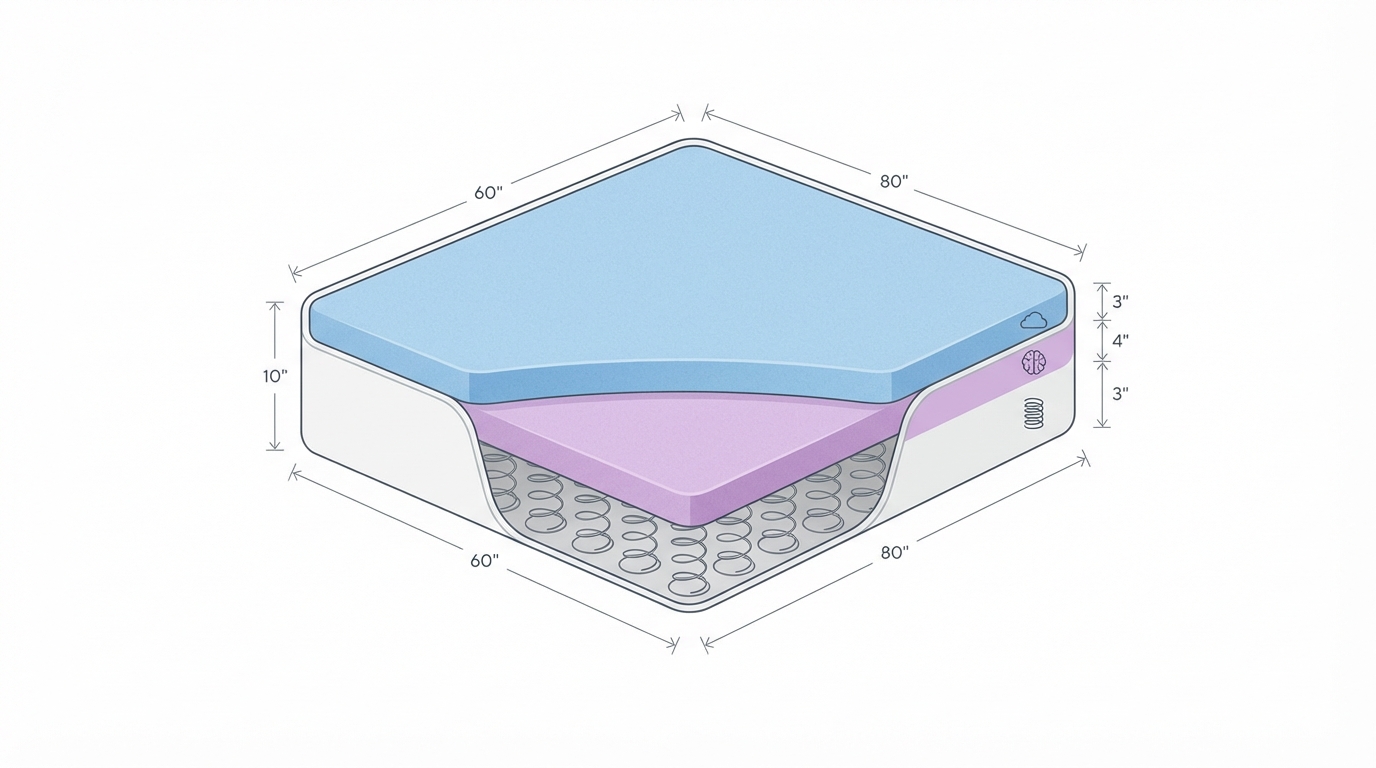
Beyond the number of people in the bed, your height, body shape, and sleep position also affect how well a queen size mattress works. These are the details that rarely appear on size charts but matter deeply at 3 in the morning when you are trying to find a comfortable spot. Understanding how your body occupies that 60 by 80 inch rectangle can help you make a more nuanced decision.
If you are taller, the 80 inch length of a queen becomes especially important. Sleep medicine specialists often suggest that a mattress should be at least 6 inches longer than your height so your feet are not pressed against the footboard or hanging past the edge. That means adults above about 6 feet 2 inches are better served by queen, king, or California king length than by twin or full, which are only 75 inches long. If one partner is significantly taller than the other, that extra length can prevent chronic foot dangling and the subtle tension it creates.
Body width plays its own role. Broader shoulders, wider hips, or a larger frame in general simply occupy more horizontal space. On a queen, that is still manageable for most couples, but it can mean that edge support becomes more critical, especially if someone tends to sleep close to the side. Mattresses with zoned support, like the Sealy Posturepedic Elite Medium Mattress – Brenham II Euro Pillow Top, often hold up better for larger bodies by strengthening the center and perimeter so the full width of the queen remains usable.
Sleep position changes how you use both length and width. Side sleepers often curl slightly, which reduces their effective length, but they also tend to need more room across the bed as arms and knees drift outward. Stomach and starfish back sleepers can take up significantly more width than they realize, which is why many couples where one person is a committed sprawler eventually move to a king. Back sleepers who stay fairly straight often do best on a queen in terms of efficient use of space. The American Academy of Sleep Medicine reminds people that experimenting with sleep position and pillow support can improve comfort, and that same experimentation can help you decide whether queen gives you enough space to adopt healthy positions.
Weight distribution is another hidden factor. While mattress durability is mostly about material quality and support systems, spreading the same combined weight across a larger surface, such as a king, can slightly reduce pressure in any one area. On a queen, especially for heavier couples, investing in a well built support system and possibly a center rail becomes more important. This is less about the measurements themselves and more about making sure that the 60 by 80 inch size you choose will stay comfortable throughout its lifespan.
“We are not very tall, but my partner is a sprawly side sleeper. Mia helped us realize that with a queen, we needed really solid edge support and motion isolation so I would not feel like I was falling off every time he rolled over. The queen she recommended feels stable on every inch, and I finally sleep through the night.” – Lauren T., September
Queen Size And Room Layout: Doors, Stairs, Frames, And Bedding
Even after you confirm a queen will fit your body and your room, there is a practical step many people overlook: how that queen will move through your home and work with frames and bedding. Because queen is such a popular size, most products are built to accommodate those 60 by 80 inch measurements, but there are still a few pitfalls worth watching for.
Delivery path is the first. A queen mattress is large enough that getting it into older homes, up tight stairways, or around angled landings can be tricky. Bed in a box construction has made this much easier because foam and hybrid queen mattresses often arrive compressed and rolled in a manageable box. If you choose a more traditional innerspring queen that is not compressed, or if your home has especially tight access, take a few measurements ahead of time. Measure door widths, hallway widths, and the narrowest point on any staircase, then compare those numbers to the diagonal length of the mattress. Doing this in advance can save you from a stressful delivery day surprise.
Bed frame compatibility is the next consideration. Standard queen frames, platforms, and foundations are built to fit 60 by 80 inch mattresses, but some have side rails or headboards that add several inches to the overall footprint. If your room is already tight, that extra bulk can change how well the bed fits. Slatted frames usually specify a maximum gap between slats that is safe for foam or hybrid mattresses. Matching a queen mattress to a supportive frame is important for longevity, especially across that larger surface area. If you are not sure your existing frame is up to the task, it may be worth upgrading along with the mattress.
Bedding is more straightforward, but there are small details that tie back to measurements. Fitted sheets labeled "queen" are designed for that 60 by 80 inch surface, but they also list a pocket depth range that should match your mattress height. A 16 inch thick queen on a thin elastic sheet made for 10 inch mattresses will constantly pop off the corners. Because you are working with a larger, heavier slab of material in a queen, investing in well fitting, breathable sheets can make nightly bed making less frustrating. High quality sets like the Tempur-Pedic TEMPUR Adapt Luxe Egyptian Cotton Sheet Set, designed to fit deeper mattresses securely, help your queen feel smooth and tailored rather than bunched and loose.
Finally, your choice of protection and accessories should respect the same measurements. A waterproof protector designed specifically for queen will shield the full surface without bunching, which is crucial for allergy control and hygiene. According to organizations like the Mayo Clinic, keeping allergens such as dust mites under control in the bedroom can ease symptoms for people with asthma or allergies, and encasing your mattress properly is a key step. When you measure for these items, stick to the actual 60 by 80 inch dimensions and the real height of your mattress, not just the marketing name.
Choosing The Right Type Of Queen Mattress For Your Sleep Style
Once you know that queen is the right size, the next decision is what kind of queen you want under you every night. The measurements stay the same at 60 by 80 inches, but the material inside can change how that space feels for your body and how much of it you can comfortably use. In my experience, matching mattress type to sleep style is just as important as picking the right size.
Memory foam and foam hybrid queens are popular because they contour closely and isolate motion well. If you sleep with a partner and do not have the luxury of king width, that can make a queen feel more peaceful by preventing every toss and turn from echoing across the bed. Foam also tends to use the full edge to edge width effectively, especially in models with reinforced perimeters, so those 60 inches of width feel fully usable. Look for versions with cooling features if you sleep hot, since traditional memory foam can retain heat. The Sleep Foundation notes that body contouring and pressure relief are often better on foam and hybrid models, which can be especially helpful for side sleepers on a queen.
Innerspring queens feel bouncier and cooler for many people, with more airflow throughout the mattress. They can be a great fit if you prefer a traditional feel, sleep hot, or move around frequently during the night. However, not all innersprings are created equal for queen use. Cheaper models may have weaker edge support, which means that while the mattress is technically 60 inches wide, the last few inches on each side do not feel stable. Upgrading to a well constructed, supportive model, such as the Sealy Posturepedic Pro Soft Mattress – Dupont II Euro Pillow Top, can help ensure that the full queen width is comfortable and supported.
For back and stomach sleepers on a queen, support and alignment matter more than plushness alone. A medium to medium firm mattress with strong lumbar support often keeps the spine in a neutral position, which in turn reduces back pain risk. Collections like The Best Mattresses For Back Sleepers or The Best Mattresses For Stomach Sleepers narrow the queen options to models that are more likely to keep you balanced in the middle of the bed instead of sagging toward the center.
Accessories can fine tune how your queen feels without changing its measurements. If you already own a queen that is supportive but a bit too firm, a high quality topper can add surface plushness while keeping the 60 by 80 inch footprint the same. A compact option like the Tempur-Pedic Mattress Topper – Pillow Travel and Guest Bundle is designed more for portability, but it illustrates how foam layers can shape comfort independently of size. For permanent softness adjustments on a queen, look for toppers sized specifically for queen with good corner elastic to prevent shifting.
How To Measure Correctly So Your Queen Mattress Truly Fits
Understanding the measurements of a queen size mattress is only half the story. The other half is measuring your space, your body, and your existing furniture accurately so those numbers translate into a great fit. Many of the sizing frustrations I see trace back to approximate measuring or guesswork. A tape measure and ten quiet minutes can prevent years of annoyance.
Start with the room. Measure wall to wall in both directions and write those numbers down. Then measure from each wall to any doors, closets, or windows you need to access regularly. As you think about placing a 60 by 80 inch queen, remember you ideally want 24 to 36 inches of open space on at least two sides and at the foot. If your room is 10 by 12 feet, for example, a queen along the 12 foot wall usually leaves enough space at the foot for a dresser and walkway, while placing it on the shorter wall might pinch the room.
Next, measure your existing bed frame or base if you plan to reuse it. Measure the internal platform or slat area where the mattress rests, not just the outer edges. If that internal area is smaller than 60 by 80 inches, a standard queen may not sit correctly, even if the frame is labeled queen. Also measure the height from floor to the top of the slats or foundation so you can calculate your total bed height when combined with the new mattress. As noted earlier, most people feel comfortable with the top of the mattress around knee height, which many health sources like the Cleveland Clinic consider a safe, low strain level for getting in and out of bed.
You can also measure yourself and your partner to see how you truly fit on a queen. Stand back to back and measure shoulder width across the two of you. If your combined shoulder width is close to or greater than 60 inches, queen may feel tight unless you habitually sleep curled or on your sides. If you mostly sleep straight on your backs, you want some buffer between shoulder width and mattress width so you are not pressed right against the edges. For height, compare your tallest sleeper's height to the 80 inch mattress length. If they are under about 6 feet 2 inches, queen length is usually adequate for comfortable positioning with a pillow.
Finally, do a quick check of the path from outside your home to the bedroom. Measure the width of each doorway, the width and turning radius of any stairs, and any tight hallway corners. Even compressed foam queens have boxes with real dimensions. Knowing the narrowest point along that path will help you choose the best delivery style and prepare properly. It is a small step that can save you a lot of stress on delivery day.
Here is a simple measuring checklist you can follow to keep everything organized:
- Room length and width, wall to wall
- Door, closet, and window locations with clearance needs
- Current bed frame internal platform or slat measurements
- Frame height from floor to top of support surface
- Tallest sleeper's height compared to 80 inch mattress length
- Combined shoulder width for couples
- Delivery path widths, including doorways, halls, and stairs
Once you have these numbers, you can compare them calmly to the 60 by 80 inch queen dimensions. This turns the decision from a guess into a clear, evidence based choice. Many people feel less anxious about upgrading to queen once they see, on paper, that the measurements truly work in their home.
After you complete your measuring, it can help to revisit any lingering sleep concerns. If you still worry about edge space, motion transfer, or back support within that queen footprint, that is the moment to talk them through with a sleep expert rather than after the mattress arrives. Organizations like the Sleep Foundation emphasize that good sleep health is a combination of environment, habits, and tools. A queen mattress that fits your measurements and your real life sleep patterns can become a powerful tool instead of a daily frustration.
When A Queen Mattress Is The Best Choice, And When To Consider Another Size

By now, you have probably formed an opinion about whether queen size sounds like it could fit your situation. It may help to pull the main scenarios together so you can see, at a glance, where queen tends to shine and where another size might serve you better. Choosing the right size from the start is not just about comfort, it is also about value, since most people keep a mattress for seven to ten years according to many industry and sleep health sources.
Queen is usually the best choice if you are a couple in a typical sized primary bedroom who want a balance of closeness, comfort, and floor space. If both partners are under about 6 feet 2 inches, do not need to co sleep with children or large pets every night, and are willing to choose a mattress with thoughtful edge support and motion isolation, queen often provides the best ratio of price to performance. It is also ideal for guest rooms, since it comfortably fits both couples and solo guests without requiring as much space or as high a bedding budget as a king.
If you are a solo sleeper considering your first "adult" bed, queen is often a future friendly upgrade. It gives you room to grow into possible shared sleep down the line, while feeling pleasantly roomy now. As long as your room can truly accommodate the 60 by 80 inch footprint with reasonable clearance, queen can feel like a luxurious personal nest. Adding supportive pillows and breathable bedding from a thoughtfully curated collection like Pillows, Sheets, Toppers, Protectors can turn that space into a genuine retreat.
On the other hand, you might want to consider a different size if your room is quite small or unusually shaped. In a studio or very compact bedroom where a queen would leave you turning sideways to reach the closet or squeezing around furniture, a full might be a saner choice even if queen technically fits. Similarly, if you or your partner are significantly taller than average or regularly share the bed with children and pets, the extra 16 inches of width on a king may save you from years of edge hugging and resentful sleep.
Budget is the final filter. Queen mattresses and bedding often hit a sweet spot in terms of cost, falling between full and king. However, there is still a real difference between full and queen in total setup price, since you will also be buying a larger frame, sheets, and protectors. If your budget is tight right now, it can be smarter to invest in a high quality full that fits your body properly than a lower quality queen that meets the size goal but not the comfort and support goals. Long term value comes from a mattress that helps you sleep well and lasts, not just from the number printed on the label.
“I almost ordered a king online because it felt like 'the grown up choice.' Talking through our measurements and habits with Mia made me realize a queen was smarter. We used the savings to upgrade to a better quality queen mattress, and I am so glad we did. Our backs feel better, and our room finally looks pulled together.” – James P., August
Conclusion: Turning Queen Size Measurements Into Real Sleep Comfort
The measurements of a queen size mattress, 60 inches by 80 inches, may sound simple on paper, but as you have seen, those numbers interact with your room, your body, your partner, and your daily life in many subtle ways. When a queen is chosen thoughtfully, it can feel like the most natural, effortless size in the world, giving you enough space to relax without swallowing your bedroom or your budget. When it is chosen hastily, those same dimensions can create daily friction, from stubbed toes to crowded sleep.
You now know how queen compares to other sizes in width and length, how it tends to work for single sleepers and couples, and how your height, build, and sleep position affect how you occupy that space. You have practical tools for measuring your bedroom, your frame, and your delivery path so you can be confident that a 60 by 80 inch mattress will truly fit, not just squeeze in. You have also seen how mattress type and quality influence how usable the full queen surface feels, especially at the edges and in the center where support matters most.
If queen seems like the right match after all of this, your next steps are thankfully straightforward. Measure your room, frame, and body carefully, then explore supportive, well built queen options that align with your sleep style. As you look at models like the Sealy Posturepedic line or curated collections for back and stomach sleepers, focus less on marketing buzzwords and more on how each mattress's construction will make those 60 by 80 inches feel under you every night. Remember that good sleep is a health investment. Organizations like the Sleep Foundation regularly highlight how adequate, high quality sleep supports everything from mood to heart health, and your mattress plays a central role in that equation.
If you are still unsure or feel caught between sizes, you do not have to figure it all out alone. A short conversation with a knowledgeable sleep guide can often clarify questions that size charts and product pages cannot touch. At Sleepology, we look at your real measurements, your real room, and your real sleep struggles, then help you connect them to the queen or alternative size that will work best. You deserve a bed that fits your life as well as it fits your tape measure, and with the information you have now, you are much closer to that reality.
Frequently Asked Questions
How much space does a queen mattress actually need in a bedroom?
A queen mattress itself measures 60 by 80 inches, but it needs more than that to feel comfortable in a room. In most cases, a bedroom of at least 10 by 10 feet works well, since that allows roughly 24 inches of walking space on two sides and at the foot when you place the bed thoughtfully. If you have larger bedroom furniture or an unusual layout, you may want more clearance, closer to 30 to 36 inches, to keep the room from feeling cramped. Marking out the mattress footprint with painter's tape and walking around it is a simple way to test whether a queen will feel spacious or tight in your specific room.
Will a queen size mattress fit two people comfortably all night?
For many couples, yes, a queen can be very comfortable, but it depends on your sleep habits and bodies. On a queen, each person gets about 30 inches of personal width, which works well if both partners are average size and tend to sleep in relatively contained positions on their backs or sides. If one or both of you are broader shouldered, very tall, or prone to spreading out like a starfish, that same width can sometimes feel tight. In those cases, choosing a queen with strong motion isolation and edge support can make the space feel more usable, or you may decide that a king is worth considering if your room and budget allow.
Is a queen big enough for a tall person?
A queen mattress is 80 inches long, and for many tall adults that is sufficient, especially if you do not sleep perfectly straight. As a general guideline, sleep experts often recommend choosing a mattress at least 6 inches longer than your height. That means someone up to about 6 feet 2 inches will usually be physically comfortable on a queen. If you are taller than that, or if you dislike having your feet near the edge, you may want to look at a California king, which adds 4 extra inches of length while trading some width, or pay special attention to your pillow setup so you are not pushed too far down the bed.
What is the difference between a queen and an Olympic queen?
A standard queen is 60 by 80 inches, while an Olympic queen is typically 66 by 80 inches. That extra 6 inches of width gives each partner about 3 more inches of personal space compared to a standard queen, which can feel meaningful if you are on the fence between queen and king. However, Olympic queen is considered a specialty size. Frames, foundations, and bedding are less widely available, and you will need to be sure that anything you buy is explicitly labeled as Olympic queen. For most people, choosing between standard queen and king within the more common sizes is simpler and more cost effective.
Do mattress toppers or pads change the size of a queen mattress?
Toppers and pads can change how a queen feels but not its fundamental measurements. A topper that is designed for queen will still be 60 by 80 inches, just like the mattress beneath it. It may add a few inches of height, which affects total bed height and the pocket depth you need in fitted sheets, but it will not make the bed longer or wider. If a queen feels too short or too narrow, no topper or pad can meaningfully fix that; you would need to change mattress size. Where toppers shine is in adjusting firmness and pressure relief on a queen that already fits your space and body.
Can I put a queen mattress on a full or king bed frame?
It is not recommended, even if it seems like the frame is "close enough." A queen mattress needs a 60 by 80 inch support surface to sit flat and be properly supported. On a full frame, which is only 54 by 75 inches, the edges of the queen would hang over, potentially causing sagging and voiding warranties. On a king frame, the mattress would be too small, leaving gaps that can be unsafe and uncomfortable. If you are moving to a queen from another size, it is best to pair it with a frame or foundation that is specifically built for queen measurements.
How can I tell if I should choose a queen or a king?
A helpful way to decide is to walk through three questions. First, does your room have enough space for a king while still leaving at least 24 to 30 inches of walking clearance and room for essential furniture? If not, queen is usually more sensible. Second, how many bodies regularly sleep on the bed at night, including pets and children, and how much personal space do you genuinely need to sleep well? If you and your partner often wake up on the edges of a queen, king might be worth the extra cost and footprint. Third, does your budget comfortably cover not just the mattress but the larger frame and bedding that come with a king? If a king would force you to settle for lower quality construction, a better built queen often provides more long term comfort and value.