

What Are The Dimensions Of A Queen Size Mattress? A Complete Guide To Sizing, Space, And Fit
Choosing a queen mattress seems simple, until you start measuring your room, thinking about a partner who tosses and turns, or wondering why your fitted sheets never quite stay put. If you are asking “what are the dimensions of a queen size mattress,” you are likely already trying to solve a real problem, like feeling cramped in a full, or trying to fit a bigger bed into a not–so–big bedroom. It can feel surprisingly stressful for something that is supposed to help you relax.
There is more at stake than just whether the mattress physically fits. According to the Sleep Foundation, most adults need 7 to 9 hours of sleep per night, and comfort, support, and space all influence how many of those hours are truly restful. When your bed is too small, too big for the room, or mismatched with your frame or bedding, you can end up with more wakeups, more aches, and more frustration than you should have to live with.
You are in the right place if you want a clear, confident answer about queen mattress dimensions and what they mean in real life. You will learn the exact measurements, how queen compares to other sizes, how much room you and a partner actually have, and how to make sure your bed, frame, and bedding all work together. You will also see how specific Sleepology mattresses and accessories can solve the comfort side of the equation, once you are sure about size.
By the end, you will not just know the numbers on a spec sheet. You will know whether a queen is genuinely the right size for your body, your bedroom, and your long term plans, and how to set it up so you get every inch of comfort you are paying for.
Queen Mattress Dimensions: The Short Answer, And Why They Matter
A standard queen size mattress in the United States measures 60 inches wide by 80 inches long. Put another way, that is 5 feet across and 6 feet 8 inches from head to toe. Those dimensions are measured from the outer edges of the mattress, and they refer to the sleeping surface size, not the frame or headboard around it.
For many adults, those 60 inches of width make a queen feel noticeably more spacious than a full size mattress, which is typically 54 by 75 inches. When you share the bed with a partner, a queen gives each person about 30 inches of personal width. That is roughly the width of a crib mattress per person, which is workable for many couples, but not generous if one of you sprawls or moves a lot at night.
The 80 inch length is one of the most important, and most overlooked, numbers. If you or your partner is taller than about 6 feet 2 inches, sleep experts and organizations like the Cleveland Clinic often recommend a mattress that is at least 80 inches long, so your feet are not hanging off the edge and your posture stays more neutral through the night. A queen shares this 80 inch length with twin XL, king, and many specialty sizes, which is part of why it is such a versatile choice.
You should also know that there can be minor manufacturing tolerances of about plus or minus 1 inch in mattress dimensions, especially with thick quilting or pillow tops. That means a queen might arrive measuring 59 by 79 inches or 61 by 81 inches and still be within spec. For most people this variation is not a problem, but if you are fitting a mattress into a tight alcove or custom frame, it is worth keeping in mind.
“Mia walked me through the difference between full and queen so clearly. We ended up with a queen hybrid that actually fits our room, and my 6'3" husband’s feet are finally not hanging off. Worth every penny.” – Dana P., November
Queen Size In Context: How It Compares To Other Mattress Sizes
Understanding the dimensions of a queen mattress gets much easier when you see it in context. On paper, 60 by 80 might not mean much until you understand what you gain over a full, and what you give up compared to a king. Since mattress size directly affects movement, pressure points, and room layout, this context helps you avoid an expensive mistake.
Queen vs Full: Is The Upgrade Worth It?
A full size mattress is typically 54 inches wide and 75 inches long. That means a queen gives you 6 extra inches of width and 5 extra inches of length. For a solo sleeper, that extra width often feels like the difference between “just enough” and room to change positions without worrying about falling toward the edge. For a couple, those 6 inches split into 3 more inches per person, which sounds small but can genuinely change how much you bump into each other.
The 5 inch difference in length is where taller sleepers really feel a change. Someone who is 6 feet tall has about 3 inches of extra length on a full, but a full mattress is often paired with deeper pillows and headboards, which eat into usable length. On a queen, most adults up to about 6 feet 2 inches are comfortably contained, especially with a supportive pillow that keeps the head aligned instead of pushed far up the bed.
From a room perspective, upgrading from a full to a queen adds 3 inches of mattress on each side if you keep the bed centered. In a typical 10 by 10 foot bedroom, that is still manageable if you are thoughtful with nightstands and walking space. According to many interior design guides, including those summarized by sleep organizations, leaving at least 24 inches of clear floor space on each accessible side of the bed makes daily movement more comfortable.
Queen vs King: Space, Budget, And Bedroom Fit
A standard king size mattress is typically 76 inches wide and 80 inches long. Compared to a queen, that is 16 extra inches of width, with the same length. For two people, that translates to about 38 inches of personal width each, more than a twin mattress per person, which is why king is often the choice for couples who feel cramped on a queen.
However, king size is significantly more demanding in terms of room size and budget. Many layout guides recommend a minimum of around 12 by 12 feet for a king if you want space for nightstands, a dresser, and comfortable circulation around the bed. In a 10 by 10 room, a king can technically fit, but it often means squeezed walkways and doors that bump into furniture. You will also spend more on sheets, protectors, and bedframes for a king, something Consumer Reports has noted when comparing overall sleep system costs.
This is where queen shines as a “practical spacious” size. It gives you enough room for most couples in standard bedrooms while keeping accessory costs and furniture scale in check. If you love the feel of a luxury mattress but do not have a massive room, a queen in a more premium construction, such as the Sealy Posturepedic Plus Medium Mattress – Paterson II Euro Pillow Top, can be a smarter investment than a larger but lower quality king.
Queen vs Twin XL And Other Specialty Sizes
Twin XL mattresses are typically 38 inches wide and 80 inches long. They are as long as a queen but much narrower, which is why they are common in college dorms and guest rooms where floor space is at a premium. A queen effectively combines the length of a twin XL with enough width for one or two sleepers, which is why many single adults choose queen as a long term size even if they live alone.
There are also non standard sizes like Olympic queen, full XL, and oversized “family” beds. These can be helpful in niche situations but are less widely available. Bedding is harder to find, and frames may need to be custom. For most shoppers, sticking with a standard queen is the best balance between choice, availability, and cost. Sleep organizations like the National Sleep Foundation often highlight how standard sizes make it easier to maintain good sleep hygiene over time, because you can easily replace worn sheets and protectors.
“We thought we needed a king, but Mia explained how a queen would give us plenty of room without overwhelming our 11 by 11 bedroom. The sizing advice saved us from buying a new bed frame and hundreds on extra bedding.” – Carlos V., October
How Much Space Do You Really Get On A Queen Mattress?

Knowing that a queen is 60 by 80 inches is one thing. Understanding how that actually feels for one person, two people, or a person plus a pet is another. Here is how the dimensions play out in everyday sleep scenarios, and how to tell if queen is likely to feel generous or tight for you.
Personal Sleeping Width On A Queen
When you share a queen mattress equally, each partner gets about 30 inches of width. For comparison, a basic dining chair seat is often around 18 to 20 inches wide, and a standard crib mattress is about 28 inches wide. That means a queen gives you a bit more space than a crib width per person.
If you are both relatively average in build and sleep positions, 30 inches can feel perfectly adequate. Side sleepers who curl up a bit, or back sleepers who stay aligned, usually manage well in this space. However, if either of you tends to sprawl in a starfish position, throw arms out wide, or change sides frequently, those extra inches of a king can provide a noticeable buffer.
A simple at home test can help. Lay a blanket flat on the floor, measure and mark out a 30 inch wide strip per person, and lie down as you normally would. If you are constantly nudging the edges or overlapping by a lot, you may want to treat queen as an acceptable minimum and consider whether your room and budget could support a king instead. If you find that you naturally stay well inside that boundary, queen should be comfortable.
Length And Height Considerations
At 80 inches in length, a queen is suitable for most adults up to about 6 feet 2 inches tall. Sleep specialists often recommend that your mattress length exceed your height by at least 6 inches to allow for a pillow and natural positioning without your feet pressing into the end. This buffer helps keep ankle and knee joints in a more neutral position overnight, which can reduce morning stiffness.
If you or your partner are closer to 6 feet 4 inches or taller, you may start to feel limited by a queen, especially if you like to sleep with your toes pointed down or if you use a tall pillow stack. In those cases, a California king, which is typically 72 by 84 inches, can relieve some of that tension, though it does change room layout considerations. For most couples of average height, queen length is more than enough when combined with a supportive pillow sized correctly for your shoulder width and sleeping position.
How Queen Size Feels For Different Household Setups
For a single adult, queen size usually feels roomy. There is enough space to roll, change positions, or share occasionally with a partner without feeling crowded. Many people who live in apartments or smaller homes like that queen gives them the flexibility to host a partner, child, or pet without dedicating a whole room to a king.
For couples, queen is often the most popular “starting” size. If you share your bed with a small child or a pet on a regular basis, though, a queen can quickly start to feel busy. In those cases, choosing a queen is often about balancing current needs with long term plans. If you are in a temporary space and plan to move to a larger home later, queen can be a smart investment that transitions easily to a guest room later when you upgrade your primary bed to a king.
Recommended Room Size And Layout For A Queen Mattress
Once you are confident that queen size works for your body and sleep style, the next question is whether it works for your room. The mattress is only part of your sleep environment. You still need space to walk, open drawers, and create a calming place to wind down. Here is how to think about room dimensions relative to those 60 by 80 inches.
Minimum Room Size Guidelines For Queen Beds
A common recommendation from interior designers and sleep health resources is that a queen mattress works best in bedrooms that are at least 10 by 10 feet. At that size, you can usually place the bed centered against a wall, fit two small nightstands, and still have approximately 24 inches of clearance along the sides. This matches spacing guidelines from sleep organizations, which find that clutter and narrow pathways can interfere with your sense of calm before bedtime.
If your room is closer to 9 by 10 feet, a queen can still fit, but you may need to compromise. That might mean skipping one nightstand, opting for wall mounted lights instead of table lamps, or placing a dresser in an adjacent hallway or closet. Measure carefully, including door swing arcs and any radiators, windows, or built in units that affect usable wall space.
For larger rooms, such as 12 by 12 feet and up, a queen can look visually smaller, especially with oversized furniture or tall ceilings. Some people love this because it creates more open floor space and makes the room feel airy. Others find that a king feels more proportionate. Visually, you can use thicker rugs, substantial headboards, or frames with built in storage to anchor a queen in a larger room without changing mattress size.
Accounting For Frames, Headboards, And Walking Space
Remember that the mattress itself is 60 by 80 inches, but the total footprint of your bed setup will be larger. Bed frames often add 1 to 4 inches of length and width, depending on whether they have side rails, footboards, or upholstered padding. For example, a platform frame with a thick, padded border might measure 65 by 85 inches or more. That is half a foot beyond the mattress dimensions.
When planning your room, measure the outer dimensions of your existing or intended frame, not just the mattress. You want at least 24 inches of clear floor space along any side where you will regularly get in and out of bed, and ideally 30 to 36 inches at the foot if you walk around the bed often. According to Mayo Clinic and similar health resources, a safe, uncluttered environment reduces fall risk and makes night time bathroom trips safer, which is especially important if you share a bed and may need to navigate in the dark.
If you use an adjustable base or a heavier hybrid mattress like the Sealy Posturepedic Elite Soft Hybrid Mattress – Brenham II, consider delivery pathways too. Stairwells, narrow halls, and sharp turns can be tricky with rigid frames. One advantage of many modern queen mattresses is that they can arrive compressed in a box, which makes maneuvering them into modest sized rooms much easier.
Quick Sizing Checklist For Queen In Your Bedroom
When you are close to a decision, a simple checklist helps prevent surprises on delivery day. Use this as a final room fit sanity check:
- Measure the length and width of your bedroom wall to wall, and note any alcoves or architectural details that reduce usable space.
- Measure doorways, hallways, and stair widths along the delivery path to confirm the boxed mattress and frame can get through.
- Mark the mattress footprint on your floor with painter’s tape at 60 by 80 inches, then add an extra 2 to 3 inches around it to represent a typical frame.
- Walk around your taped “bed” and confirm you have at least 24 inches of clearance on the sides you plan to use and 30 inches at the foot if possible.
- Account for nightstands, dressers, closet doors, and windows so you are not blocking storage or natural light.
- Double check placement of outlets if you use adjustable bases, CPAP machines, or phone chargers near the bed.
If your room passes this checklist for a queen but fails for a king, it is usually a strong signal that queen is the “right size, right now” choice.
Once you are confident in the fit, you can turn your attention back to comfort. Many Sleepology shoppers in modest sized rooms pair a queen mattress with slim profile nightstands and a taller headboard to create a cozy, balanced look without sacrificing sleep space.
“We literally taped out a queen on our floor like Mia suggested. It showed us a king would have made the closet unusable. The queen we chose from Sleepology fits perfectly and the room finally feels intentional instead of cramped.” – Jenna L., December
Queen Mattress Thickness, Support, And Frame Compatibility
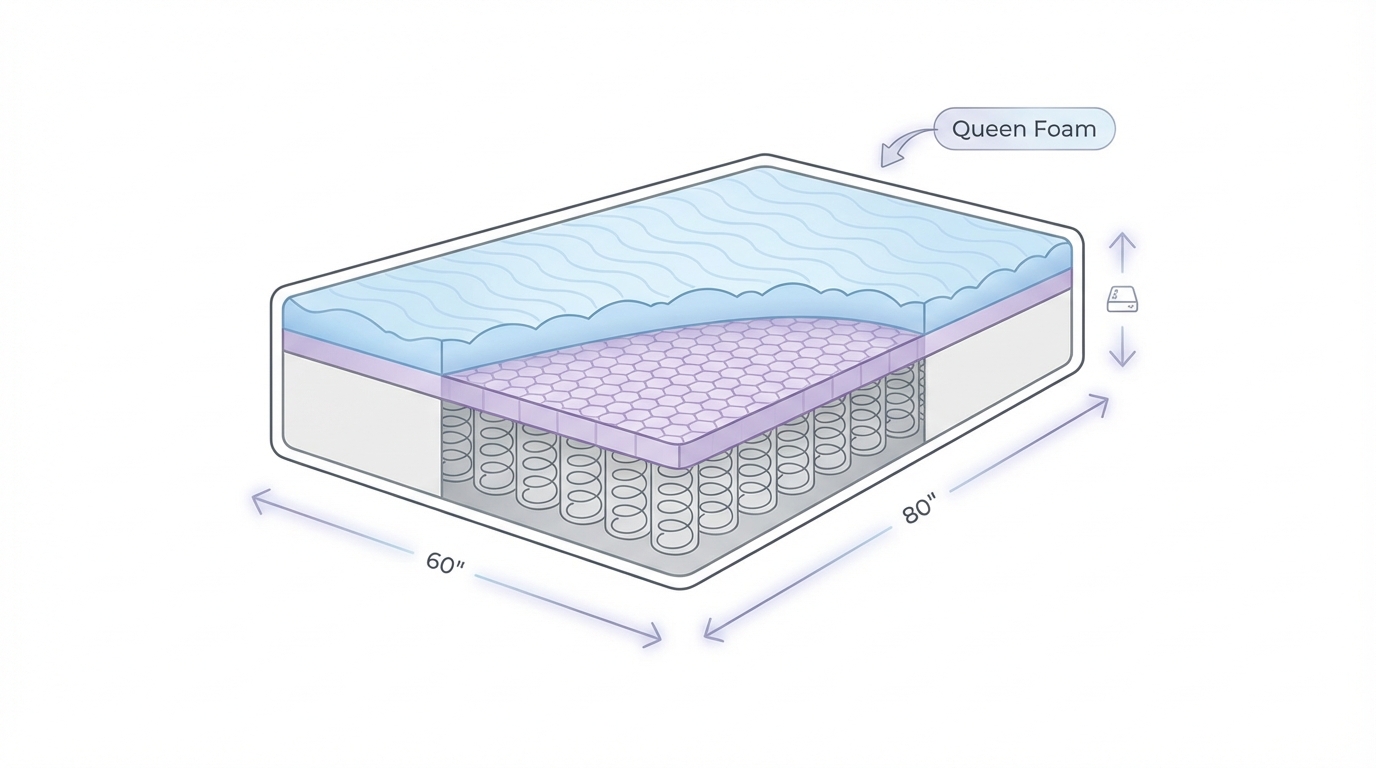
So far we have talked about width and length, the core dimensions of a queen mattress. The third dimension, height or thickness, matters just as much for comfort, accessibility, and how your bed works with your frame and bedding. The wrong combination can make your bed feel too high, too low, or unstable, even if the length and width are perfect.
Typical Queen Mattress Heights
Modern queen mattresses come in a wide range of thicknesses, often from about 8 inches on the thinner side up to 16 inches or more for plush pillow tops and advanced hybrids. According to overviews from Sleep Foundation and similar organizations, many adults are most comfortable with a total bed height around 24 to 26 inches from floor to the top of the mattress. That range makes it easier to sit on the edge of the bed with feet flat on the floor, which supports your knees and hips when getting up.
Your total bed height is the sum of your frame height, any foundation or box spring height, and your mattress thickness. For example, if you have a 12 inch tall standard metal frame plus a 9 inch foundation and a 14 inch mattress, your total height jumps to 35 inches. That might feel like climbing onto a barstool for some people, especially if they are shorter or have mobility issues. On the other hand, pairing a low platform frame of 6 inches with a 10 inch mattress creates a 16 inch total height, which can be too low for comfort.
This is where matching your queen mattress to the right base is crucial. Thicker euro pillow top designs, such as the Sealy Posturepedic Pro Soft Mattress – Dupont II Euro Pillow Top, often work beautifully on low profile platforms or adjustable bases with minimal added height. Medium profile mattresses around 12 to 13 inches give you more flexibility, pairing well with both standard frames and lower foundations.
Frame Types And Support Requirements
Innerspring, memory foam, and hybrid queen mattresses all have slightly different support needs, but they share one non negotiable requirement: a stable, appropriately spaced foundation. The American Academy of Sleep Medicine and many manufacturer warranties emphasize that sagging or damage from poor support can shorten mattress life and compromise spinal alignment.
For a queen mattress, that usually means:
- A platform frame with slats spaced about 3 inches apart or less, plus a center support beam.
- A solid foundation or box spring designed to match the mattress brand’s specifications.
- An adjustable base that supports the mattress evenly and has a compatible weight capacity for two sleepers.
Avoid placing a queen mattress directly on widely spaced wooden slats or on the floor long term. Besides voiding some warranties, this can trap heat and moisture and may lead to premature soft spots. If you are upgrading from a smaller mattress, double check that your existing base is truly queen sized, which matches the full 60 by 80 inch dimensions.
How Height Affects Bedding Fit And Comfort
Thicker queen mattresses also impact sheet fit. Deep pocket sheets are designed to accommodate taller mattresses, but “deep” can mean different things by brand. If your queen mattress is 14 or 15 inches tall and you use a mattress protector plus a topper, you will want deep pocket sheets labeled for at least 15 to 18 inch depths to avoid constant corner pop offs.
Premium sheet sets such as the Tempur-Pedic TEMPUR Adapt Luxe Egyptian Cotton Sheet Set or the Tempur-Pedic ProPerformance Sheet Set are designed with stretch and depth that handle a wide range of modern mattress profiles. This is especially helpful on queen beds where two people may tug from opposite sides. A properly sized fitted sheet that hugs the corners makes the 60 by 80 inch surface feel stable and smooth.
Queen Size Variations And Special Cases
While “queen” almost always refers to a mattress that is 60 by 80 inches, there are a few variations and related sizes that can cause confusion. Understanding them ensures you buy bedding, frames, and accessories that truly match what you own or plan to buy.
Standard Queen vs Olympic Queen vs Split Queen
The standard queen at 60 by 80 inches is by far the most common size in the United States. It is the size you will see on nearly all mainstream mattresses, frames, and sheet sets. When people simply say “queen,” they mean this standard.
An Olympic queen is a specialty size that is typically 66 inches wide by 80 inches long. It is 6 inches wider than a standard queen but the same length. These are less common and are often used in RVs or specific furniture sets. If you own an Olympic queen, you must buy bedding specifically labeled for that size. Standard queen sheets will be too tight, and king sheets will be too loose.
A split queen is another variation where the mattress is divided into two pieces side by side, each usually 30 inches wide by 80 inches long. Split queens are intended for adjustable bases where each partner controls their own side. They still occupy a 60 by 80 inch footprint, but you will use specialized sheets or strap systems to keep the two halves aligned. Most Sleepology shoppers choose a standard one piece queen unless they know they want independent adjustability.
Handling Manufacturing Tolerances And Brand Differences
Even within the standard queen category, you may notice slight measurement differences between brands. Some mattresses with very dense foam cores or thick edge support may run half an inch narrower or shorter than others, while still being sold as 60 by 80 queens. Industry guidelines typically allow a tolerance of about 1 inch either way without affecting fit or function.
For most buyers, the practical takeaway is straightforward. If you are pairing a new queen mattress with an existing queen frame, it will almost always fit. If you are ordering custom furniture to surround the mattress, wait until your actual mattress is delivered and measure it before finalizing cabinetry or built ins. When buying sheets or mattress protectors, choose sizes labeled for queen with some stretch or deep pockets to accommodate brand variation.
If you add a topper, such as a plush memory foam layer for pressure relief, remember that it changes the effective height but not the 60 by 80 inch length and width. A product like the Tempur-Pedic Mattress Topper – Pillow Travel and Guest Bundle can add comfort, but it will not turn a queen into a king in terms of space. Sleep research consistently shows that surface feel affects comfort and pressure points, while size affects movement and contact with your partner.
Queen vs Other Popular Sizes: At A Glance Comparison
When you are getting close to a decision, a simple side by side comparison can crystallize which size fits best for your household. Here is a concise table that compares standard queen to a few other common mattress sizes.
| Mattress Size | Dimensions (W x L) | Best For | Typical Minimum Room Size |
|---|---|---|---|
| Full | 54" x 75" | Single adults in smaller rooms, older kids or teens | 9' x 9' |
| Queen | 60" x 80" | Most couples, single adults who want extra space | 10' x 10' |
| King | 76" x 80" | Couples who want maximum width, families co sleeping with young kids | 12' x 12' |
| California King | 72" x 84" | Taller couples, sleepers over 6'4" who need extra legroom | 12' x 12' |
These room size suggestions align with guidance from mattress industry resources and sleep health organizations, which emphasize not only mattress fit but also movement space, storage, and overall sleep environment quality. When in doubt between two sizes, a common rule from sleep experts is to choose the larger size if your room and budget comfortably allow it, since people rarely regret having more sleep surface.
Matching Your Queen Mattress To Your Body And Sleep Style
Even when you are sure queen is the right size, the mattress itself still needs to work for your body, favorite positions, and any pain issues you carry into bed. Health organizations like Mayo Clinic often emphasize that spinal alignment and pressure relief are just as important as size when it comes to reducing back pain and improving sleep continuity.
Back, Side, And Stomach Sleepers On A Queen
Back sleepers usually do well on queen mattresses that keep the lumbar region supported and avoid letting the hips sink too deeply. Since queen gives you enough width to keep your arms comfortably at your sides, you can focus more on choosing the right firmness. Collections like The Best Mattresses For Back Sleepers at Sleepology are curated around this alignment, so if you know queen is your size, you can shop within that filter to hone in on models that suit your spine.
Side sleepers tend to take up more horizontal space, especially if they bend their knees and extend arms forward. On a queen, most side sleepers have enough room to stay in this position without falling toward the edge, but it highlights why that 60 inch width matters. Softer to medium mattresses that cushion shoulders and hips, such as the Sealy Posturepedic Medium Mattress – Medina II Euro Pillow Top, can make the queen surface feel more forgiving at common pressure points.
Stomach sleepers generally need a slightly firmer surface to keep the hips from dipping and straining the lower back. They often spread out more, which can make a queen feel a bit tight if shared with a partner. If one of you is a dedicated stomach sleeper and the other is a side sleeper, queen can still work, but you may want to explore firmer options in collections like The Best Mattresses For Stomach Sleepers to find a compromise that supports both of you.
Body Size, Weight Distribution, And Edge Use
Your height and weight also affect how a queen mattress feels. Heavier individuals compress the comfort layers more deeply, which can make the usable surface feel slightly smaller, especially if edge support is weak. Many higher quality queen mattresses now include reinforced perimeters so you can sit or sleep closer to the side without feeling like you might roll off.
If one partner is significantly taller or broader than the other, queen size is often still workable, but your mattress choice becomes more important. Look for robust coil systems or high density foam cores that distribute weight evenly. Research shared by mattress associations suggests that better weight distribution can slow sagging over time and help each partner feel less disturbed by the other’s movement.
Accessories can further personalize comfort on a standard 60 by 80 inch surface. For example, a full body pillow like The BodyPillow by Tempur-Pedic can help a side sleeper maintain alignment without needing extra mattress width, which makes queen feel more supportive for them even if their partner prefers to stay centered.
Setting Up Your Queen Mattress For Healthy, Comfortable Sleep

Once you know queen is your size and you have chosen the right construction, there are a few final setup details that help you get the kind of restorative sleep that sleep specialists and researchers talk about.
Positioning Your Queen For Light, Noise, And Temperature
According to organizations like the American Academy of Sleep Medicine, a dark, quiet, and cool environment supports deeper sleep stages. Where you place your queen mattress in the room can either help or fight these conditions. Whenever possible, avoid putting the head of your bed directly against a window where outdoor light and drafts can disturb you. If you must, consider blackout curtains and weather stripping to minimize disruption.
Similarly, think about proximity to doors, vents, and electronics. A queen bed centered away from noisy corridors, with pathways that do not require stepping around furniture or cords, helps your nervous system feel safer and less on guard. All of this may sound far removed from the simple question of mattress dimensions, but in reality, a size that fits your room well gives you more options to create a healthy layout.
Protecting Your Queen Mattress And Bedding Investment
A queen mattress is a meaningful investment, not only in dollars but in your nightly wellbeing. Mattress hygiene research suggests that using a breathable, waterproof protector can significantly reduce allergen buildup and extend usable life. When shopping for protectors and sheets, always match the size to “queen” and check depth for your specific mattress height.
If you want to fine tune firmness or add cooling without changing size, a high quality topper or pad can help. Just remember that these layers sit within the same 60 by 80 inch footprint. They do not adjust how much personal space each sleeper has, but they can make that space more comfortable for sensitive joints, hot sleepers, or people recovering from injury.
Regularly rotating your queen mattress, following brand recommendations, also helps maintain even wear. Some models are designed to be rotated head to foot a few times a year. Over the 7 to 10 year lifespan that many experts, including the Sleep Foundation, cite for quality mattresses, these habits can keep your queen feeling more like it did in the first months.
Conclusion: Is A Queen Size Mattress Right For You?
When you strip away the marketing language, a queen size mattress is simply a 60 by 80 inch sleeping surface that has become popular because it hits a rare sweet spot. It is wide enough for most couples, long enough for most adults, and compact enough to fit comfortably in the average bedroom. That balance is why so many sleep experts, retailers, and real world sleepers treat queen as the default starting point for adult mattress shopping in .
The key is making sure those dimensions match your specific life. Your height, build, and sleep positions, your partner’s habits, whether pets or kids join you at night, and the layout of your bedroom all influence whether queen feels cozy, cramped, or just right. Once you have measured your space, considered your personal width and length needs, and thought about furniture and movement paths, the right choice tends to become surprisingly clear.
If queen is that right choice for you, the next step is choosing a mattress that supports how you sleep, not just where. Whether you gravitate toward a pressure relieving euro pillow top, a responsive hybrid, or a firmer surface for back and stomach sleeping, Sleepology’s curated selection of queen sized mattresses and accessories is designed to make the final stretch of your decision as confident as the size choice you have just made. You deserve a bed that fits your room, your body, and your life, and a queen mattress, set up thoughtfully, can absolutely deliver that.
Frequently Asked Questions
How big is a queen size mattress in feet and inches?
A standard queen size mattress measures 60 inches wide by 80 inches long. In feet, that is 5 feet across and 6 feet 8 inches from head to toe. These measurements refer to the mattress itself, not the bed frame, which may add a few inches in each direction depending on the design.
Is a queen mattress big enough for two adults?
For most couples, a queen mattress provides enough space to sleep comfortably, especially if both partners are of average build and do not sprawl dramatically. Each person gets about 30 inches of width, which is similar to a crib mattress per person. If one or both partners are larger, very restless, or you regularly co sleep with a child or pet, you might find a king more comfortable, but queen is considered a practical minimum for two adults.
What size room do I need for a queen bed?
A queen mattress works best in rooms that are at least 10 by 10 feet. That gives you room for the 60 by 80 inch mattress, a typical frame, nightstands, and roughly 24 inches of walking space on each accessible side. In a slightly smaller room, such as 9 by 10 feet, you can still fit a queen, but you may need to get creative with furniture scale and placement to keep the space from feeling cramped.
Will a queen mattress fit on a full size bed frame?
No, a standard queen mattress will not fit properly on a full size frame. A full mattress is 54 inches wide and 75 inches long, while a queen is 60 by 80. The queen is both wider and longer, so it will overhang a full frame, which can be unsafe and will not provide adequate support. Always pair a queen mattress with a frame or foundation designed for queen dimensions.
What is the difference between a queen and an Olympic queen?
A standard queen mattress measures 60 by 80 inches, while an Olympic queen is typically 66 by 80 inches. An Olympic queen gives you 6 more inches of width but the same length and is less common in stores. If you own or are considering an Olympic queen, you will need frames and bedding specifically labeled for that size, since standard queen accessories will not fit correctly.
Do queen mattresses come in different thicknesses?
Yes, queen mattresses come in a wide range of thicknesses, often from about 8 inches to 16 inches or more. Thickness does not change the 60 by 80 inch footprint, but it affects how high the bed sits, how supportive or plush it feels, and what depth of sheets you need. When choosing a queen mattress, consider your frame height and mobility needs so your total bed height lands in a comfortable range, usually around 24 to 26 inches from floor to top.
Can a mattress topper make a queen bed feel bigger?
A mattress topper can change how a queen bed feels, but it cannot make it physically larger. Toppers add comfort, pressure relief, or cooling on top of the existing 60 by 80 inch surface. If you feel cramped because you or your partner need more personal space, a topper alone will not solve that issue. In that situation, you would need to move to a larger size, such as a king, if your room and budget allow.