

Have you ever wondered why some mattresses feel like they're launching you into orbit with every movement, while others seem to absorb motion like a black hole? When it comes to choosing between a memory foam mattress and an innerspring mattress, the bounce factor might be more important than you think. This isn't just about fun and games—the way your mattress responds to movement affects everything from how easily you can change sleeping positions to whether your partner's midnight bathroom trip disturbs your sleep. I've spent years helping customers at Sleepology Mattress Shop understand the real-world differences between these two popular mattress types, and I can tell you that the memory foam vs innerspring debate goes far beyond simple preference. The bounce test reveals fundamental differences in how these mattresses support your body, handle temperature, and hold up over time. Whether you're a restless sleeper who tosses and turns throughout the night, a couple trying to minimize motion transfer, or someone dealing with back pain who needs just the right combination of support and comfort, understanding how innerspring mattress benefits stack up against memory foam mattress pros can transform your sleep quality. In this comprehensive mattress comparison, I'm going to walk you through everything you need to know about mattress durability, mattress firmness comparison, and how to determine which is the best mattress for bounce based on your unique sleeping style and needs. By the time you finish reading, you'll have a clear understanding of which mattress type will help you sleep better and wake up feeling refreshed.
Key Takeaways
- Innerspring mattresses offer more bounce and responsiveness compared to memory foam options
- Memory foam excels at motion isolation while innerspring provides better airflow and cooling
- Mattress durability varies significantly between innerspring and memory foam constructions
- Your sleeping position and body weight should guide your choice between these mattress types
- Testing both mattress types in person helps you make the most informed decision
Unleashing the Essentials: Innerspring vs Memory Foam Mattresses
When you're standing in a mattress store or browsing online, the choice between an innerspring mattress and a memory foam mattress can feel overwhelming. I get asked about this mattress comparison almost daily at Sleepology Mattress Shop, and I understand why it's such a common question. These two mattress types represent fundamentally different approaches to sleep support, each with distinct advantages that appeal to different types of sleepers.
The innerspring mattress has been around for over a century, and for good reason. This traditional mattress type uses a system of metal coils or springs as its primary support structure, topped with various comfort layers. The springs compress and rebound as you move, creating that characteristic bounce that many people associate with a "real" mattress. Modern innerspring designs have come a long way from the squeaky beds of decades past, now incorporating advanced coil systems that provide targeted support and reduced motion transfer.
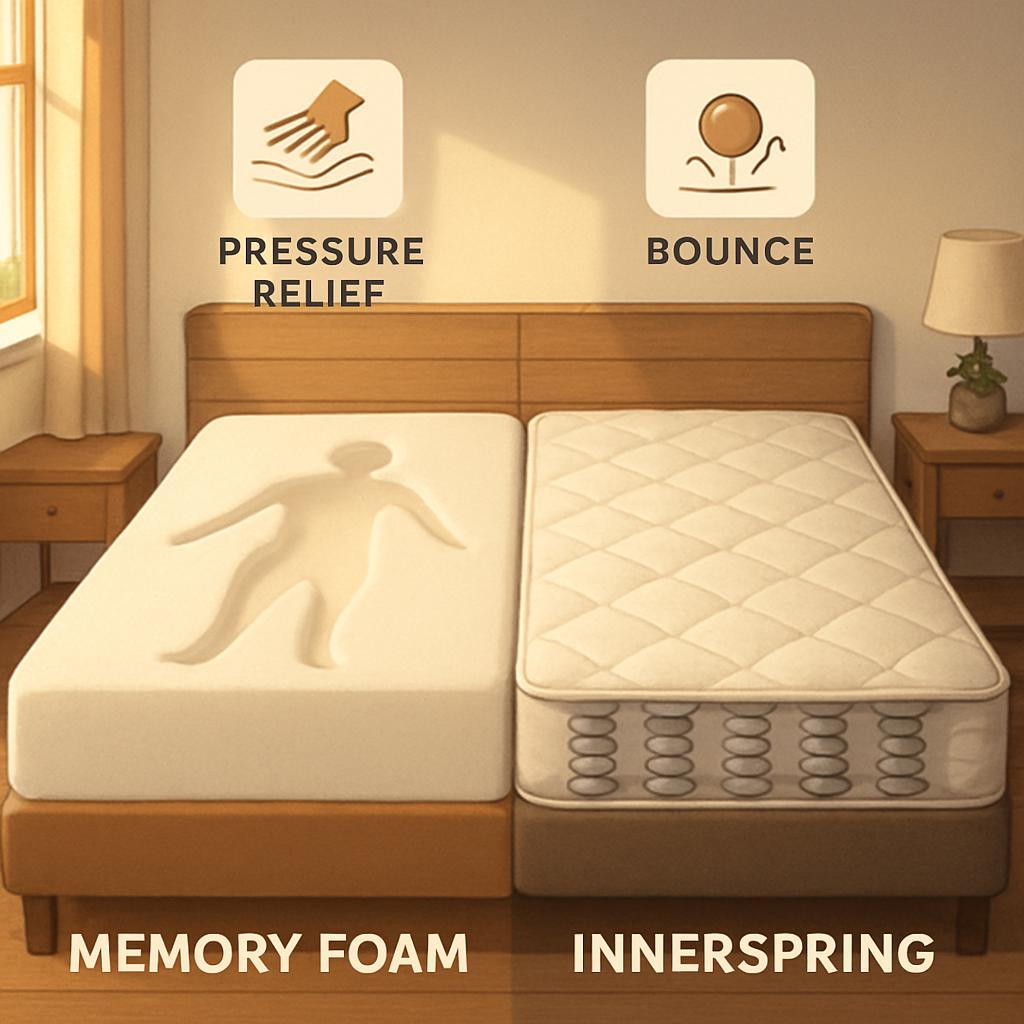
Memory foam mattresses, on the other hand, represent a more recent innovation in sleep technology. Originally developed by NASA in the 1960s, memory foam didn't make its way into consumer mattresses until the 1990s. This material responds to heat and pressure, molding to your body's unique contours and creating a cradling sensation that many sleepers find incredibly comfortable. When you press into memory foam and release, it slowly returns to its original shape—a stark contrast to the immediate bounce-back of innerspring coils.
The memory foam vs innerspring decision ultimately comes down to how these different constructions affect your sleep experience. At Sleepology Mattress Shop, we carry both types because we know that what works perfectly for one person might not suit another. Some of our customers prefer the traditional feel and responsiveness of an innerspring mattress like the Sealy Spring Bloom Medium, while others find the conforming support of memory foam options to be their ideal sleep solution.
The mattress bounce test is one practical way to understand these differences. When you sit on the edge of an innerspring mattress and push down, you'll feel immediate resistance and a quick return to the original position. Do the same thing on a memory foam mattress, and you'll notice your hand sinks slowly into the material and takes several seconds to recover its shape once you remove the pressure. This simple test reveals fundamental differences in how these mattresses will respond to your body throughout the night.
Understanding mattress durability is another critical factor in this comparison. Both innerspring and memory foam mattresses can last for years with proper care, but they age differently. Innerspring mattresses may develop sagging in heavily used areas as coils weaken over time, while memory foam can lose some of its responsiveness and develop body impressions. The quality of materials and construction plays a huge role in how long either type will maintain its supportive properties.
Understanding Innerspring Mattresses: Key Features and Benefits
Innerspring mattresses remain incredibly popular for several compelling reasons, and understanding their construction helps explain why so many people still choose them. The innerspring mattress benefits extend beyond simple familiarity—these mattresses offer genuine advantages that make them the right choice for many sleepers.
At the heart of every innerspring mattress is its coil system. These metal springs form the foundation that provides support and determines many of the mattress's characteristics. The coils compress when you lie down, distributing your body weight across the mattress surface. What makes modern innerspring mattresses so effective is the engineering that goes into these coil systems. Manufacturers have developed various coil types and arrangements to address different sleep needs and preferences.
The comfort layers sitting on top of the coil system also play a crucial role in how an innerspring mattress feels. These layers might include foam, fiber padding, cotton, wool, or other materials designed to provide cushioning and temperature regulation. The combination of supportive coils below and comfortable layers above creates the overall sleep experience. Some innerspring mattresses have plush pillowtop constructions, while others feature firmer surfaces—all built on the same basic principle of coil support.
One of the biggest innerspring mattress benefits is breathability. The open structure of coil systems allows air to circulate freely through the mattress, helping to regulate temperature throughout the night. If you tend to sleep hot, this airflow can make a significant difference in your comfort level. The space between coils acts like a natural ventilation system, preventing heat from building up the way it sometimes can in solid foam constructions.
Here are the key features that make innerspring mattresses stand out:
- Responsive support that adjusts instantly to movement. When you shift positions during the night, innerspring coils respond immediately, making it easier to move around and find comfortable sleeping positions.
- Strong edge support for sitting and sleeping near the mattress perimeter. The coil structure extends to the edges, providing a stable surface that doesn't collapse when you sit on the side of the bed or sleep close to the edge.
- Natural cooling properties from air circulation through the coil system. This makes innerspring mattresses particularly appealing to hot sleepers who want a cooler sleep surface.
- Familiar bounce that many people prefer for ease of movement. The springy feel makes activities like getting in and out of bed, changing positions, or intimate moments more comfortable for many couples.
- Generally more affordable than premium memory foam options. Quality innerspring mattresses often cost less than comparable memory foam models, making them accessible to more budget-conscious shoppers.
The mattress firmness comparison between different innerspring models shows impressive variety. You can find innerspring mattresses ranging from ultra-firm to plush soft, all using the same basic coil technology but with different comfort layer configurations. This versatility means you're not locked into one firmness level just because you choose innerspring construction.
What Makes Innerspring Unique?
The unique characteristics of innerspring mattresses stem from their fundamental design principle: using mechanical support rather than material density to hold up your body. This approach creates a sleep experience that's distinctly different from memory foam or other mattress types, with specific advantages that appeal to certain sleepers.
Responsiveness is perhaps the most defining feature of innerspring construction. When you move on an innerspring mattress, the coils compress and expand in real-time, providing support exactly where and when you need it. This instantaneous response makes changing sleeping positions effortless. If you're someone who moves around a lot during sleep, you'll appreciate how an innerspring mattress works with your movements rather than resisting them. The best mattress for bounce is almost always going to be an innerspring model because of this inherent spring action.
The variety within the innerspring category deserves attention because not all coil systems are created equal. Bonnell coils, the oldest and most traditional type, have an hourglass shape and are interconnected throughout the mattress. They're affordable and durable but can transfer motion between sleepers. Continuous coils use a single wire formed into multiple coils, creating a very stable and supportive structure. Offset coils have a squared-off design that allows them to hinge more easily, conforming better to body contours while maintaining strong support.
Pocketed coils, also called individually wrapped coils or Marshall coils, represent the most advanced innerspring technology. Each coil sits in its own fabric pocket and moves independently from its neighbors. This design dramatically reduces motion transfer—a traditional weakness of innerspring mattresses—while maintaining the responsiveness and bounce that makes innerspring construction appealing. Many of the premium innerspring and hybrid mattresses I show customers at Sleepology use pocketed coil systems for this reason.
"I was skeptical about going back to an innerspring mattress after trying memory foam, but the difference in temperature was immediately noticeable. I sleep so much cooler now, and I don't feel stuck in the mattress when I need to change positions. The support is excellent, and my back pain has actually improved."
Temperature regulation sets innerspring mattresses apart in the mattress comparison conversation. The coil structure creates natural airflow channels throughout the mattress interior. As you shift positions during the night, this movement actually pumps air through the mattress, carrying away body heat. This passive cooling system works without any special materials or technologies—it's simply a byproduct of the open coil structure. For hot sleepers, this can be a game-changing feature that makes the difference between restless, sweaty nights and comfortable, cool sleep.
The durability of innerspring mattresses depends heavily on the quality of the coil system and the gauge (thickness) of the wire used. Heavier-gauge steel creates more durable coils that resist sagging and maintain their support longer. The number of coils also matters—more coils generally means better support and longer mattress life, though the quality of the coils matters more than sheer quantity. A well-made innerspring mattress with quality coils can easily last 8-10 years or more with proper care.
Support distribution in innerspring mattresses works differently than in memory foam. Rather than conforming closely to every curve of your body, innerspring mattresses provide support through pushback—the coils resist compression, holding your body in a more neutral alignment. For back and stomach sleepers who need to keep their spine aligned without sinking too deeply into the mattress, this type of support often works exceptionally well. The firmer, more uniform support surface prevents the kind of excessive sinking that can lead to back pain for some sleepers.

The Varieties of Innerspring Options
When you're shopping for an innerspring mattress, you'll quickly realize that not all coil systems are created equal. The world of innerspring mattresses offers a surprising range of construction types, each designed to deliver different levels of support, bounce, and durability. Understanding these variations is essential when conducting your mattress comparison and can make all the difference in finding the best mattress for bounce that suits your sleeping style.
The most traditional option is the Bonnell coil system, which has been around for more than a century. These hourglass-shaped coils are interconnected, creating a bouncy, responsive sleep surface. While Bonnell coils are typically found in more budget-friendly mattresses, they still provide reliable support and that classic innerspring feel. However, because the coils are connected, you may experience more motion transfer when your partner moves during the night.
Next up are offset coils, which represent a step up in sophistication. These coils feature a hinged design that allows them to conform more closely to your body while still maintaining the supportive feel of traditional innerspring construction. The offset design creates a firmer sleeping surface around the edges, which improves mattress durability and reduces the feeling of roll-off when you sleep near the perimeter of the bed.
Continuous coils take a different approach entirely. Rather than individual coils, this system uses a single wire formed into multiple coils in a row. This creates a very stable, durable support system that many sleepers find exceptionally supportive. The continuous coil design is known for its firmness and longevity, making it a popular choice for those who prefer a more substantial feel from their innerspring mattress.
The most advanced innerspring option is the pocketed coil system, also known as Marshall coils or encased coils. In this design, each coil is individually wrapped in fabric and operates independently from its neighbors. This is a game-changer for motion isolation, as movement in one area of the mattress doesn't transfer to other areas. Pocketed coil systems also excel at contouring to your body while maintaining the responsive bounce that innerspring mattresses are famous for. Many modern hybrid mattresses, like the Sealy High Point Firm Hybrid Mattress, combine pocketed coils with comfort layers to deliver the best of both worlds.
When it comes to mattress firmness comparison, innerspring mattresses come in a wide spectrum from ultra-firm to plush soft. The number of coils, their gauge (thickness), and the comfort layers on top all contribute to the overall feel. A higher coil count generally means better support and durability, though the quality of the coils matters just as much as the quantity. Coil gauge also plays a role—lower gauge numbers indicate thicker, firmer coils, while higher gauge numbers mean thinner, softer coils.
Beyond the coil system itself, many innerspring mattresses feature additional comfort layers that enhance the sleeping experience. Euro tops, pillow tops, and cushion firm designs add varying degrees of plushness while maintaining the supportive bounce of the innerspring core. These comfort layers can include materials like cotton, wool, foam, or gel-infused foam, each contributing different benefits to temperature regulation and pressure relief.
The innerspring mattress benefits extend beyond just bounce and support. These mattresses typically offer superior breathability compared to all-foam options, as air can circulate freely through the coil system. This makes innerspring mattresses particularly appealing for hot sleepers who struggle with heat retention. The responsive nature of innerspring mattresses also makes them easier to move around on, which is helpful when changing sleeping positions throughout the night or getting in and out of bed.
When considering the memory foam vs innerspring debate, it's worth noting that innerspring options generally provide more edge support, allowing you to use the full surface of the mattress without feeling like you might roll off. This is especially important for couples who need to maximize their sleeping space or for anyone who likes to sit on the edge of the bed.
Memory Foam Mattresses: Pros and Cons Uncovered
Memory foam mattresses have revolutionized the sleep industry since their introduction to the consumer market in the 1990s. Originally developed by NASA to improve cushioning in aircraft seats, memory foam technology has evolved into one of the most popular mattress materials available today. But like any sleep solution, memory foam comes with both advantages and drawbacks that deserve careful consideration during your mattress comparison process.
The defining characteristic of a memory foam mattress is its viscoelastic properties—the material responds to heat and pressure by conforming closely to your body's unique shape. This creates a cradling sensation that many sleepers find incredibly comfortable. However, this same characteristic can feel restrictive to others who prefer a more responsive, bouncy sleep surface. Understanding both sides of the memory foam equation will help you determine whether this mattress type aligns with your sleep preferences.
| Pros | Cons |
|---|---|
| Excellent pressure point relief for shoulders and hips | Can retain heat, especially in traditional memory foam |
| Superior motion isolation for undisturbed sleep | Lacks the bounce that some sleepers prefer |
| Conforms to body shape for personalized support | May feel too soft or "stuck" for combination sleepers |
| Hypoallergenic and resistant to dust mites | Initial off-gassing odor when new |
| Minimal noise compared to innerspring mattresses | Difficult to move around on or change positions |
| Works well with adjustable bases | May not provide enough support for heavier sleepers |
One of the most significant memory foam mattress pros is its ability to distribute weight evenly across the sleep surface. This reduces pressure on specific points like your shoulders, hips, and lower back, which can be particularly beneficial for side sleepers and those with joint pain or arthritis. The material's responsive nature means it adjusts continuously throughout the night as you move, maintaining optimal support regardless of your sleeping position.
On the flip side, the contouring nature of memory foam can work against certain sleepers. Stomach sleepers, in particular, may find that their hips sink too deeply into the mattress, creating an uncomfortable arch in the lower back. Combination sleepers who change positions frequently might feel restricted by the slow response time of traditional memory foam, which can make repositioning feel more effortful than it would on a more responsive surface.
Heat retention has historically been one of the biggest complaints about memory foam mattresses. The dense cellular structure that makes memory foam so comfortable can also trap body heat, leading to an uncomfortably warm sleep experience. However, mattress manufacturers have made significant strides in addressing this issue through gel infusions, open-cell foam structures, and phase-change materials designed to regulate temperature more effectively.
When conducting your mattress bounce test, memory foam will perform very differently from an innerspring mattress. While innerspring mattresses spring back quickly and have that classic bouncy feel, memory foam absorbs movement and responds slowly. This is excellent for motion isolation—you won't feel your partner tossing and turning—but it fails the traditional bounce test that some couples consider important for bedroom activities beyond sleep.
From a durability standpoint, high-quality memory foam mattresses can last between seven to ten years, which is comparable to innerspring options. However, mattress durability in memory foam depends heavily on the density of the foam. Higher-density foams (5 pounds per cubic foot or higher) maintain their supportive properties longer than lower-density options, though they also tend to cost more upfront.
The mattress firmness comparison between different memory foam models reveals a wide range of options. Memory foam mattresses come in soft, medium, medium-firm, and firm variations, allowing you to find the right level of support for your body type and sleep preferences. However, it's important to note that memory foam firmness can feel different from innerspring firmness due to the way the material conforms to your body.
Exploring the Advantages of Memory Foam Mattresses
The benefits of choosing a memory foam mattress extend far beyond the initial comfort you feel when lying down. These advantages touch on everything from sleep quality and pain management to practical considerations like allergen resistance and longevity. Let me walk you through the key memory foam mattress pros that make this sleep surface such a popular choice for millions of sleepers.
First and foremost, memory foam excels at pressure relief. When you lie on a memory foam mattress, the material softens in response to your body heat and molds to your exact shape. This distributes your weight across a larger surface area, reducing pressure points that can cause discomfort and interrupt sleep. For people who wake up with sore shoulders, aching hips, or a stiff back, this pressure-relieving quality can be genuinely life-changing. The material essentially eliminates the hard spots that traditional mattresses create where your body's heaviest parts press down.
Motion isolation is another area where memory foam truly shines. If you share your bed with a partner, you know how disruptive it can be when they get up in the middle of the night or toss and turn. Memory foam absorbs movement rather than transferring it across the sleep surface, which means you're far less likely to be disturbed by your partner's movements. This makes memory foam an excellent choice for light sleepers or couples with different sleep schedules.
"I was skeptical about switching from my old innerspring to memory foam, but it's been amazing for my back pain. I wake up feeling so much better, and I don't feel my husband moving around at night anymore. Best sleep investment we've made!" – Review from November 3, 2024
The hypoallergenic properties of memory foam shouldn't be overlooked, especially if you suffer from allergies or asthma. The dense structure of memory foam creates an inhospitable environment for dust mites, mold, and other common allergens that thrive in traditional mattresses. While you should still use a mattress protector for optimal cleanliness, memory foam itself resists allergen accumulation better than most other mattress materials.
Another practical advantage is the silent nature of memory foam. Unlike innerspring mattresses, which can develop squeaks and creaks over time as the coils age, memory foam remains completely quiet throughout its lifespan. There are no moving parts to wear out or create noise when you shift positions during the night. This silence can significantly improve sleep quality, particularly for those who are sensitive to sound.
Memory foam's adaptability makes it an ideal match for adjustable bases, which are becoming increasingly popular for their ability to elevate your head or feet for improved comfort. The flexible nature of memory foam allows it to bend and conform to different base positions without damaging the material or compromising support. If you like to read or watch television in bed, or if you have circulation issues that benefit from leg elevation, a memory foam mattress on an adjustable base can be an excellent combination.
The material's ability to maintain spinal alignment is particularly noteworthy in the memory foam vs innerspring discussion. When your body sinks into memory foam, heavier areas like your hips sink deeper while lighter areas like your waist receive proportionally less give. This creates a more natural spinal curve than you might achieve on a firmer, less conforming surface. Proper spinal alignment during sleep can reduce back pain and help you wake up feeling more refreshed.
Memory foam also offers impressive longevity when you invest in quality construction. High-density memory foam resists body impressions and sagging better than lower-quality foams, maintaining its supportive properties for years. While the initial investment might be higher than some innerspring options, the long-term value can be excellent when you factor in the mattress durability and consistent performance over time.
For those who sleep alone, memory foam's contouring properties provide customized support that responds to your unique body shape and sleeping position. The material doesn't push back against you the way a firmer surface might, instead cradling your body in a way that many sleepers describe as "sleeping on a cloud." This gentle support can be particularly beneficial for side sleepers who need extra cushioning for their shoulders and hips.
The Comfort Factor
Comfort is deeply personal, and what feels like heaven to one sleeper might feel completely wrong to another. When evaluating the comfort factor in the memory foam vs innerspring debate, you need to consider not just how the mattress feels when you first lie down, but how it supports you throughout an entire night's sleep and how that support translates to how you feel the next morning.
Memory foam mattresses deliver comfort through conforming support. The material responds to your body heat and weight, creating a custom sleep surface that hugs your curves and supports your natural alignment. This creates what many people describe as a "cocooning" sensation—you feel embraced by the mattress rather than simply lying on top of it. For individuals with chronic pain, arthritis, or fibromyalgia, this gentle, pressure-relieving comfort can make the difference between a restful night and hours of tossing and turning.
The comfort experience varies significantly based on the firmness level you choose. A soft memory foam mattress will allow more sinkage and create that deeply cushioned feeling, while a firm memory foam option provides more resistance while still conforming to your body's shape. The Sealy Lacey Soft Gel Foam Mattress exemplifies how modern memory foam can provide plush comfort while incorporating cooling gel technology to address temperature concerns.
Your sleeping position plays a huge role in determining which mattress type will feel most comfortable. Side sleepers often find memory foam particularly comfortable because the material cushions the shoulders and hips—the pressure points that bear the most weight in this position. The mattress allows these areas to sink in slightly while supporting the waist, maintaining proper spinal alignment without creating uncomfortable pressure.
Back sleepers have more flexibility when it comes to memory foam comfort. A medium to medium-firm memory foam mattress typically works well for this sleeping position, providing enough contouring to support the natural curve of the lower back while keeping the spine properly aligned. The key is finding a balance where your hips don't sink too deeply but still receive adequate cushioning.
Stomach sleepers face the biggest challenge with memory foam comfort. Because this sleeping position requires a firmer surface to prevent the hips from sinking too deeply and creating lower back strain, many stomach sleepers find that only the firmest memory foam options work for them. Some may ultimately find that an innerspring mattress or hybrid model better suits their needs.
Temperature comfort is another crucial aspect that affects overall sleep satisfaction. Traditional memory foam has a reputation for sleeping hot because its dense structure can trap body heat. This warmth might feel cozy in winter but uncomfortable during summer months. Modern memory foam formulations have made significant improvements through various cooling technologies. Gel-infused memory foam, plant-based memory foam, and open-cell structures all help dissipate heat more effectively than traditional memory foam.
The initial comfort you feel when testing a memory foam mattress in a store can be misleading. Memory foam needs time to respond to your body heat and weight—it might feel firm initially but soften as you lie on it for several minutes. This is why the in-store mattress bounce test doesn't always tell the full story with memory foam. You need to spend at least 10-15 minutes lying in your typical sleeping position to get an accurate sense of how the mattress will feel throughout the night.
Comfort also relates to how easy it is to move around on the mattress. Memory foam's slow response time means that when you want to change positions, you have to work slightly harder than you would on a more responsive surface. Some sleepers never notice this, while others find it frustrating. Combination sleepers who frequently switch between sleeping on their side, back, and stomach may prefer a more responsive surface that makes repositioning effortless.
Edge support affects comfort in practical ways that aren't always obvious until you've lived with a mattress for a while. Memory foam mattresses typically have softer edges than innerspring models, which can make you feel less secure when sleeping near the perimeter or sitting on the edge of the bed. Some memory foam mattresses incorporate reinforced edges to address this, but it's an area where innerspring mattresses generally have the advantage.
The overall comfort factor also includes psychological elements. Some people simply prefer the feeling of sleeping "on" a mattress rather than "in" one. If you're used to the buoyant, responsive feel of an innerspring mattress, the enveloping sensation of memory foam might take some adjustment. This isn't necessarily better or worse—it's simply different, and your personal preference will guide whether this difference enhances or detracts from your comfort.
Temperature Regulation and Motion Isolation
Two of the most critical performance characteristics that influence your sleep quality are how well your mattress manages temperature and how effectively it minimizes motion transfer. Memory foam mattresses have a complicated relationship with both of these factors, excelling brilliantly in one area while historically struggling with the other. Let's break down what you need to know about temperature regulation and motion isolation in memory foam mattresses.
Motion isolation is where memory foam absolutely dominates the mattress comparison landscape. The viscoelastic properties that allow memory foam to conform to your body also enable it to absorb movement rather than transferring it across the sleep surface. When your partner gets up to use the bathroom or shifts positions, the motion stays localized to their area of the mattress. This is particularly valuable for light sleepers or couples with different sleep schedules.
- Zero partner disturbance. Memory foam's ability to isolate motion means you won't feel your partner's movements, even if they're restless throughout the night. This can dramatically improve sleep quality for couples.
- Ideal for different schedules. If one partner goes to bed earlier or wakes up earlier, the other person can continue sleeping undisturbed. The lack of motion transfer makes it easy to get in and out of bed without waking your partner.
- Perfect for pet owners. If your dog or cat shares your bed, memory foam prevents their nighttime movements from disturbing your sleep, making it easier to coexist peacefully.
- Reduces sleep disruptions. Fewer disturbances throughout the night means deeper, more restorative sleep cycles, which translates to feeling more refreshed in the morning.
Temperature regulation presents a more complex picture. Traditional memory foam has earned a reputation for sleeping hot, and this concern is well-founded. The dense cellular structure that makes memory foam so comfortable at pressure relief also restricts airflow, which can trap body heat. As your body warms the foam, it becomes softer and more conforming, but this also creates a feedback loop where you sink deeper into the material, further reducing air circulation.
However, the memory foam industry has made remarkable strides in addressing temperature concerns through innovative technologies. Gel-infused memory foam incorporates cooling gel beads throughout the foam structure, helping to draw heat away from your body and disperse it more evenly. Plant-based memory foam formulations create a more breathable cell structure than traditional petroleum-based foam, allowing for better air circulation. Open-cell memory foam features a less dense structure that permits greater airflow while maintaining the pressure-relieving properties that make memory foam popular.
Phase-change materials represent another advancement in temperature regulation. These materials are engineered to absorb, store, and release heat to maintain a more consistent temperature throughout the night. As your body temperature rises, the material absorbs the excess heat; when you cool down, it releases that stored heat back, creating a more stable thermal environment.
- Gel-infused technology helps dissipate heat. The gel beads conduct heat away from your body, creating a cooler sleep surface than traditional memory foam offers.
- Open-cell structures improve breathability. The less dense construction allows air to move through the foam more freely, reducing heat retention without sacrificing comfort.
- Copper or graphite infusions enhance cooling. These materials naturally conduct heat away from the body, helping to regulate temperature more effectively throughout the night.
- Breathable covers add another cooling layer. Many modern memory foam mattresses feature covers made from moisture-wicking, breathable materials that further enhance temperature regulation.
The interaction between temperature and comfort goes beyond just feeling hot or cool. Your body temperature naturally drops as you prepare for sleep, and maintaining a slightly cool environment helps promote deeper, more restful sleep. If your mattress retains too much heat, it can interfere with this natural process, leading to restless sleep and frequent waking. This is why temperature regulation deserves serious consideration in your mattress comparison process.
It's worth noting that personal heat sensitivity varies dramatically from person to person. Some sleepers naturally run hot and find even the most advanced cooling memory foam too warm, while others appreciate the cozy warmth that traditional memory foam provides. Your own temperature preferences and whether you tend to sleep hot or cold should heavily influence your decision in the memory foam vs innerspring debate.
The combination of excellent motion isolation and improved temperature regulation in modern memory foam mattresses makes them an increasingly appealing option for many sleepers. While innerspring mattresses naturally sleep cooler due to better airflow through the coil system, they can't match memory foam's motion isolation capabilities. If motion isolation is your top priority and you're willing to invest in quality memory foam with modern cooling technologies, you can achieve both benefits without significant compromise.
Key Differences Between Innerspring and Memory Foam Mattresses
Understanding the fundamental differences between innerspring and memory foam mattresses helps you move beyond marketing claims and make a decision based on how these mattress types actually perform in the areas that matter most for your sleep quality. While both can provide comfortable, supportive sleep, they achieve these goals through completely different mechanisms that create distinctly different sleeping experiences.
The most obvious difference lies in construction and materials. Innerspring mattresses build their foundation on metal coils that provide support through resistance and bounce. These coils compress under your weight and then push back, creating a responsive, buoyant feel. Memory foam mattresses, by contrast, use layers of viscoelastic foam that conform to your body through heat and pressure, creating support through contouring rather than resistance. This fundamental distinction in how the mattresses respond to your body creates a cascade of differences in performance characteristics.
When it comes to the mattress bounce test, innerspring mattresses clearly take the lead. The spring system provides instant responsiveness—when you press down, the mattress pushes back immediately. This bounce makes it easy to change positions during the night, get in and out of bed, and engage in activities beyond sleep. Memory foam, on the other hand, responds slowly to pressure and movement. While this slower response contributes to excellent motion isolation, it means memory foam fails the traditional bounce test. For some couples, this responsiveness difference matters significantly, while others prioritize the motion isolation that memory foam provides.
The mattress firmness comparison between these two types reveals interesting complexity. An innerspring mattress rated as "medium" will feel quite different from a memory foam mattress with the same rating. Innerspring firmness comes from the coil system's resistance, creating a more supportive, stable surface that doesn't conform as dramatically to your body shape. Memory foam firmness involves more sinkage and contouring, so even a firm memory foam mattress will cradle your body more than a firm innerspring model. This makes it essential to test mattresses in person rather than relying solely on firmness ratings.
Durability and lifespan represent another key difference in the mattress comparison. Innerspring mattresses typically last seven to ten years, with the coils eventually losing their resilience and the comfort layers compressing over time. The weak point often lies in the coil system, which can develop squeaks or sagging as the springs weaken. Memory foam mattresses have a similar lifespan when you invest in quality construction, but they age differently. High-quality, dense memory foam maintains its supportive properties longer than lower-density options. However, memory foam can develop permanent body impressions where you sleep most frequently, though this doesn't necessarily mean the mattress has lost its support.
The best mattress for bounce clearly goes to innerspring options. This category isn't just about the literal bounce you feel when sitting or lying on the mattress—it also encompasses the overall responsiveness and ease of movement. If you're an active sleeper who changes positions frequently throughout the night, or if you have mobility concerns that make it difficult to get in and out of bed, the responsive nature of an innerspring mattress offers practical advantages that memory foam can't match.
Price considerations often factor into the decision between memory foam vs innerspring. Generally, you can find good quality innerspring mattresses at lower price points than comparable memory foam models. However, the price range for both types varies enormously based on materials, construction quality, and brand reputation. Budget-friendly options exist in both categories, as do luxury models that command premium prices. When comparing prices, consider the expected mattress durability and how long each option will maintain its supportive properties.
Maintenance requirements differ between these mattress types as well. Innerspring mattresses benefit from regular rotation to ensure even wear on the coil system and comfort layers. Some innerspring models can even be flipped, though many modern designs have specific top and bottom sides. Memory foam mattresses typically should not be flipped but do benefit from rotation every few months. Memory foam requires more careful handling during moves because folding or bending it improperly can damage the foam structure.
The environmental impact and materials used in construction represent another distinction worth considering. Innerspring mattresses contain metal coils, which are recyclable, but they also include foam comfort layers, fabric, and sometimes flame retardants. Memory foam mattresses have evolved beyond their purely petroleum-based origins, with many manufacturers now offering plant-based foams and more environmentally friendly production methods. Both types can be challenging to recycle at end-of-life due to their multiple material components, though some manufacturers have developed take-back programs.
Weight and ease of handling also differ significantly. Memory foam mattresses are notably heavy due to the dense foam construction, making them difficult to move, rotate, or set up. Innerspring mattresses, while not exactly lightweight, are generally easier to maneuver because the coil structure is less dense than solid foam layers. This practical consideration matters during initial delivery and setup, as well as any time you need to move or rearrange your bedroom.
For allergy sufferers, memory foam offers advantages due to its dense structure that resists dust mites and allergen accumulation. Innerspring mattresses, with their more open construction, can potentially harbor more allergens within the coil system over time. However, using a quality mattress protector largely mitigates this concern for both mattress types, making it less of a deciding factor for most shoppers.
Comparing Mattress Durability and Lifespan
When you're investing in a new mattress, you want to know it's going to last. The mattress comparison between innerspring and memory foam mattresses reveals some interesting differences when it comes to durability and how long you can expect each type to serve you well. I've found that understanding these differences can save you money in the long run and help you make a smarter choice for your bedroom.
Innerspring mattresses have been around for decades, and their durability largely depends on the quality of the coil system inside. Traditional Bonnell coils tend to show wear faster than individually wrapped pocketed coils. You might start noticing sagging or reduced support after about five to seven years with a basic innerspring mattress. However, higher-quality innerspring mattresses, especially those with advanced coil technologies like the Sealy Albany Medium Hybrid, can last anywhere from eight to ten years or even longer with proper care.
Memory foam mattresses, on the other hand, typically offer a different durability profile. High-density memory foam can maintain its shape and support for eight to ten years on average. The key factor here is foam density—higher density foams resist body impressions better and bounce back to their original shape more effectively. Lower-density memory foam mattresses might start showing permanent indentations within just five to six years, which can affect your comfort and the support you need for healthy sleep.
The mattress durability of both types also depends heavily on how you use and care for them. Innerspring mattresses benefit from regular rotation every three to six months, which helps distribute wear evenly across the surface. They're also more forgiving if you like to sit on the edge of your bed or if kids occasionally use it as a trampoline—though I don't recommend that! The coil structure provides resilience against this kind of occasional stress.
Memory foam mattresses require a bit more careful handling. They don't typically need rotating as often because the foam conforms uniformly to body weight. However, they can be more susceptible to damage from bending or folding during moving, and they need proper foundation support to prevent sagging. A solid platform or slatted base with slats no more than three inches apart works best to maintain the integrity of the foam layers over time.
Temperature and humidity also play a role in mattress durability. Innerspring mattresses naturally allow more airflow through their coil systems, which helps prevent moisture buildup that can lead to mold or mildew. This breathability can extend the lifespan of the mattress, especially in humid climates. Memory foam, particularly older formulations, can retain more heat and moisture, potentially shortening its usable life if not properly ventilated. Modern memory foam mattresses often include cooling technologies and breathable covers to address this concern.
Another factor in the memory foam vs innerspring debate is how the materials break down over time. Metal coils can eventually lose their spring tension, leading to that uncomfortable feeling of being "stuck" in the mattress. The supportive feel of an innerspring mattress can diminish as the coils weaken. Memory foam, conversely, can become softer and less responsive as the cellular structure of the foam breaks down with repeated compression. You might notice that your memory foam mattress doesn't contour quite as well or takes longer to return to its original shape after you get up.
Weight capacity is another durability consideration. Innerspring mattresses generally handle heavier weights better over time because the coil system distributes weight across a larger area. If you or your partner are on the heavier side, an innerspring mattress might maintain its structural integrity longer. Memory foam can develop body impressions more quickly under consistent heavy weight, though high-density foam formulations have improved significantly in this area.
Long-Lasting Performance
Getting the most years out of your mattress investment requires understanding what contributes to long-lasting performance in both innerspring and memory foam options. I've learned that several factors determine whether your mattress will still feel comfortable and supportive after five, eight, or even ten years of nightly use.
The construction quality makes a tremendous difference. With innerspring mattresses, coil gauge matters—thicker gauge coils (lower numbers) typically offer more durability than thinner ones. The number of coils also impacts longevity. A queen-size mattress with 800 or more coils generally outlasts one with only 300 to 400 coils because the support is distributed across more points. Pocketed coils individually wrapped in fabric tend to maintain their support longer than connected coil systems because each coil works independently without affecting its neighbors.
| Mattress Type | Average Lifespan | Key Durability Factor | Best For |
|---|---|---|---|
| Basic Innerspring | 5-7 years | Coil gauge and count | Budget-conscious buyers |
| Premium Innerspring | 8-10+ years | Pocketed coil system | Those wanting bounce and airflow |
| Low-Density Memory Foam | 5-6 years | Foam density (3 lbs or less) | Guest rooms or temporary use |
| High-Density Memory Foam | 8-10 years | Foam density (5 lbs or more) | Pressure relief seekers |
| Hybrid (Coils + Foam) | 7-10 years | Quality of both components | Those wanting best of both worlds |
For memory foam mattresses, density is the single most important indicator of durability. Foam density is measured in pounds per cubic foot. Memory foam with a density of 4 to 5 pounds per cubic foot or higher will resist body impressions much better than foam rated at 3 pounds or less. When you're shopping, don't be shy about asking for the foam density specifications—reputable manufacturers will gladly share this information because they know it reflects quality.
The base layer of any mattress significantly affects long-lasting performance. In memory foam mattresses, the base foam layer—usually a high-density polyurethane foam—provides the foundation that prevents the entire mattress from sagging prematurely. This layer should be at least 6 inches thick and have a density of at least 1.8 pounds per cubic foot. Skimping on base layer quality is where many budget mattresses fall short and fail within a few years.
Proper support underneath your mattress extends its life considerably. Both innerspring and memory foam mattresses need adequate support from the bed frame or foundation. A worn-out box spring can cause an innerspring mattress to sag prematurely, while insufficient support can cause memory foam to develop permanent impressions in the center of the bed where weight concentrates most. I always recommend checking your foundation when you buy a new mattress—sometimes the foundation needs replacing even if it looks fine.
Your sleeping habits and body type impact mattress durability too. If you tend to sleep in the same position every night, you'll create more wear in that specific area. Rotating your mattress helps distribute this wear. Innerspring mattresses especially benefit from rotation because it prevents the coils in your primary sleeping zone from wearing out faster than the rest. Memory foam mattresses with uniform construction can go longer between rotations, but it still helps extend their life.
The protective measures you take matter more than you might think. Using a quality mattress protector guards against spills, sweat, and body oils that can break down foam and fabric over time. For innerspring mattresses, protectors prevent moisture from reaching the coils and potentially causing rust. For memory foam, they keep oils and moisture from degrading the foam structure. This simple addition can add years to your mattress's functional life.
Environmental factors in your bedroom also influence how long your mattress lasts. Excessive humidity can affect both types negatively, though innerspring mattresses with their better airflow handle it slightly better. Extreme temperatures can accelerate foam breakdown in memory foam mattresses. Keeping your bedroom at a moderate temperature and humidity level helps both mattress types maintain their integrity longer.
Warranty coverage offers clues about expected durability. Most quality innerspring mattresses come with warranties ranging from 10 to 20 years, while premium memory foam mattresses often feature similar warranty periods. However, it's important to read the fine print. Many warranties only cover defects or sagging beyond a certain depth—usually 1.5 inches or more. Normal body impressions less than that threshold are considered typical wear and aren't covered.
Firmness Level Comparison
The firmness level you experience with a mattress affects not just your immediate comfort but also how well the mattress holds up over time and how it performs in the mattress bounce test. Innerspring and memory foam mattresses approach firmness very differently, and understanding these differences helps you choose the right mattress for your needs and preferences.
Innerspring mattresses deliver firmness primarily through the coil system's resistance. A firm innerspring mattress typically has heavier gauge coils, more coils per square foot, or less cushioning on top of the coils. The firmness you feel is more about pushback—the mattress pushes against your body weight with immediate resistance. When you lie down on a firm innerspring mattress, you feel supported right away without much sinking. Medium and soft innerspring mattresses achieve their feel through lighter gauge coils, fewer coils, or additional comfort layers like pillow tops or euro tops that cushion the coil system underneath.
Memory foam mattresses create their firmness sensation through foam density and the thickness of different foam layers. A firm memory foam mattress typically has less of the soft, contouring top layer and more of the supportive base foam closer to the surface. Medium memory foam mattresses balance conforming comfort layers with supportive base layers. Soft memory foam mattresses feature thicker comfort layers that allow more sinking and contouring. The key difference is that memory foam firmness involves gradual conforming rather than immediate pushback.
This creates a fundamentally different feel. When you first lie on an innerspring mattress, what you feel in the first few seconds is pretty much what you'll feel all night. The mattress maintains its shape and provides consistent support that doesn't change much as you settle in. With memory foam, your initial impression changes over the first 30 seconds to a minute as your body heat softens the foam and it begins contouring to your shape. What feels firm initially might feel medium once the foam has warmed and responded to your body.
The mattress firmness comparison becomes especially interesting when you look at how firmness holds up over time. Innerspring mattresses can lose firmness as coils weaken, and this usually happens gradually across the entire mattress. You might not notice it at first, but over several years, that firm mattress might start feeling more medium. Memory foam mattresses tend to soften more noticeably in the areas where you sleep most often. The center of the bed might develop a noticeable impression while the edges remain firmer.
Your perception of firmness also depends on your body weight. Heavier individuals will compress springs more and sink deeper into memory foam, making any mattress feel softer than it would to a lighter person. If you weigh over 200 pounds, you might find that a mattress labeled "medium" feels quite soft, while someone weighing 130 pounds might find that same mattress feels firm. Innerspring mattresses generally maintain their firmness level more consistently across different body weights compared to memory foam.
The bounce factor ties directly to firmness. Firmer innerspring mattresses typically offer more bounce and responsiveness. You can move around easily, change positions without feeling stuck, and get in and out of bed without effort. This responsive quality is part of what makes innerspring mattresses popular for couples—you can move without disturbing your partner as much because the mattress doesn't transfer motion as extensively. The best mattress for bounce is almost always going to be an innerspring or hybrid design.
Memory foam's firmness comes with minimal bounce by design. The foam absorbs movement rather than responding to it with spring-back energy. This makes memory foam excellent for motion isolation—your partner can toss and turn without you feeling it—but it also means you might feel like you're moving through molasses when you try to change positions or get up. Firmer memory foam mattresses offer slightly more ease of movement than soft ones, but none match the responsiveness of innerspring designs.
Temperature affects how you perceive firmness too, especially with memory foam. On cold nights, memory foam can feel firmer because it needs body heat to soften and contour. On hot nights, it might feel softer because the foam softens more readily. Innerspring mattresses maintain more consistent firmness regardless of temperature because metal coils don't respond to heat the way foam does. This consistency is one of the innerspring mattress benefits that people who are sensitive to temperature changes really appreciate.
If you're trying to decide between firmness levels, consider your sleeping position first. Side sleepers generally need softer mattresses that cushion shoulders and hips. An innerspring mattress with a plush pillow top or a medium-soft memory foam mattress works well. Back sleepers usually prefer medium to medium-firm mattresses that support the spine without creating pressure points. Stomach sleepers typically need firmer mattresses to prevent their hips from sinking too much and creating back strain. Both innerspring and memory foam can accommodate these needs, but they'll feel different even at similar firmness levels.
The layering in hybrid mattresses—which combine innerspring support with memory foam comfort layers—offers an interesting middle ground in the mattress firmness comparison. You get the responsive support and bounce of coils with the pressure-relieving conforming of foam on top. These hybrids can be engineered to specific firmness levels by adjusting both the coil system and the foam layers, giving manufacturers more control over the final feel.
When testing firmness in a store, spend at least 10 to 15 minutes on each mattress in your typical sleeping position. For memory foam, give it time to warm up and respond to your body. For innerspring, pay attention to whether you feel pressure points right away or if the support feels evenly distributed. Press on the edges to test edge support, which tends to be stronger in innerspring mattresses across all firmness levels. Sit on the side of the bed as you would when getting in or out—firmer mattresses of both types will feel more stable and supportive during these movements.
How To Choose Between Innerspring and Memory Foam
Choosing between an innerspring mattress and a memory foam mattress can feel overwhelming, but understanding your personal sleep needs makes the decision much simpler. The memory foam vs innerspring debate isn't about finding the "best" mattress overall—it's about discovering which type works best for your unique body and sleep habits. Both mattress types offer distinct advantages, and the right choice depends on factors like your preferred sleeping position, body weight, comfort preferences, and even how much you move during the night.
When I'm helping customers at our store, I always start by asking them to think about what bothers them most about their current mattress. Are they waking up with aches and pains? Do they feel too hot at night? Does their partner's movement keep disrupting their sleep? These questions help narrow down whether an innerspring mattress or memory foam mattress will solve their specific problems. The mattress comparison between these two types reveals clear differences in how they respond to pressure, distribute weight, and maintain temperature throughout the night.
Innerspring mattresses are known for their responsive support and excellent breathability. The coil systems in these mattresses provide a bouncy, traditional feel that many sleepers prefer. If you're someone who changes positions frequently during the night or you like the feeling of sleeping "on" rather than "in" your mattress, an innerspring might be your perfect match. The innerspring mattress benefits include better airflow, which helps keep you cool, and that classic bounce that makes it easier to move around and get in and out of bed. For couples, some innerspring models also perform well in the mattress bounce test, which matters if intimacy is a consideration.
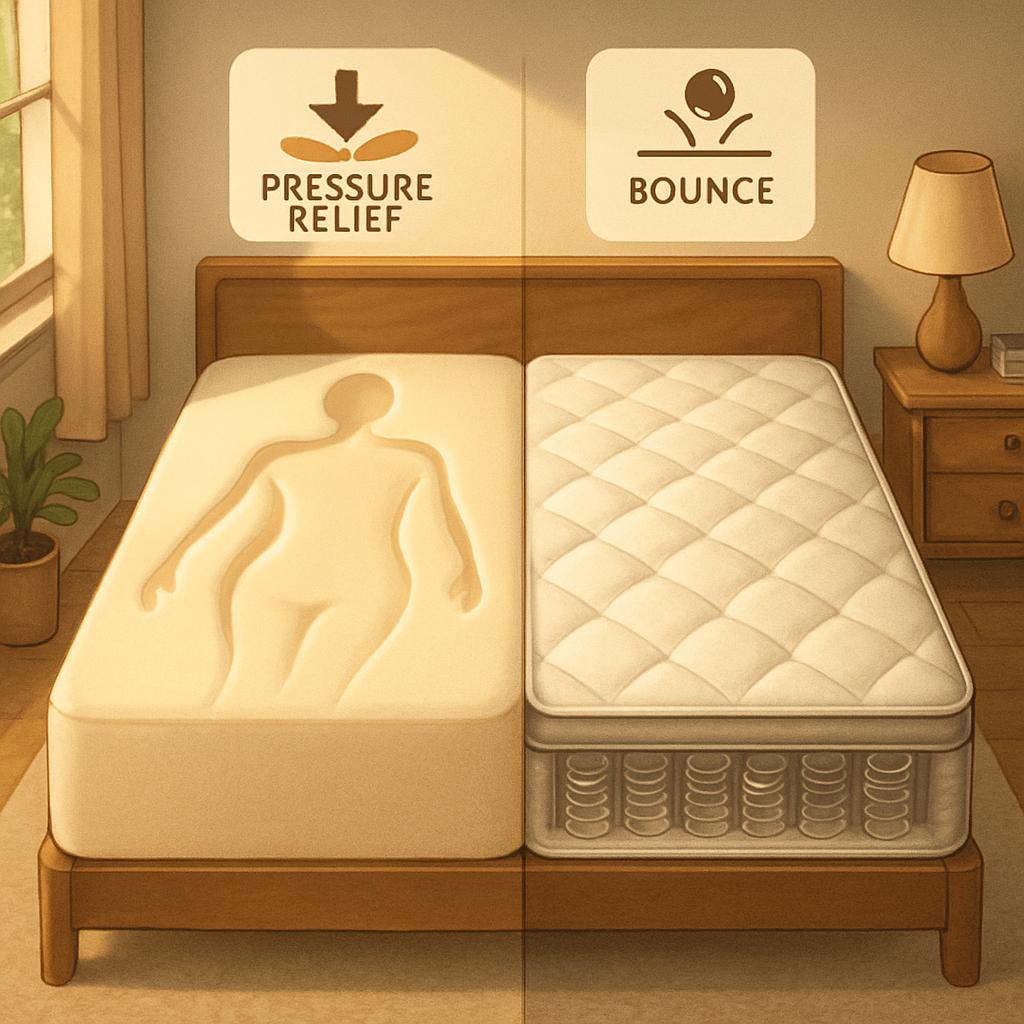
Memory foam mattresses, on the other hand, excel at pressure relief and motion isolation. These mattresses conform closely to your body's curves, distributing your weight evenly and reducing pressure points that can cause discomfort. The memory foam mattress pros include exceptional motion isolation—meaning your partner's movements won't disturb your sleep—and superior pressure relief for people dealing with joint pain or chronic discomfort. Modern memory foam mattresses have also addressed the heat retention issues that plagued earlier models, with many now featuring cooling gels and breathable layers.
The mattress durability of both types has improved significantly over the years. Quality innerspring mattresses typically last between 7-10 years, while high-quality memory foam mattresses can last 10-15 years with proper care. When conducting a mattress firmness comparison, you'll find that both types come in a range of options from soft to ultra-firm. However, innerspring mattresses tend to maintain their firmness level more consistently over time, while memory foam can soften slightly as it ages and conforms to your body's shape.
At Sleepology Mattress Shop, we carry premium options in both categories. If you're leaning toward memory foam, our Sealy Paterson Medium Gel Foam Mattress offers the perfect balance of conforming comfort and cooling technology. For those interested in innerspring options, we have a wide selection that includes everything from traditional Bonnell coil systems to advanced pocketed coil designs that reduce motion transfer while maintaining that responsive bounce.
The best mattress for bounce depends on what you're looking for. Innerspring mattresses naturally score higher on bounce tests due to their coil construction, which provides immediate responsiveness. Memory foam mattresses score lower on the mattress bounce test because they absorb energy rather than reflect it back. This isn't necessarily a drawback—it's simply a characteristic that makes memory foam better for motion isolation but less ideal if you prefer a bouncier surface.
Assessing Your Sleeping Position and Body Type
Your sleeping position is one of the most important factors when deciding between memory foam vs innerspring mattresses. Different sleeping positions create different pressure points and support needs, and each mattress type handles these demands differently. Understanding how your preferred sleep position interacts with mattress construction will help you avoid waking up with aches, pains, or that groggy feeling that comes from poor-quality sleep.
Side sleepers typically benefit most from memory foam mattresses. When you sleep on your side, your shoulders and hips bear most of your body weight, creating significant pressure points. Memory foam excels at cushioning these areas by contouring to your body's shape and distributing weight more evenly. The memory foam mattress pros really shine for side sleepers, as the material allows your shoulders and hips to sink in slightly while still supporting your spine's natural alignment. Without adequate pressure relief, side sleepers often wake up with shoulder pain or hip discomfort, which is why many find memory foam to be a game-changer.
"After years of waking up with shoulder pain, switching to a memory foam mattress completely changed my sleep quality. My body finally gets the pressure relief it needs, and I wake up feeling refreshed instead of sore." – Customer review from verified purchase, November 2024
Back sleepers need a balance of support and comfort, and both innerspring and memory foam mattresses can work well depending on your specific needs. Back sleepers require a mattress that supports the natural curve of the spine without allowing the lower back to sag. Firmer innerspring mattresses provide excellent support for back sleepers, especially those with higher body weight. The responsive nature of innerspring construction keeps your spine aligned while still offering enough give to accommodate your body's natural curves. However, medium-firm memory foam mattresses also work wonderfully for back sleepers by cradling the lumbar region and maintaining proper spinal alignment throughout the night.
Stomach sleepers typically need firmer support to prevent their hips from sinking too deeply, which can cause lower back strain. For stomach sleepers, innerspring mattresses often provide the best solution. The innerspring mattress benefits include a firmer, more supportive surface that keeps your body level and prevents the "hammock effect" that can occur with softer memory foam. That said, a firm memory foam mattress can also work for stomach sleepers, particularly lighter individuals who don't sink as deeply into the mattress surface.
Combination sleepers—those who shift between multiple positions throughout the night—face a unique challenge in the mattress comparison process. These sleepers need a mattress that accommodates different sleeping positions without creating discomfort. Innerspring mattresses typically work better for combination sleepers because the responsive bounce makes it easier to change positions during the night. Memory foam's conforming properties can sometimes make you feel "stuck" when trying to roll over, though newer responsive memory foam technologies have improved this aspect considerably.
Your body type also plays a significant role in determining the best mattress for bounce and overall comfort. Heavier individuals (over 230 pounds) typically need more robust support to prevent excessive sinking. For these sleepers, innerspring mattresses often provide better long-term support and mattress durability. The coil systems in innerspring mattresses are designed to handle more weight without bottoming out, which helps maintain proper spinal alignment and prevents that uncomfortable feeling of hitting the foundation through the mattress.
Lighter individuals (under 150 pounds) often find memory foam mattresses more comfortable because they're able to compress the material enough to experience its pressure-relieving benefits. Lighter sleepers sometimes complain that firmer innerspring mattresses feel too hard because they don't have enough body weight to compress the coils sufficiently. A softer memory foam mattress allows lighter sleepers to sink in just enough to relieve pressure points while still maintaining support.
Average-weight sleepers (between 150-230 pounds) have the most flexibility in choosing between innerspring and memory foam mattresses. Both types can work well, making the decision more about personal preference regarding mattress firmness comparison, temperature regulation, and the feel you prefer. This is where testing becomes particularly important—lying on different mattresses in various sleeping positions helps you understand how each type responds to your specific body.
Tailoring Your Choice
Once you understand how your sleeping position and body type interact with different mattress types, it's time to get specific about tailoring your choice to match your personal circumstances. The mattress comparison process becomes much more focused when you consider your lifestyle, health conditions, and the practical realities of your sleeping environment. This is where the memory foam vs innerspring debate gets really interesting, because the right answer becomes clear when you factor in your unique situation.
If you share your bed with a partner, motion isolation becomes a critical factor. Memory foam mattresses significantly outperform innerspring options when it comes to isolating movement. When your partner gets up during the night or tosses and turns, a memory foam mattress absorbs that motion rather than transferring it across the bed. This is one of the most important memory foam mattress pros for couples, especially when partners have different sleep schedules or one person is a restless sleeper. Innerspring mattresses, particularly those with continuous coil systems, tend to transfer motion more readily, though modern pocketed coil designs have improved this considerably.
Temperature regulation is another personal factor that can make or break your sleep quality. If you're someone who sleeps hot, the breathability of innerspring mattresses offers a significant advantage. The open structure of coil systems allows air to circulate freely throughout the mattress, helping dissipate body heat. Traditional memory foam mattresses trap heat because of their dense, conforming structure, though this has improved dramatically with newer gel-infused and open-cell foam technologies. If temperature control is your top priority and you're considering memory foam, look for models specifically designed with cooling features.
Your budget also shapes the mattress comparison process, though it's important to remember that a quality mattress is an investment in your health and wellbeing. Generally speaking, you can find quality innerspring mattresses at various price points, from budget-friendly options to luxury models. Memory foam mattresses also span a wide price range, with basic models being quite affordable and premium options featuring advanced cooling and support technologies costing significantly more. The key is balancing your budget with the features that matter most for your sleep quality and the mattress durability you expect.
Health conditions and chronic pain significantly influence which mattress type will serve you best. People dealing with arthritis, fibromyalgia, or other conditions causing widespread pain often find relief with memory foam mattresses. The pressure-relieving properties of memory foam can reduce painful pressure points and provide more comfortable sleep. Those recovering from injuries or dealing with back problems may need the firmer, more supportive feel of an innerspring mattress, particularly if they need to avoid sinking too deeply into the mattress surface. Always consider consulting with your healthcare provider about mattress recommendations if you're managing chronic pain or recovering from surgery.
The size and weight of your mattress matters more than many people realize, especially if you move frequently or live in a space with stairs or narrow hallways. Memory foam mattresses can be quite heavy due to their dense construction, making them more challenging to move and rotate. Innerspring mattresses vary in weight depending on the coil gauge and number of coils, but they're generally somewhat easier to maneuver. If you anticipate moving in the near future or have physical limitations that make moving heavy objects difficult, factor this practical consideration into your decision.
Your bedroom's foundation or bed frame also influences which mattress type will perform best. Memory foam mattresses typically need solid, supportive foundations with minimal give. They can work well on platform beds, adjustable bases, or traditional box springs designed for foam mattresses. Innerspring mattresses also work on various foundations, though they particularly benefit from box springs that complement their coil system. Some innerspring models require specific foundation types to maintain their warranty, so verify compatibility before making your purchase.
Consider how you use your bed beyond sleeping. If you spend time sitting on the edge of your bed to put on shoes, read, or watch TV, edge support becomes important. Innerspring mattresses generally provide superior edge support because their coil systems extend to the perimeter, creating a stable, supportive edge. Memory foam mattresses tend to compress more around the edges, which can make you feel like you might roll off when sitting on the side of the bed. This might seem like a minor detail, but it affects your daily comfort and the usable surface area of your mattress.
Think about your plans for the mattress's lifespan. If you're buying a mattress for a guest room that gets occasional use, mattress durability matters differently than for your primary bed. A quality innerspring mattress might maintain its supportive feel longer with infrequent use, while a memory foam mattress might be perfect for everyday use in your master bedroom where you can take full advantage of its pressure-relieving properties. Similarly, if you're buying a mattress for a child or teenager who's still growing, consider how their body and sleep needs might change over the mattress's lifespan.
Considering Weight and Comfort Preferences
Weight distribution plays a much bigger role in mattress performance than most people realize when comparing memory foam vs innerspring options. Your body weight directly affects how much you compress the mattress material, which in turn impacts support, comfort, pressure relief, and even the lifespan of your mattress. Understanding this relationship helps you choose a mattress that won't just feel good in the showroom but will continue providing quality sleep for years to come.
For sleepers in the heavier weight category—typically those over 230 pounds—innerspring mattresses often provide better long-term performance and mattress durability. The robust coil systems in innerspring construction are specifically designed to support higher weights without excessive compression. When a heavier person lies on a mattress, they need stronger support to prevent sinking through the comfort layers to the foundation below, which creates uncomfortable pressure points and poor spinal alignment. Quality innerspring mattresses with higher coil counts and reinforced edge support systems maintain their supportive structure even under heavier weights, providing the responsive support needed for restorative sleep.
That said, not all innerspring mattresses are created equal when it comes to supporting heavier bodies. Look for models with higher coil gauge numbers (indicating thicker, stronger coils) and reinforced center support zones that provide extra durability where your body's heaviest parts rest. The innerspring mattress benefits for heavier sleepers include better airflow (which helps with temperature regulation), easier movement on the bed surface, and that responsive bounce that makes changing positions more effortless. Plus, quality innerspring construction tends to resist sagging better over time when supporting heavier weights.
Memory foam mattresses can also work wonderfully for heavier individuals, but you need to be more selective about density and construction. High-density memory foam (5 pounds per cubic foot or higher) provides the support heavier sleepers need without bottoming out. The memory foam mattress pros for heavier sleepers include excellent pressure relief, superior motion isolation if sharing the bed, and that cradling comfort that reduces stress on joints. However, lower-quality or lower-density memory foam mattresses may compress too much under heavier weights, creating that stuck-in-the-bed feeling and potentially leading to premature sagging.
Medium-weight sleepers (roughly 150-230 pounds) have the most flexibility in the mattress comparison process. Both innerspring and memory foam mattresses can provide excellent support and comfort for average-weight sleepers, making personal preference the deciding factor. These sleepers can comfortably choose based on other priorities like temperature regulation, motion isolation, or simply the feel they prefer. Most mattresses are designed with this weight range in mind, so you'll have access to the full range of firmness levels and comfort features in both categories.
For average-weight sleepers, the mattress firmness comparison becomes more about sleeping position and personal comfort preferences than structural support needs. A medium-firm memory foam mattress might feel perfect if you're a side sleeper in this weight range, providing just enough sink to cushion pressure points while maintaining spinal alignment. An innerspring mattress in a similar firmness level offers more bounce and responsiveness, which some sleepers prefer for easier movement and a more traditional mattress feel. The best mattress for bounce in this weight category depends on whether you prioritize that responsive, springy feel or prefer the slow-responding, conforming nature of memory foam.
Lighter sleepers—those under 150 pounds—face different challenges in finding the right mattress. These sleepers often don't have enough body weight to adequately compress firmer mattresses, which can result in poor pressure relief and uncomfortable sleep. Memory foam mattresses frequently work better for lighter individuals because they can activate the pressure-relieving properties of the foam without needing excessive body weight. A softer to medium memory foam mattress allows lighter sleepers to sink in just enough to relieve pressure on shoulders and hips while still maintaining proper support.
Lighter sleepers who choose innerspring mattresses should look for softer comfort layers and responsive coil systems that don't require heavy weight to compress properly. The challenge with innerspring construction for lighter bodies is that firmer models can feel too hard, almost like sleeping on the floor, because these sleepers can't compress the coils enough to reach the comfort layers. Our Stearns & Foster Estate Euro Pillowtop Soft Mattress features plush comfort layers that provide excellent pressure relief for lighter sleepers while maintaining the responsive support that innerspring construction offers.
Beyond weight, your personal comfort preferences play an equally important role. Some people simply prefer the feeling of sleeping "on" a mattress rather than "in" it. This sensation relates directly to the mattress bounce test—innerspring mattresses offer more immediate response and bounce, while memory foam provides that slow-responding, contouring feel. Neither is objectively better; they're just different experiences that appeal to different preferences. If you like feeling the mattress respond quickly when you move or change positions, innerspring is likely your preference. If you enjoy the sensation of the mattress conforming to your body's exact shape, memory foam will probably feel more comfortable.
Temperature sensitivity is another comfort preference that varies widely among individuals. Some people naturally sleep hot and need every bit of cooling they can get, making the breathability of innerspring mattresses particularly appealing. Others sleep cold and appreciate the warmth-retaining properties of traditional memory foam. Modern mattresses address these preferences with various technologies—cooling gels in memory foam, breathable cover fabrics, and even phase-change materials that actively regulate temperature. Consider your temperature preferences honestly, because even the most supportive mattress won't provide quality sleep if you're too hot or too cold.
Your sensitivity to motion also shapes your ideal mattress choice. If you're a light sleeper who wakes easily when your partner moves, memory foam's superior motion isolation becomes a critical feature rather than just a nice bonus. The way memory foam absorbs movement means you're far less likely to feel your partner getting in and out of bed or shifting positions during the night. Innerspring mattresses, particularly those with interconnected coil systems, transfer more motion across the bed surface. However, if you sleep alone or aren't bothered by your partner's movements, this factor becomes less important in your decision.
Finally, consider how your comfort preferences might change over time. Bodies change, health conditions develop, and what feels comfortable at age 30 might not work at age 50. While you can't predict the future perfectly, choosing a quality mattress with good durability gives you the best chance of long-term satisfaction. Both quality innerspring and memory foam mattresses can last 10 years or more with proper care, but their feel may change differently over time. Innerspring mattresses may lose some bounce and develop minor sagging in high-use areas, while memory foam may soften and conform more readily as it ages. Think about which aging pattern sounds more acceptable for your long-term comfort.
The Importance of Testing Your Mattress
No matter how much research you do on memory foam vs innerspring mattresses, nothing replaces actually lying on different models to see how they feel with your body. The mattress comparison process isn't complete until you've physically tested the options you're considering. What looks perfect on paper might feel completely wrong when you actually lie down, and a mattress you hadn't considered might end up being exactly what you need. Testing is particularly important because mattresses are a significant investment that affects your health and wellbeing every single night.
When you come into Sleepology Mattress Shop to test mattresses, I always encourage people to take their time and really experience each option. Don't just sit on the edge or lie down for a few seconds—spend at least 10-15 minutes on each mattress you're seriously considering. This gives your body time to settle into the material and gives you a more accurate sense of how the mattress will feel during actual sleep. The initial impression when you first lie down can be misleading, especially with memory foam mattresses that take a moment to respond to your body weight and temperature.
The mattress bounce test is just one aspect of proper testing, but it's an important one that reveals how responsive the mattress is. To properly conduct a bounce test, lie on your back in the center of the mattress and then try shifting positions—roll to your side, turn over, sit up. Pay attention to how easily you can move and whether the mattress helps or hinders your movements. Innerspring mattresses typically make position changes easier because of their responsive bounce, while memory foam requires a bit more effort to overcome the conforming properties of the foam. Neither response is wrong, but understanding which feels more natural to you helps guide your decision.
Here are the key elements you should evaluate when testing mattresses:
- Initial comfort impression: Notice how the mattress feels the moment you lie down. Does it feel too firm, too soft, or just right? Remember that initial impressions can change, so don't make snap judgments.
- Pressure point relief: Pay attention to your shoulders, hips, and lower back. Do you feel uncomfortable pressure in these areas, or does the mattress cushion them adequately? Quality pressure relief prevents those aches and pains you might wake up with.
- Spinal alignment: If possible, have someone check whether your spine stays in a neutral position when you lie on your side. Your spine should form a straight line from your neck to your hips, not curve up or sag down.
- Ease of movement: Try changing positions several times. Can you roll over easily, or does the mattress make you feel stuck? This matters more than you might think for sleep quality.
- Edge support: Sit on the edge of the mattress as if you're putting on shoes. Does the edge provide stable support, or do you feel like you might slide off? Good edge support also increases the usable sleeping surface.
- Temperature perception: While you can't fully judge temperature regulation in a showroom, you can get a sense of whether the mattress feels warmer or cooler against your body. Memory foam tends to feel warmer initially, while innerspring feels more neutral.
- Motion transfer: If you're testing with a partner, have one person move around while the other lies still. Can you feel their movements, or does the mattress isolate motion effectively? This is particularly important for couples.
- Overall comfort after extended lying: After 10-15 minutes, do you still feel comfortable, or are you becoming aware of discomfort? Your body's response over time is more telling than your first few seconds on the mattress.
Testing mattresses also helps you understand the mattress firmness comparison in practical terms rather than abstract descriptions. What one person considers "medium-firm" might feel firm to someone else and medium to another person. Firmness is subjective and depends on your body weight, sleeping position, and personal preferences. The only way to truly know if a firmness level works for you is to lie on it and pay attention to your body's response.
Don't be afraid to test mattresses in multiple positions, even if it feels a bit awkward in the showroom. If you're primarily a side sleeper, spend most of your testing time on your side. If you switch positions throughout the night, try all your typical sleeping positions. This realistic testing approach gives you much better information than simply lying on your back for a few seconds on each mattress. I've seen countless customers discover that their assumptions about what they wanted were wrong once they actually tested different options.
Mattress durability is harder to evaluate during testing, but you can get some clues. Press firmly into the mattress with your hands and release—does the material bounce back quickly and fully? For innerspring mattresses, listen for any squeaks or creaks that might indicate lower-quality construction. Check the overall build quality, examining the stitching, materials, and edge construction. While these factors don't guarantee long-term durability, they indicate the attention to quality in the manufacturing process.
Practical Steps for Evaluating Bounce and Support
Evaluating bounce and support requires a systematic approach that goes beyond just flopping down on a mattress and hoping for the best. The mattress bounce test and support evaluation give you concrete information about how a mattress will perform during actual sleep, helping you make a more informed decision in the memory foam vs innerspring debate. These practical assessment steps work in any mattress showroom and take only a few minutes per mattress, yet they provide invaluable insights into how that mattress will feel night after night.
Start your bounce evaluation by lying flat on your back in the center of the mattress with your arms at your sides. Take a few deep breaths and let your body settle for at least 30 seconds. This initial settling gives you baseline information about how quickly the mattress responds to your body weight. Memory foam mattresses will continue softening and conforming as they warm up from your body heat, while innerspring mattresses reach their maximum compression almost immediately. Notice which response pattern feels more comfortable to you—the gradual conforming of memory foam or the immediate response of innerspring construction.
Next, test the mattress's responsiveness by pressing down firmly with your hands beside your body and then quickly releasing. Watch how the material recovers. Innerspring mattresses bounce back almost instantly, demonstrating the responsive support that defines their character. Memory foam mattresses recover more slowly, gradually returning to their original shape. This recovery speed directly impacts how easily you can move around on the mattress during the night. Neither response is superior, but understanding your preference helps guide your decision toward the best mattress for bounce in your situation.
The real-world bounce test involves actual movement rather than just pressing with your hands. From your back, roll onto your side using a normal sleeping movement. Does the mattress help or hinder this movement? Now roll from one side to the other. How much effort does it take? Innerspring mattresses generally make these position changes easier because their responsive nature works with your movement. Memory foam mattresses require slightly more effort because you need to overcome the conforming properties of the foam. Some people find this cradling effect comforting, while others feel restricted by it.
Support evaluation requires different techniques than bounce testing. While still lying on your back, slide your hand into the space between your lower back and the mattress. In a properly supportive mattress, there should be minimal space—just enough for your hand to slide through with slight resistance. Too much space indicates the mattress isn't supporting your lumbar curve adequately, which can lead to lower back pain. If you can't slide your hand through at all, the mattress might be too firm, pushing your lower back up and creating an unnatural curve. This simple test reveals a lot about whether the mattress provides appropriate support for your body.
Edge support testing is equally important, especially if you share your bed or tend to use the full surface area when sleeping. Sit on the edge of the mattress as if you're putting on shoes or getting ready to stand up. The edge should provide stable, supportive resistance without excessive compression or the feeling that you might slide off. Good edge support is one of the key innerspring mattress benefits, as coil systems typically extend to the mattress perimeter providing consistent support. Memory foam mattresses often compress more at the edges, though high-quality models address this with reinforced perimeters or firmer foam around the edges.
Lie diagonally across the mattress to test support consistency across the entire surface. Some mattresses have different support zones in different areas, with firmer support under the hips and softer cushioning under the shoulders. Notice whether these zones feel appropriate for your body or whether they create uncomfortable transitions. Uniform support might feel better for some sleepers, while zoned support benefits others, particularly those with specific pressure point issues or back problems.
For couples, the partner disturbance test provides critical information about motion isolation. Have your partner (or a helpful salesperson) sit down, lie down, and move around on the mattress while you lie still on the other side. Can you feel their movements? How much do they disturb your position? Memory foam significantly outperforms innerspring in this test due to its motion-isolating properties, which is one of the most important memory foam mattress pros for couples with different sleep schedules or movement patterns. Modern pocketed coil innerspring systems have improved motion isolation considerably compared to traditional continuous coil designs, but they still don't match memory foam's performance in this area.
Temperature perception testing is limited in a showroom environment, but you can gather some initial impressions. Notice whether the mattress feels neutral, slightly warm, or cool when you first lie down. Memory foam tends to feel warmer as it responds to body heat, while innerspring mattresses typically maintain a more neutral temperature. If you're particularly concerned about sleeping hot, ask about specific cooling technologies in the mattresses you're considering, such as gel infusions, breathable covers, or ventilated foam layers.
The final step in your practical evaluation involves mentally projecting your testing experience into nightly use. Imagine lying on this mattress for eight hours. Would you still feel comfortable? Would the firmness level that feels good now still feel appropriate after several hours? Would the responsiveness or conforming nature of the mattress enhance or detract from your sleep quality? These projections aren't perfect, but they help you think beyond the immediate sensation to the long-term reality of sleeping on the mattress every night.
Throughout your testing process, take notes or photos to remember your impressions of different models. After testing several mattresses, they can start to blur together in your memory. Recording your immediate reactions, comfort levels, and any specific features you noticed helps you make a more informed comparison when it's time to make your final decision. Note which mattresses passed your bounce and support tests most successfully and why they stood out from the others.
Remember that mattress testing in a showroom provides valuable information, but it's not identical to sleeping on the mattress for a full night. That's why trial periods and return policies matter so much. Even with thorough testing, you might discover that a mattress feels different after sleeping on it for several nights. Your body needs time to adjust to a new mattress, and some characteristics only become apparent with extended use. Quality mattress retailers understand this reality and offer trial periods that let you truly evaluate your purchase in real-world sleeping conditions.
Make the Right Choice for Your Sleep Needs
When it comes down to choosing between a memory foam mattress and an innerspring mattress, there's no single "right" answer that works for everyone. What matters most is finding the mattress that aligns with your personal sleep style, comfort preferences, and budget. Both mattress types bring unique strengths to your bedroom, and understanding these differences helps you make a confident decision that you'll appreciate night after night.
If you're someone who values a traditional feel with plenty of bounce and breathability, an innerspring mattress might be your perfect match. The responsive support of innerspring construction allows for easy movement throughout the night, making it especially appealing if you tend to change positions frequently or if you share your bed with a partner. The natural airflow through the coil systems keeps you cooler during warm nights, and many sleepers appreciate the familiar feel that innerspring mattresses provide. Plus, innerspring options often come at various price points, giving you flexibility in your mattress shopping experience.
On the other hand, if pressure relief and body contouring are high on your priority list, a memory foam mattress delivers exceptional comfort that adapts to your unique shape. The way memory foam cradles your body helps reduce pressure points at your shoulders, hips, and lower back, which can translate to more restful sleep and less tossing and turning. The motion isolation properties of memory foam mattresses make them ideal for couples, since you won't feel your partner's movements throughout the night. Modern memory foam mattresses have come a long way in addressing heat retention concerns, with many featuring cooling technologies that keep you comfortable all night long.
The mattress bounce test we've explored throughout this comparison gives you practical insight into how each mattress type performs in real-world conditions. Remember that responsiveness isn't just about bounce—it's about how quickly the mattress responds to your movements and how well it supports you in different sleeping positions. Whether you prefer the quick response of innerspring coils or the gradual contouring of memory foam, testing these characteristics helps you understand what feels right for your body.
Your sleeping position plays a significant role in determining which mattress type will serve you best. Side sleepers often find that memory foam mattresses provide the pressure relief they need at their shoulders and hips, while back and stomach sleepers may appreciate the supportive pushback of an innerspring mattress. Your body weight also influences mattress performance, with heavier individuals sometimes preferring the robust support of innerspring construction and lighter sleepers often enjoying the contouring properties of memory foam.
Mattress durability and lifespan should factor into your decision as well. Both innerspring mattresses and memory foam mattresses can last for years when properly cared for, though their durability characteristics differ. Quality innerspring mattresses with individually wrapped coils tend to maintain their support structure well over time, while high-density memory foam resists body impressions and sagging. Considering the long-term investment in your sleep health helps you evaluate which option offers the best value for your specific needs.
The firmness level comparison between these two mattress types shows that both come in a range of options, from plush to firm. What feels firm in memory foam might feel different than firm in innerspring due to the distinct support systems. I encourage you to test multiple firmness levels in both categories at Sleepology Mattress Shop, where you can experience firsthand how each mattress type responds to your body and sleeping style.
Don't overlook the importance of edge support when making your decision. If you sit on the edge of your bed frequently or sleep near the perimeter, strong edge support becomes especially valuable. Many innerspring mattresses naturally provide excellent edge support due to their coil systems, though some memory foam mattresses now feature reinforced edges that perform admirably as well.
Your sleep environment and personal health considerations should also inform your choice. If you have allergies or asthma, the dust mite resistance of memory foam mattresses might appeal to you. If you tend to sleep hot, the breathability of innerspring construction could help you maintain a comfortable temperature throughout the night. These practical considerations matter just as much as comfort when you're investing in better sleep.
The beauty of shopping for mattresses today is that you have access to detailed information, customer reviews, and expert guidance to support your decision. Taking time to research and test different options isn't being picky—it's being smart about a purchase that affects your daily well-being. Quality sleep influences everything from your mood and productivity to your long-term health, making your mattress one of the most important investments you can make.
Whether you ultimately choose the responsive bounce of an innerspring mattress or the contouring comfort of a memory foam mattress, you're taking a positive step toward better sleep. Your perfect mattress is out there, waiting to transform your nights and energize your days. Sweet dreams are just a mattress decision away, and I'm confident that with the knowledge you've gained from this mattress comparison, you'll find exactly what you need to sleep better, feel better, and live better.
Frequently Asked Questions (FAQs)
What is the main difference between memory foam and innerspring mattresses?
The main difference lies in their construction and feel. Innerspring mattresses use metal coils to provide support with a bouncy, responsive feel, while memory foam mattresses use dense foam layers that contour to your body shape. Innerspring offers better breathability and bounce, whereas memory foam provides superior pressure relief and motion isolation.
Which mattress type is better for couples?
Memory foam mattresses typically work better for couples because they excel at motion isolation. When one partner moves or gets out of bed, the other partner won't feel the movement. However, if both partners prefer a bouncier surface and don't mind some motion transfer, an innerspring mattress with individually wrapped coils can also work well.
How long do memory foam mattresses last compared to innerspring mattresses?
High-quality memory foam mattresses typically last between 7 to 10 years, while quality innerspring mattresses generally last 6 to 8 years. Mattress durability depends on the quality of materials, how well you care for it, and your body weight. Rotating your mattress regularly and using a proper foundation can extend the lifespan of either type.
Do memory foam mattresses sleep hot?
Traditional memory foam mattresses can retain heat, but many modern memory foam mattresses include cooling technologies like gel infusions, open-cell foam structures, and breathable covers. If you're concerned about sleeping hot, look for memory foam options specifically designed with temperature regulation features, or consider an innerspring mattress which naturally allows more airflow.
Which mattress type is better for back pain?
Both mattress types can help with back pain, but it depends on your specific needs. Memory foam mattresses contour to your spine and relieve pressure points, which many people with back pain find helpful. Innerspring mattresses provide firmer support that some back pain sufferers prefer. The best choice depends on your sleeping position, body weight, and the nature of your back pain.
What does the bounce test tell you about a mattress?
The mattress bounce test shows how responsive and supportive a mattress is. Innerspring mattresses typically have more bounce, making it easier to move around and change positions. Memory foam mattresses have less bounce and more of a sinking feeling as they contour to your body. The bounce test helps you understand how the mattress will respond to your movements during sleep.
Are innerspring mattresses noisier than memory foam?
Innerspring mattresses can develop squeaks and creaks over time as the coils age and shift, especially in older or lower-quality models. Memory foam mattresses are virtually silent because they have no moving parts. If noise is a concern, look for innerspring mattresses with individually wrapped coils, which tend to be quieter, or consider a memory foam option.
Which mattress type is better for side sleepers?
Memory foam mattresses are generally better for side sleepers because they contour to the curves of your body and relieve pressure at your shoulders and hips. Side sleepers need cushioning at these pressure points, which memory foam provides excellently. However, a softer innerspring mattress with a thick comfort layer can also work well for side sleepers.
How do I know what firmness level I need?
Your ideal firmness level depends on your sleeping position, body weight, and personal preference. Side sleepers typically need medium to medium-soft mattresses for pressure relief. Back and stomach sleepers often prefer medium-firm to firm mattresses for proper spinal alignment. Heavier individuals generally need firmer mattresses for adequate support, while lighter people may prefer softer options.
Can I use my existing box spring with either mattress type?
Innerspring mattresses work well with traditional box springs. Memory foam mattresses need a solid, supportive foundation—either a platform bed, a bunkie board, or a foundation specifically designed for foam mattresses. Using the wrong foundation can void your warranty and affect mattress performance, so check the manufacturer's recommendations before making your purchase.
What are the different types of innerspring coils?
The main types of innerspring coils include Bonnell coils (hourglass-shaped and interconnected), offset coils (similar to Bonnell but with a flatter top for better contouring), continuous coils (made from a single wire for durability), and pocketed coils (individually wrapped for better motion isolation and contouring). Pocketed coil systems typically offer the best performance in modern innerspring mattresses.
Do memory foam mattresses have a chemical smell?
New memory foam mattresses often have a temporary smell called off-gassing, which comes from the manufacturing process. This smell is typically harmless and fades within a few days to a week. To speed up the process, unwrap your mattress in a well-ventilated room and let it air out for 24 to 48 hours before using it. Quality memory foam mattresses from reputable brands have minimal off-gassing.
Which mattress type provides better edge support?
Innerspring mattresses generally provide better edge support due to their coil construction, especially models with reinforced perimeters. Traditional memory foam mattresses tend to have weaker edges, though many newer models feature reinforced foam edges that perform much better. Strong edge support matters if you sit on the edge of your bed frequently or sleep near the perimeter.
How much should I expect to spend on a quality mattress?
Quality innerspring mattresses typically range from $500 to $2,000 for a queen size, while memory foam mattresses usually cost between $600 and $2,500. Premium options from brands like Tempur-Pedic, Sealy, or Stearns & Foster can cost more but offer superior materials and longer warranties. Your mattress is an investment in your health, so focus on value and quality rather than just price.
Should I flip or rotate my mattress?
Most modern mattresses, both innerspring and memory foam, are designed with specific top and bottom layers, so you should only rotate them head to foot, not flip them over. Rotating your mattress every three to six months helps distribute wear evenly and can extend its lifespan. Always check your manufacturer's specific care instructions, as some mattresses don't require rotation at all.