

How Wide Is a Queen Size Mattress? A Practical Guide To Space, Comfort, And Fit
If you are upgrading your bed or trying to make the most of a smaller bedroom, the simple question of how wide a queen size mattress is can feel surprisingly complicated. You might be juggling room measurements, a partner who tosses and turns, maybe a pet or two, and a budget that needs to stretch. It is a lot to think about, and it is completely normal to feel a little overwhelmed when you realize how many mattress sizes and variations are out there.
There is also real sleep quality at stake, not just inches on a tape measure. According to organizations like the Sleep Foundation, most adults need 7 to 9 hours of sleep each night for optimal health, and mattress comfort and room to move are big contributors to that total. When your bed is too narrow, you feel every kick, roll, and elbow, and that constant micro‑waking adds up to daytime fatigue, irritability, and even more aches and pains. So the width of a queen mattress is not just a number, it is part of your long term health and daily energy.
You are in the right place if you want clear answers, not marketing fluff. We will start with the exact dimensions of a standard queen, then look at how that width feels in real life for singles and couples, how it compares to full and king sizes, and how to match a queen to your bedroom size and furniture. You will also see how queen‑adjacent options like Olympic queen or split king stack up when you want more width without totally rearranging your home.
My goal is to help you walk away knowing not just how wide a queen mattress is, but whether a queen really fits your body, your room, and your life. Along the way, I will point to specific mattress and accessory options from Sleepology that tend to work especially well for queen shoppers, so you can go from questions to a clear, confident plan.
The Exact Width Of A Queen Size Mattress
Most people have heard that a queen mattress is bigger than a full and smaller than a king, but they are less sure of the actual numbers. The standard answer in the United States is very straightforward. A queen size mattress is 60 inches wide and 80 inches long. That is 5 feet of width from side to side and 6 feet 8 inches of length from head to toe.
When you picture that 60 inch width, it helps to break it down per sleeper. If you share your queen with a partner, each of you gets about 30 inches of personal space. For comparison, many adults shoulders are 16 to 20 inches across, so that 30 inch allotment leaves a bit of breathing room for rolling from back to side without tumbling into each other. This is one of the big reasons queen mattresses are the most popular size for couples and single adults, especially in homes where bedrooms are not huge.
The 80 inch length is also more generous than a twin or full, which are typically 75 inches long. If you or your partner are up to about 6 feet 4 inches tall, an 80 inch length usually feels adequate, especially if you sleep slightly bent at the knees or on your side. Very tall sleepers who are closer to 6 feet 6 inches or more may still prefer the extra length of a California king, but many people are pleasantly surprised at how comfortable a queen feels once they are actually lying on it with a supportive pillow and proper bedding.
It is worth noting that while the length of a queen is fairly standard across brands, the height or thickness can vary widely, often from about 9 to 15 inches or more. That thickness does not change the 60 inch width, but it affects how your bedding fits and how high the sleeping surface will sit once you add a foundation or an adjustable bed frame and base. Taller mattresses paired with higher bases may be more comfortable for people with joint pain, since getting in and out of bed requires less bending.
According to sleep health resources like the Mayo Clinic and Cleveland Clinic, chronic pain and limited mobility are common reasons people wake up more often during the night. A mattress that matches your height and movement needs, along with its width and length, can make it easier to change positions without aggravating joints or muscles. So while the queen’s 60 inch width is the headline, thinking about thickness and bed height is part of choosing a queen that really works for your body.
“Mia walked me through the size difference between full, queen, and king in a way that finally clicked. Once we understood that a queen is 60 inches wide, we realized it was the sweet spot for our 10 x 11 room. We paired it with a lower platform base and gained back enough walking space to add a small reading chair.” – Dana P., November
How A 60 Inch Queen Feels For Different Sleepers
Understanding the width of a queen on paper is one thing. Knowing how that 60 inch width feels at 2 a.m. when your partner is starfishing and the dog has claimed the foot of the bed is another. This is where your sleep style, body size, and who you share the bed with really matter.
For solo sleepers, a queen often feels luxurious without being excessive. You gain a full 7 inches of extra width over a full size, which is 53 inches wide, and that extra space can make a big difference if you toss and turn. If you like to sprawl diagonally, hug a body pillow, or keep your laptop or a child next to you occasionally, the queen’s width allows you to do that without hanging off the edge. Many back sleepers who want extra room but also want strong spinal support do very well on queen size options like the Sealy Posturepedic Medium Mattress – Medina II, which combines stable support with enough cushioning to keep shoulders and hips comfortable.
For couples, the queen’s 60 inch width is usually the minimum size that feels comfortable long term. Each person gets those 30 inches of space, compared to only about 26.5 inches each on a full. That may not sound like much, but it is the difference between elbows constantly touching and having a small buffer zone for movement. Partners who are average sized and enjoy sleeping closer together, or who mostly sleep on their sides or backs, usually find a queen works very well, especially when paired with a mattress that limits motion transfer so you do not feel every turn.
Things get trickier when one or both partners are taller, broader, or extremely active in their sleep. Research on sleep and relationships, including studies discussed by the Sleep Foundation, has shown that disrupted sleep from a partner’s movements can contribute to increased stress and tension. In these cases, the queen’s width can start to feel tight. If you recognize that one of you frequently pushes the other toward the edge, you may benefit from moving up to a king, or at least choosing a queen with very strong edge support and excellent motion isolation, such as a hybrid model like the Sealy Posturepedic Elite Soft Hybrid Mattress – Brenham II.
Pets and kids are another factor. A medium sized dog or a young child joining occasionally is usually fine in a queen, especially if both adults are average sized. But if you regularly co sleep with a toddler or have multiple pets, 60 inches can start to feel cramped. In those scenarios, it is worth asking whether the queen’s width matches your actual nighttime reality, not just your idealized picture of sleep.
“We were trying to make a queen work with two kids who wander in at night and a Labrador at the end of the bed. Mia had us literally mark out 60 inches on the floor and practice lying down. That exercise alone convinced us to step up to a king, and we have had far fewer wake ups since.” – Jared L., October
Queen Width Compared To Full And King
Once you know a queen is 60 inches wide, the natural follow up is how that compares to the sizes just below and above it. The jumps in width might seem small, but they have a big impact on comfort, especially for couples and active sleepers.
A full size mattress is 53 inches wide and 75 inches long. The width difference between a full and a queen is 7 inches, which translates to 3.5 extra inches per person if two people are sharing the bed. In practice, that can be the difference between feeling like you are constantly right on top of each other and having enough room for your arms without ending up on the edge. Fulls can work well for single adults, teens, or guest rooms, but for couples, especially those who do not always cuddle close, a full rarely feels restful over the long term.
On the other side, a standard king measures 76 inches wide and 80 inches long. That means a king is a full 16 inches wider than a queen, or 8 extra inches of space for each person. For couples who value personal space, sleep with children or pets, or simply prefer a bit of distance, that additional width can be transformative. From a pure surface area standpoint, a queen gives you 4,800 square inches, while a king offers 6,080 square inches. So the queen is a smart middle ground that offers meaningful width without demanding as much floor space as a king.
It is also helpful to compare queen width to California king, which is 72 inches wide and 84 inches long. A California king is 4 inches narrower than a king, but 4 inches longer. That makes it a good solution for tall sleepers who need legroom, but couples who primarily want shoulder room usually feel more comfortable on a standard king. Compared to a queen, a California king still adds a generous 12 inches of width, which is significant if your room and budget can accommodate the larger footprint.
Room size plays a major role here. Interior design and sleep experts often recommend leaving at least 24 to 36 inches of walking space around the sides and foot of your bed. Once you subtract that clearance, you may find that a queen’s 60 inch width is the largest size that still allows you to open closet doors, pull out drawers, and move naturally. A queen can feel spacious in a 10 x 10 foot room where a king would feel overwhelming, both visually and functionally.
“We were convinced we needed a king, but Mia had us measure our 10 x 11 room and tape out both sizes. Seeing the 76 inch width on the floor made it obvious we would be squeezing sideways between the bed and dresser. The queen we ordered instead feels roomy to sleep in, and the room itself feels balanced and uncluttered.” – Melissa R., December
Standard Queen vs Other Queen Variations

Now that the standard queen’s 60 inch width is clear, it helps to look at queen adjacent sizes that you may run into while shopping. These can be useful if you need a little more or less width while staying in a similar length range, but they also add confusion if you are not sure how they compare.
A standard queen, again, is 60 inches wide and 80 inches long. This is by far the most common and widely available queen size in the United States, which means you will have the best selection of mattresses, bed frames, and bedding in this size. For most people and bedrooms, this is the default starting point.
An Olympic queen is typically 66 inches wide and 80 inches long, which adds 6 inches of width over a standard queen while keeping the same length. Those extra 6 inches give each partner 3 more inches of personal space, a noticeable difference if you often feel crowded on a standard queen but cannot quite fit a king in your room. The tradeoff is that fewer brands make Olympic queens, and it can be harder to find well fitting sheets and bed frames, so you will want to be sure you have a reliable source for accessories if you go this route.
There are also less common sizes like a “short queen,” often used in RVs, which usually measure around 60 inches wide and 74 to 75 inches long. The width remains the same as a standard queen, but the shorter length helps fit tight spaces. If you are shopping for a home bedroom, you are almost always looking at the full 80 inch length, but it is worth double checking when buying online, since a short queen will feel cramped for taller sleepers.
European queen sizes can be slightly different as well, often measured in centimeters and then approximated to inches. For example, a 160 x 200 cm mattress is roughly 63 inches wide and 79 inches long, a little wider and a touch shorter than a US queen. If you have a European bed frame or imported furniture, it is important to measure the frame’s inner dimensions to be sure a standard 60 inch wide US queen will actually fit.
Because of this variation, I always recommend measuring both your bed frame and the mattress itself with a tape measure, instead of relying solely on labels or memory. As brands like Casper and Tampa Mattress Makers point out in their size guides, even small differences in width can affect how well a mattress fits into an existing frame or how snugly your sheets hug the corners. When in doubt, a standard queen is the safest choice for maximum compatibility with accessories.
How Queen Width Fits Into Your Bedroom Layout
Knowing that a queen is 60 inches wide is only half the story. The other half is how that width interacts with your room dimensions, furniture, and how you actually move around the space. A queen that technically fits can still feel wrong if it dominates the room or makes basic tasks awkward.
Start by looking at your room measurements. In a bedroom that is around 10 x 10 feet, a queen typically fits comfortably as the main bed size, especially when placed with the headboard against the longest wall. You will want to leave at least 24 to 30 inches of clearance on each side of the bed where you get in and out, and preferably around 30 to 36 inches at the foot if there is a dresser, bench, or door nearby. That amount of space makes getting dressed, changing bedding, and vacuuming far easier.
Furniture placement matters just as much as the raw numbers. Nightstands, dressers, desks, and closet doors all eat into floor space. In a compact room, choosing scaled down or wall mounted nightstands can help a queen feel right sized instead of overwhelming. If you are considering a thicker mattress, like the Sealy Posturepedic Plus Medium Mattress – Paterson II Euro Pillow Top, pairing it with a minimalist base rather than a bulky box spring can keep the overall footprint visually lighter.
It is also worth thinking about how you use your bedroom beyond sleep. If you work from home and need a desk, or if you value having a reading nook or yoga space, you may prefer the breathing room you get when you choose a queen instead of a king. On the other hand, if your bedroom is primarily for sleep and relaxation and you have a larger space, you might decide that upgrading to a king is more valuable than keeping an extra chair in the corner.
Finally, consider vertical space. A queen mattress that is higher off the floor can make small rooms feel tighter if it blocks part of a window or sits significantly higher than other furniture. Low profile frames or adjustable bases that sit closer to the ground can help a 60 inch wide bed appear more proportional, especially in rooms with standard ceiling heights.
Mattress Size Comparison Table: Width, Length, And Best Uses
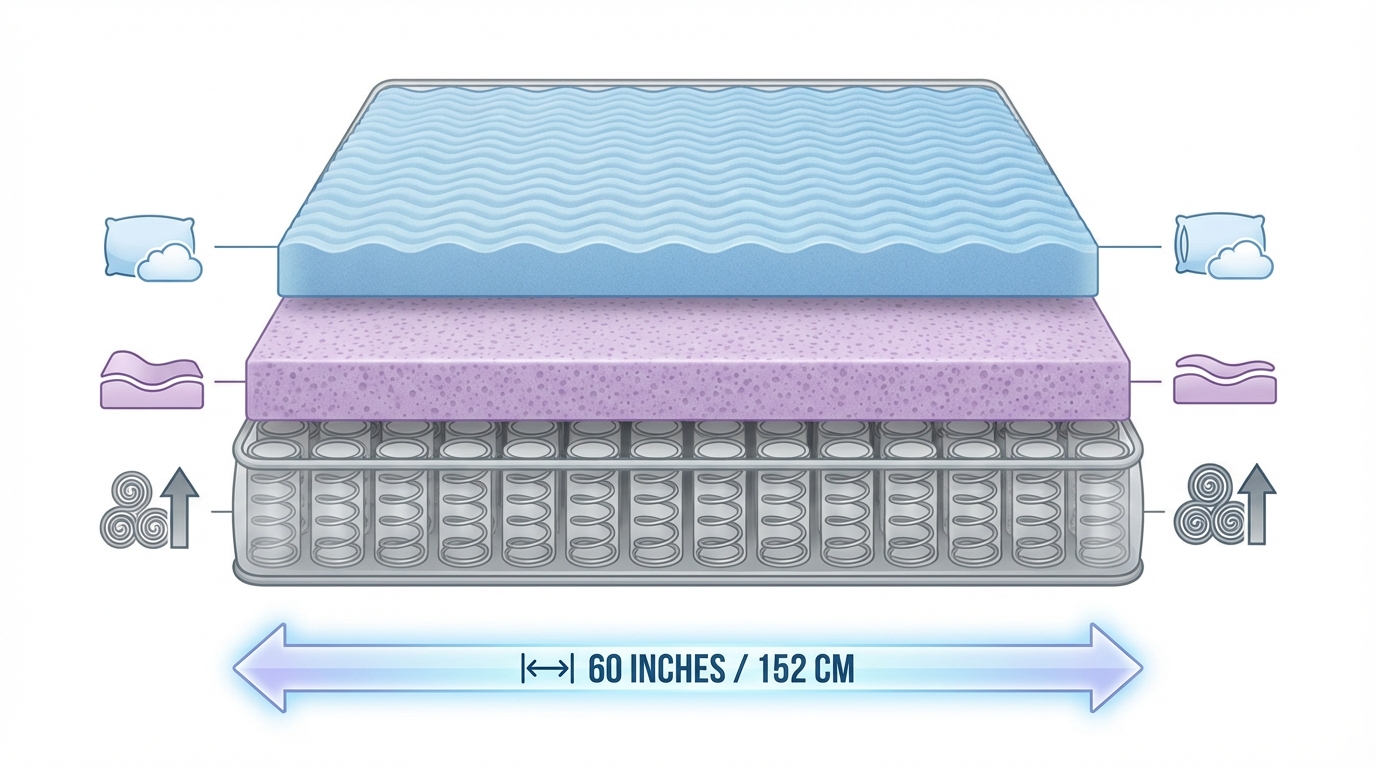
To see where the 60 inch wide queen sits relative to other common sizes, it helps to compare them side by side. This table focuses on US standard mattress sizes and how their dimensions typically work in real life.
| Mattress Size | Dimensions (W x L) | Typical Sleepers | Room Size Fit (Common Use) |
|---|---|---|---|
| Full | 53" x 75" | Single adult, teen, occasional couple | Works well in small bedrooms or guest rooms, often around 9' x 10' or 10' x 10' |
| Queen | 60" x 80" | Single adult wanting space, most couples | Ideal for primary bedrooms around 10' x 10' and up, balances comfort and floor space |
| King | 76" x 80" | Couples wanting maximum personal space, couples with child or pet in bed | Best in larger rooms, commonly 12' x 12' or bigger |
| California King | 72" x 84" | Tall sleepers, couples prioritizing legroom | Works best in long, larger bedrooms, especially where extra length is beneficial |
This overview makes the queen’s role clear. It is the size most people land on when they want enough width to share comfortably but cannot or do not want to dedicate as much floor space as a king requires. It also shows that the queen’s extra length over a full gives taller sleepers more room to stretch out, which can reduce curled up sleeping and the associated morning stiffness.
Remember that these room size fits are guidelines, not rigid rules. If your room is a little smaller or larger, focusing on clear pathways and how your furniture is arranged can matter more than the exact dimensions on paper. Measuring twice and visualizing the bed with painter’s tape on the floor can help you confirm that a 60 inch queen will feel like a good roommate, not a pushy one.
How Queen Width Affects Sleep Quality And Health
The width of your mattress influences more than comfort, it affects how deeply you sleep and how your body feels when you wake up. Sleep researchers have repeatedly found that both the quality and quantity of sleep play key roles in immune function, mood regulation, and even long term heart and metabolic health. When your bed is too narrow, you are more likely to experience fragmented sleep from bumping into your partner or shifting constantly to stay on the mattress.
For couples, the queen’s 60 inch width is often the smallest size that allows both partners to adopt their natural sleep positions without constant compromise. Side sleepers, for example, tend to take up more lateral space because they draw their knees up and may stack or hug pillows. Back sleepers usually occupy a narrower footprint but may spread their arms. In my work as a sleepologist, I see many couples where one partner is a side sleeper and the other sleeps more on their back, and a queen often gives them enough width to co exist comfortably with the right mattress choice.
Motion transfer is another factor. Even with 60 inches of width, a very bouncy mattress can undo the benefits of extra space. Organizations like Consumer Reports and independent testing labs often highlight motion isolation as a key performance metric. If one partner is a light sleeper, choosing a queen mattress with good motion control, such as the Sealy Posturepedic Medium Mattress – Medina II Euro Pillow Top, can make the queen’s width feel more relaxing because you are not being jostled awake with every turn.
Body alignment also matters. According to sleep health resources from major clinics, poorly supported sleep postures can aggravate back and neck pain. In a bed that is too narrow, you may unconsciously curl or twist to avoid falling off, especially if your partner tends to encroach on your side. A queen’s added width over a full can reduce that edge anxiety and give your spine more opportunity to stay neutral, particularly when combined with a supportive pillow like The BodyPillow by Tempur-Pedic that keeps your knees and hips aligned if you sleep on your side.
Noise is another underappreciated factor. A crowded bed often leads to more creaking from shifting weight on the frame or foundation. When evaluating whether a queen will be wide enough for you, it is worth pairing it with a solid, quiet foundation or an adjustable base that is properly sized for the 60 inch width. Reducing both physical and auditory disturbances creates the kind of stable environment your nervous system associates with deep, restorative sleep.
Is A Queen Wide Enough For You And Your Partner?
Even with all the measurements and general guidelines, the question that really matters is personal. Is a 60 inch wide queen truly enough for you and your partner, in your real life, with your real habits and bodies? There is no one right answer, but there are a few questions that can clarify the picture quickly.
First, consider your combined shoulder width and sleeping styles. If both of you are average build and tend to sleep on your sides or backs without spreading out dramatically, a queen is usually wide enough. If one or both of you have broad shoulders, are tall, or like to sleep in a “starfish” position, 60 inches may feel tight. I often recommend that couples stand side by side, shoulders touching, then add a comfortable buffer on each side. If that total is close to or greater than 60 inches, a king might be a better fit.
Second, think about how often kids or pets join you. An occasional morning cuddle with a small child or cat fits easily into most queen setups. Regular co sleeping with a toddler or dog, especially larger breeds, is where many couples start to feel crowded. The queen’s width can handle two adults and one small extra body now and then, but if your bed resembles a family couch every night, more width will almost always support better sleep.
Third, factor in your sensitivity to disturbances. If one of you is a very light sleeper or deals with conditions like insomnia, anxiety, or chronic pain, having a bit more separation can be invaluable. While a well built queen with strong motion isolation can help, there is a limit to how much distance 60 inches can create between two people. In these cases, you might weigh the pros and cons of staying with a queen to preserve room space versus moving to a king for relationship harmony and sleep health.
Last, do not forget about your budget over the long term. A queen often represents a sweet spot where you can invest more in quality materials, like a supportive hybrid core and pressure relieving foams, without the higher price jump that comes with king size. If you are choosing between a basic king and a well constructed queen that suits your body type and sleep style, the queen can deliver better value and longevity.
When A Queen Is The Best Choice
There are many situations where a queen’s 60 inch width is not just adequate, it is ideal. Understanding these scenarios can reassure you that choosing a queen is not settling, it is selecting the right tool for the job.
One of the strongest cases for a queen is in primary bedrooms that are around 10 x 10 to 11 x 12 feet. In these spaces, a king’s 76 inch width often forces you to push furniture against walls and squeeze around corners, which can make the room feel cramped and cluttered. A queen maintains a sense of openness and balance, leaving room for a dresser, nightstands, and perhaps a small chair or bench without sacrificing circulation space.
A queen is also an excellent match for couples who enjoy sleeping relatively close. Some partners find that a king feels almost too distant emotionally, as if they are in separate beds. With a queen, you can still hold hands or snuggle easily while having just enough width to roll away when you are ready to sleep. Pairing a queen with a cushioning yet supportive mattress like the Sealy Posturepedic Pro Soft Mattress – Dupont II Euro Pillow Top can make that closeness comfortable for side sleepers, since the shoulders and hips are well padded.
For single adults, a queen is often the perfect long term investment. It offers space to sprawl, grow into, or eventually share, without needing to change bed frames when life circumstances shift. If you work irregular hours or share your home with roommates, having your own 60 inch wide “sleep sanctuary” can feel like a grounded, private retreat. Adding breathable, high performance sheets like the Tempur-Pedic ProPerformance Sheet Set can further support sleep quality by helping regulate temperature and moisture through the night.
Finally, a queen size bed often simplifies moving and rearranging. Queen mattresses and frames are lighter and easier to maneuver through doorways and up stairs than kings, which matters if you foresee moving homes, reconfiguring rooms, or using your bed in different spaces over the years. The queen’s width provides enough everyday luxury without locking you into furniture that is difficult to adapt to new layouts.
When You Might Want Wider Than A Queen
While a queen is the most popular mattress size, there are absolutely times when it is worth considering more width. Recognizing those situations early can save you from a second round of mattress shopping a year or two later.
If both you and your partner are tall, broad shouldered, or simply prefer sprawling positions, starting with a king is often wise. In these cases, even with a high quality queen, you may find yourselves competing for space, inching toward the edge, or unconsciously adjusting your positions to avoid bumping into each other. Over time, that low grade tension shows up as more restless nights and subtle resentment about “whose side” is bigger.
Couples dealing with sleep challenges like snoring, mild sleep apnea, or frequent nighttime bathroom trips may also do better with extra width. According to medical organizations and sleep clinics, fragmented sleep from a partner’s snoring or movements can significantly impair daytime functioning. While a queen’s 60 inch width can work with good motion isolation, a king’s added 16 inches gives you more room to shift, turn away, or sleep at slight angles that reduce sound and movement impact.
Another reason to go wider is long term co sleeping with children. If you intentionally share your bed with a child for comfort, cultural reasons, or night feeding, a king or even an Olympic queen can create the physical space to make that sustainable. On a standard queen, it is common for one parent to get pushed into a narrow strip at the edge, which is hard on the spine and shoulders. In these situations, you can also consider pairing a king mattress with an adjustable base to help with reflux, snoring, or reading in bed, since each partner can customize their position.
Of course, all of this assumes your room can handle the added width without sacrificing core usability. If upgrading to a king means blocking closet doors, shrinking walking paths to less than 18 inches, or requiring tight sidesteps to reach the bathroom, the gains in sleep space may not be worth the daily frustration. When in doubt, mock up both footprints with tape and live with them for a couple of days before deciding.
Making A Queen Feel Roomier: Practical Tips

If you like the idea of a queen but worry that 60 inches will feel small, there are smart ways to make a queen feel more spacious without changing the mattress itself. A lot of perceived roominess comes down to how you use your space and what you pair the mattress with.
First, choose a mattress with good edge support. When the edges feel solid, you can comfortably use the full 60 inch width without subconsciously avoiding the sides. Many modern hybrid mattresses, such as the Sealy Posturepedic Elite Soft Hybrid Mattress – Brenham II, are designed with reinforced perimeters that prevent that “roll off” sensation and maximize usable surface area.
Second, use pillows strategically to define personal space. For couples, a long body pillow placed between partners, or each partner having their own supportive pillows that hold their preferred side sleeping posture, can reduce encroachment. A full length option like The BodyPillow by Tempur-Pedic can support knees, hips, and shoulders so you are less tempted to drift into your partner’s lane during the night.
Third, keep bedside clutter under control. When nightstands are piled high or too large for the room, the queen’s width visually dominates the space. Choosing smaller, proportional tables, using wall mounted shelves, or keeping decor simple around the headboard can make the bed feel like a comfortable centerpiece instead of an overwhelming presence.
Finally, prioritize high quality, breathable bedding that enhances how the surface feels. Smooth, well fitting sheets, like the Tempur-Pedic ProPerformance Sheet Set, reduce tug of war over tangled linens. Well chosen mattress toppers and protectors from our pillows, sheets, toppers, and protectors collection can fine tune comfort without adding excess bulk that makes the bed look and feel wider than it really is.
A Simple Checklist To Decide If A Queen’s Width Is Right For You
To pull everything together, it can help to run through a quick, practical checklist. If you answer “yes” to most of these, a 60 inch wide queen is very likely a good fit.
Before the list itself, remember that good sleep is about alignment between your body, your bedroom, and your lifestyle. The goal is not to chase the biggest size possible, but to find the one that supports deep, consistent rest while still fitting your home and budget.
Use this checklist as a guide:
- Your bedroom is at least about 10' x 10' and you want space for other furniture.
- You are a single adult who wants extra room to spread out or grow into sharing.
- You are a couple of average build who like sleeping relatively close but want some personal space.
- You rarely or only occasionally share your bed with children or pets.
- You are comfortable investing in a higher quality queen mattress instead of stretching your budget thin for a basic king.
- You care about being able to move or rearrange your bed more easily in the future.
- You are willing to choose a mattress with good motion isolation and edge support to maximize the queen’s usable width.
If several of these points are not true for you, that is a signal to take a closer look at king or specialty sizes. On the other hand, if most of them match your situation, a queen is very likely the size that will give you the best balance of comfort, flexibility, and value.
Once you have a sense of your size direction, the next step is to focus on comfort and support, especially if you are a back sleeper or combination sleeper. Our curated collection of the best mattresses for back sleepers includes multiple queen options that are specifically designed to keep your spine aligned while taking advantage of that 60 inch width.
Conclusion: Turning Measurements Into Better Sleep
Knowing that a queen size mattress is 60 inches wide and 80 inches long is a powerful starting point, but the real value comes from how you use that information. When you combine those dimensions with an honest look at your body size, sleep style, bedroom layout, and who shares your bed, you can make a decision that supports your sleep for years instead of months.
A queen’s width often hits a sweet spot. It offers meaningful personal space for couples, generous sprawl room for solo sleepers, and a footprint that respects the reality of typical bedroom sizes. With the right mattress construction, supportive pillows, and thoughtful room setup, a queen can feel both cozy and airy, like a sleep space that truly belongs to you.
If you are still uncertain, that is completely normal. Working through questions about size, comfort, and budget is exactly what an experienced sleep guide is for. At Sleepology, we help people every day translate these numbers and options into a mattress choice that feels right from the first night and still feels right years later. Whether you land confidently on a queen or discover that a different size suits you better, the fact that you are asking detailed questions now means you are already on the path to better, more restorative sleep.
Frequently Asked Questions
How wide is a queen size mattress in feet?
A standard queen mattress is 60 inches wide, which equals exactly 5 feet from side to side. The length is 80 inches, or 6 feet 8 inches. When you see queen beds in showrooms, they may look larger because of headboards and footboards, but the actual mattress width remains 5 feet. This is the dimension you should use when planning your room layout and comparing it to full and king sizes.
Is a queen big enough for two people to sleep comfortably?
For most couples of average build, a queen is wide enough for comfortable nightly sleep, especially when paired with a mattress that has good motion isolation and edge support. Each person gets about 30 inches of space, which is usually enough for back or side sleepers who do not spread out dramatically. If either partner is very tall, broad shouldered, or a very active sleeper, you may want to consider whether a king’s added width would provide a more peaceful night.
How much wider is a queen than a full?
A queen is 7 inches wider and 5 inches longer than a full. A full mattress measures 53 inches by 75 inches, while a queen measures 60 inches by 80 inches. If two people share a full, each has only about 26.5 inches of space, whereas on a queen each partner has 30 inches. That extra width can significantly reduce the feeling of crowding and makes the queen a better long term choice for most couples.
Will a queen size mattress fit in a 10 x 10 bedroom?
In many cases, yes, a queen will fit comfortably in a 10 x 10 foot bedroom, especially if you plan the furniture layout thoughtfully. With a 60 inch wide mattress, you can typically position the bed against one wall and still maintain around 24 to 30 inches of walking space on each side, depending on your nightstand sizes. The key is to avoid oversized furniture that eats up floor area and to ensure that closet and door swings remain unobstructed.
What bedding size do I need for a queen mattress?
You will need queen size sheets, mattress protectors, and comforters designed specifically for a 60 inch by 80 inch mattress. While some full/queen labeled comforters can work on both sizes, fitted sheets and protectors must match the queen’s exact dimensions and your mattress depth. Many modern queen mattresses are taller, so choosing deep pocket sheets like the Tempur-Pedic ProPerformance Sheet Set helps ensure a smooth, secure fit that does not pop off the corners.
Is there a size between a queen and a king?
Yes, an Olympic queen is one option that sits between a standard queen and a king in width. An Olympic queen usually measures about 66 inches wide and 80 inches long, adding 6 inches of width over a standard queen while keeping the same length. This can be a good compromise if your room cannot comfortably handle a 76 inch wide king but you still want more personal space than a 60 inch queen provides. Just be aware that bed frames and sheets for Olympic queens are less common than for standard queens and kings.
Should I choose a queen or king if I have back pain?
The choice between queen and king has more to do with width and personal space than with back pain directly. For back pain, the most important factors are mattress support, alignment, and comfort, regardless of size. A high quality queen, such as the Sealy Posturepedic Medium Mattress – Medina II, can support good spinal alignment just as well as a king. If you find that crowding on a queen causes you to sleep in awkward positions, then a king’s extra width might indirectly help your back. Otherwise, it is better to prioritize the quality and construction of the mattress in the size that fits your room and lifestyle.