

How To Choose A Mattress: A Step‑By‑Step Guide To Finding Your Best Sleep
If you feel intimidated by mattress shopping, you are not alone. Most people walk into a store or open a dozen tabs, see a wall of “plush,” “firm,” “cooling,” and “hybrid” labels, and start wondering if there is a secret degree you were supposed to get before buying a bed. Add past mistakes, a partner with different preferences, or a tight budget, and it is easy to freeze and stick with the sagging mattress you already have.
The stakes are higher than they look at first glance. According to the Sleep Foundation, most adults need 7 to 9 hours of sleep per night, and mattress comfort and support have a direct impact on how much restorative sleep you actually get. When your mattress is not right, you often see the signs in subtle ways first, like shoulder stiffness, waking up at 3 a.m. for no clear reason, or needing more coffee to feel normal. Over time, poor sleep quality can feed into back pain, mood changes, and lower energy for the things you care about.
You are here to figure out how to choose a mattress in a clear, systematic way, without being pushed into whatever happens to be on sale or trending. That is exactly what we will do together. We will walk through how to read your own body, how to match your sleep habits to mattress types and firmness levels, how to compare quality and value, and how to avoid common traps that lead to buyer’s remorse.
By the end, you should feel less like a confused shopper and more like a sleep coach for yourself and your household. You will know which questions to ask, which details actually matter, and how to translate labels and marketing language into “Will this help me sleep comfortably and wake up pain free?” Along the way, I will suggest a few Sleepology mattresses and accessories as concrete examples of how these principles look in real products, so you can move from theory to an actual shortlist when you are ready.
Step 1: Start With You, Not The Mattress
Choosing a mattress correctly begins with understanding your body, your sleep, and your room. Too many people begin with a brand or a fancy feature, then try to bend their needs around it. The goal is to reverse that: define your needs clearly, then find the construction that serves them.
One of the first questions I ask people in the showroom is surprisingly simple: “How do you feel in the first 30 minutes after getting out of bed?” If you notice lower back tightness, hip or shoulder pain, or a heavy, groggy feeling that does not match your schedule, those are clues that your mattress is not supporting you or relieving pressure correctly. The Cleveland Clinic points out that spinal alignment during sleep is a key part of managing back pain, and your mattress is the primary surface responsible for that night after night.
Your sleep position is another major pillar. Back, side, stomach, and restless combination sleepers load their body weight into a mattress in very different ways. Side sleepers create sharp pressure at the shoulders and hips, while stomach sleepers can easily overextend their lower back on a soft surface. Back sleepers live in the middle ground and typically benefit from balanced support with some contour. The Sleep Foundation notes that medium to medium firm mattresses tend to work well for many back and side sleepers, while stomach sleepers often do better on the firmer end of that spectrum.
Body weight and shape also matter more than most people realize. A petite side sleeper under 130 pounds will not sink as far, so surfaces labeled “medium” can feel firmer and may need a bit more plush comfort on top. Someone over 230 pounds will compress foams more deeply and needs denser materials and stronger coil systems to stay supported and avoid sagging over time. Height can play a role as well, especially if you are deciding between queen, king, or California king, since your feet should not be pressed into the edge just to lie straight.
Finally, dig into your temperature and environment. If you regularly push off blankets at night, sleep with a fan, or wake up sweaty at the back or chest, you are a warm sleeper and should favor more breathable builds and fabrics. Innerspring and many hybrids naturally allow more airflow, while some memory foams retain heat. Research from organizations like the Mayo Clinic suggests that a slightly cool bedroom, generally around 65 degrees Fahrenheit, supports better sleep, so your mattress should work with that goal instead of trapping heat against you.
“I went to Sleepology thinking I just needed something ‘firmer.’ Mia had me describe how my hips and shoulders felt in the morning, then watched me lie on a few options. She caught that my shoulders needed more cushioning while my lower back needed more support. That changed everything. I left with a medium hybrid under $1,500 and within a week I was waking up without that throbbing hip pain.” – Jenna R., November
Step 2: Understand The Main Mattress Types
Once you have a clear picture of your body and sleep habits, the next step is understanding how the main mattress types behave. You will see dozens of brand names, but under the hood they fall into a handful of basic categories. Each one has a “personality” in terms of feel, support, and temperature.
Innerspring Mattresses
Innerspring mattresses use a system of metal coils as the support core with layers of padding or foam on top. If you grew up on a mattress that felt “bouncy,” it was probably an innerspring. Today’s designs vary widely, from simple tied coils to sophisticated pocketed coils that respond individually.
Well made innersprings tend to excel at support and cooling. The open coil system allows air to move through the mattress, which is why people who sleep hot often prefer them. Coil gauge, count, and design influence how firm and responsive the mattress feels. Thicker coils and more turns generally provide stronger support and a more substantial feel, while individually wrapped coils can contour more closely and limit motion transfer between partners.
People who like to feel “on” rather than “in” their mattress often gravitate toward innersprings with a cushioned top. If you enjoy some buoyant support, sleep mostly on your back or stomach, or frequently sit on the edge of the bed, a quality innerspring is worth serious consideration. At Sleepology, mattresses like the Sealy Posturepedic Plus Firm Mattress – Paterson II Euro Pillow Top show how a coil system paired with a European pillow top can be firm under the spine while still giving a bit of comfort at the surface.
Foam Mattresses
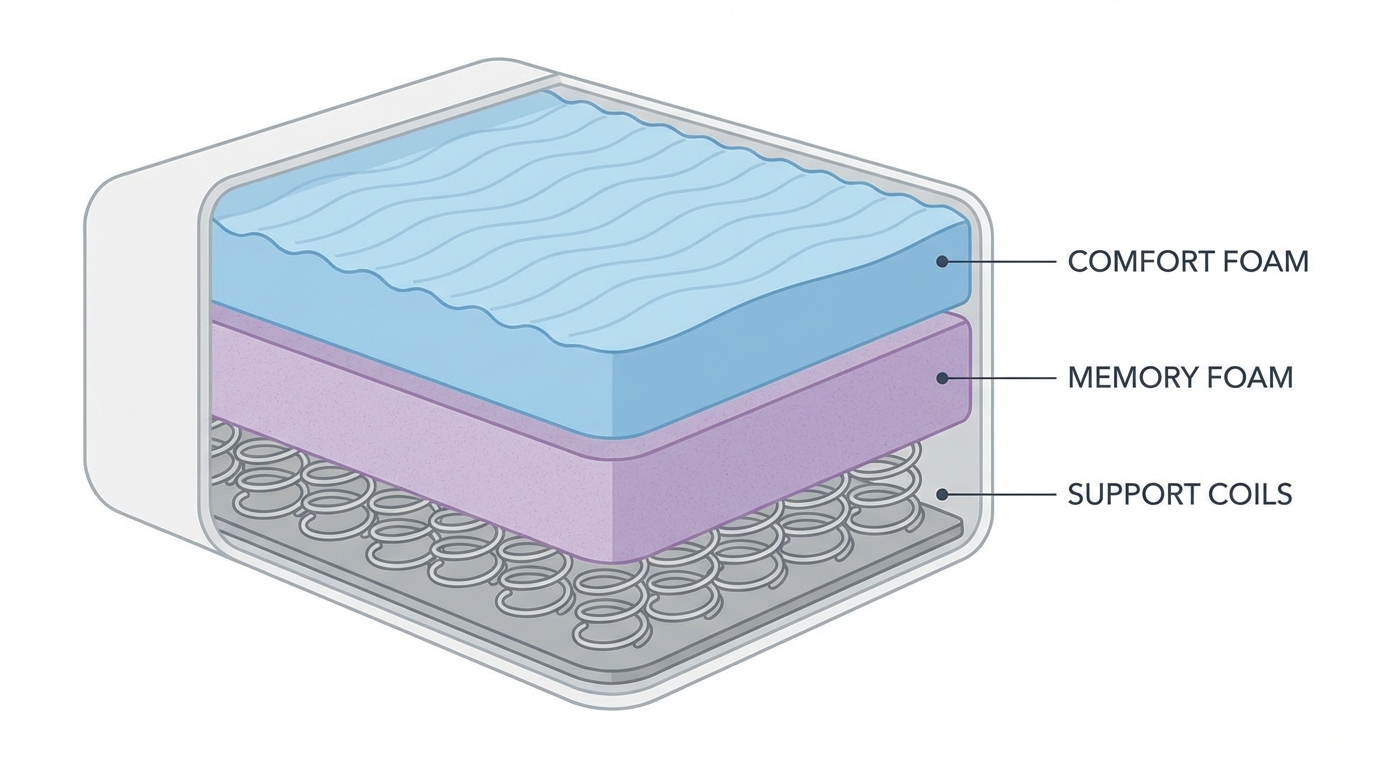
Foam mattresses use layers of different foams instead of coils. The most common are memory foam, which is slow responding and deeply contouring, and polyfoam, which can be soft or firm and tends to be a bit more responsive. Latex foam, often made from rubber tree sap, has its own unique springy feel and is naturally more breathable.
If your priority is pressure relief, especially at the shoulders and hips, foam mattresses are strong contenders. High quality foams cradle your curves and distribute your weight more evenly, which can reduce localized pressure that triggers tossing and turning. The tradeoff is that some all foam beds can feel less breathable and may trap more heat, particularly in denser memory foams without cooling features. Organizations like Consumer Reports have noted that foam mattresses often perform well in motion isolation but can vary widely in temperature performance depending on construction.
Foam is especially popular among side sleepers and people with joint pain. The key is density and layering. Denser foams in the support core resist sagging better and perform more consistently over the years, while comfort layers closer to the surface fine tune how plush or firm the bed feels. If you sleep hot but love the feel of foam, look for breathable covers, ventilated foams, and hybrid designs rather than relying solely on gel infusions to stay cool.
Hybrid Mattresses
Hybrid mattresses combine a coil support system with foam or latex comfort layers on top. Done well, hybrids can offer the best traits of both worlds: the support, airflow, and edge stability of springs with the pressure relief and contour of foams.
The feel of a hybrid is driven by the overall recipe. A coil system with a substantial layer of responsive memory foam will feel quite different from one topped with buoyant latex. Pocketed coils are common in hybrids, since they flex individually to match your shape and help keep motion from rippling across the bed. For many couples, this combination is a sweet spot that allows each partner to move without constantly waking the other.
Hybrids are often a strong match for combination sleepers who change positions at night. You get enough contouring for side sleeping without feeling stuck when you roll to your back or stomach. In , hybrids continue to dominate the mid and upper tiers of the market because they align so well with the way many people actually sleep. For example, Sleepology’s Sealy Posturepedic Elite Medium Mattress – Brenham II Euro Pillow Top uses targeted coil support with a medium feel, which works well for back and side sleepers who want a blend of cushioning and pushback.
Latex Mattresses
Latex mattresses use natural or synthetic latex foam layers for both comfort and support. High quality natural latex has a distinctly buoyant, elastic feel. It compresses under pressure but springs back quickly, so you feel more “lifted” than hugged.
Latex is often chosen by people who want a more eco conscious option, prefer a cooler and more responsive surface than traditional memory foam, or need extra durability. Studies and lab testing have found that quality latex resists body impressions better than many softer foams, which can make it a smart choice for heavier bodies or for people who want a mattress that stays consistent past the 8 to 10 year mark.
Pure latex mattresses tend to run on the pricier side, so many shoppers meet in the middle with a latex hybrid that uses coils for support and latex in the comfort layers. If you are very sensitive to chemical smells, you may also appreciate that latex mattresses typically have minimal off gassing compared to some synthetic foams, a point highlighted by several independent testing organizations.
Step 3: Match Firmness And Feel To Your Sleep Position

Once you have a feel for the types, the next piece is firmness. This is where most confusion happens, because “firm” and “soft” labels are not standardized across brands. One brand’s medium can feel like another’s plush. Rather than chasing the perfect label, focus on how the mattress interacts with your sleep position and body.
Back Sleepers
Back sleepers usually need the most balanced support. The goal is to keep your spine in its natural gentle S curve, with your shoulders and hips sinking in just enough that your lower back is supported, not floating above the surface or collapsing into it. If the mattress is too soft, your hips may sink more than your shoulders, creating a hammock shape that stresses the lumbar area. If it is too firm, your lower back can be forced into a slight arch and your upper back may carry more tension.
Research cited by the Cleveland Clinic suggests that medium firm mattresses often perform best for back pain, because they tend to keep the spine more neutral for many body types. For back sleepers, this usually translates to a mattress that feels “supportive with a bit of give.” You should be able to slide a hand under your lower back without a large gap, and you should not feel your hips sinking significantly lower than your ribcage.
Back sleepers often do well on supportive hybrids or firmer innersprings with a cushioned top. A model like the Sealy Posturepedic Pro Medium Mattress – Dupont II Euro Pillow Top is a good example, offering responsive coil support with a medium comfort level that allows your shoulders and hips to settle slightly while still holding your spine in line. If you have a history of lower back issues, emphasizing support first and layering softness with a mattress topper if needed can be a smart strategy.
“I have degenerative disc issues, so lying on anything too soft flares up my back, but rock hard mattresses make my shoulders ache. The Sleepology team steered me to a medium hybrid instead of the ultra firm one I was eyeing. I paired it with a contour pillow they suggested and I have had more consistent back relief than with anything else I tried, including a $3,000 bed I bought years ago.” – Mark S., October
Side Sleepers
Side sleeping is extremely common, and it demands a bit more finesse from a mattress. Your shoulders and hips are the widest points of your body, so they need to sink enough into the surface to align your spine straight from neck to tailbone when viewed from behind. At the same time, your midsection should not sag lower than those points.
A mattress that is too firm for your body weight will push back strongly at the shoulders and hips. Over several hours, that can compress the shoulder joint or the outside of the hip and cause numbness, tingling, or pain. A mattress that is too soft can let your spine curve like a banana, especially if you pull your knees up toward your chest. According to the Sleep Foundation, most side sleepers do best on medium soft to medium mattresses, with lighter individuals often preferring the softer end of that range and heavier individuals leaning slightly firmer.
All foam and hybrid designs with generous comfort layers often excel here because they can give at the pressure points while still holding you up through the core. The Sealy Posturepedic Elite Soft Mattress – Albany II Euro Pillow Top, for instance, wraps a plush top around a supportive coil core, which can relieve shoulder pressure for smaller side sleepers who find many beds too firm. If you share a bed with a heavier partner, you may want a slightly more supportive build, like the Sealy Posturepedic Elite Soft Mattress – Brenham II Euro Pillow Top, that uses zoning and robust coils to keep both of you aligned.
Stomach Sleepers
Stomach sleeping places a unique load on the body because most of your weight is centered at your chest, abdomen, and hips. On a mattress that is too soft, your midsection can sink significantly deeper than the rest of you, creating an exaggerated arch in the lower back and straining the small joints of the spine. This is one reason many chiropractors and sleep specialists gently encourage stomach sleepers to transition to side or back sleeping when possible.
If stomach is still your primary or fallback position, prioritize support. Most stomach sleepers do better on medium firm to firm mattresses that hold the hips up closer to level with the chest and knees. You should feel the surface pushing up under your abdomen enough that your lower back does not sway dramatically. An innerspring or hybrid with a firmer feel is often more suitable than a deeply contouring all foam bed that allows a lot of sink.
A model like the Sealy Posturepedic Plus Firm Mattress – Paterson II Euro Pillow Top is a common match we use for stomach sleepers at Sleepology, because it offers strong coil support with a euro top that keeps it from feeling like a board. If you naturally roll between stomach and side, you may want to err toward medium firm and then fine tune comfort at the shoulders with your pillow choice.
Combination And Restless Sleepers
If you change positions throughout the night, you need a mattress that is forgiving across several positions and responsive enough that you do not feel stuck when you roll. Medium and medium firm hybrids are often ideal here, as they can provide contour for side sleeping with enough bounce and support for back and occasional stomach sleeping.
The Sleep Foundation points out that combination sleepers benefit from mattresses with good responsiveness, meaning the surface recovers quickly when you move. Latex and coil systems naturally excel here. You should also pay attention to how easy it is to pivot and sit up. If you need to brace yourself to roll to your side or you feel like you are climbing out of a hole, the mattress may be too soft or have overly slow responding foams for your style of movement.
For couples where one partner is restless and the other is lighter or easily disturbed by motion, look for pocketed coil systems or high density foam cores that isolate motion better. You want the mattress to respond where you move without sending shockwaves to the other side of the bed.
Step 4: Compare Mattress Types Side By Side
With all of those variables in mind, it can help to see the main mattress types lined up together. The table below summarizes how the most common designs tend to perform across a few key attributes that matter in real life.
| Mattress Type | Typical Feel And Support | Temperature Tendency | Best Fit For |
|---|---|---|---|
| Innerspring | Buoyant, responsive, strong support from coils, thinner comfort layers | Generally cooler because of airflow through coils | Back and stomach sleepers, hot sleepers, people who like a traditional bouncy feel |
| Foam (Memory / Polyfoam) | Contouring, “hugged” feel, excellent pressure relief, motion isolation | Can sleep warmer if not ventilated or paired with cooling fabrics | Side sleepers, people with joint pain, couples needing motion isolation |
| Hybrid (Coils + Foam or Latex) | Balanced: support from coils plus cushioning from foams, moderate bounce | Typically cooler than all foam, especially with breathable covers | Combination sleepers, couples, people who want “best of both” traits |
| Latex (All Latex or Latex Hybrid) | Springy, lifted feel, responsive, good pressure relief without deep sink | Often cooler than dense memory foam, especially with airflow design | Eco minded shoppers, hot sleepers, people over 200 lbs wanting durability |
This chart is a starting point, not a rigid rulebook. Each category has softer and firmer options, and construction details like coil gauge, foam density, and quilting can change the feel dramatically. Use this to narrow your focus to one or two types that align with how you like to sleep and then evaluate specific models from there.
Step 5: Choose The Right Mattress Size For Your Space And Life
Mattress size is more than a simple question of “What fits in my room?” It also affects how well you and your partner (and sometimes kids or pets) can move, stretch, and sleep without constantly bumping into each other.
Matching Size To Sleepers And Room
Start with how many people regularly use the bed. A twin or twin XL works fine for one child, teen, or smaller adult, especially in compact spaces or dorm style rooms. A full size can be comfortable for a single adult who likes more width or for two smaller people who do not mind sleeping close, but space per person is limited. For two adults, a queen is generally the minimum comfortable size. It allows enough width that many couples can move without constant contact, and it fits well in most bedrooms.
King and California king sizes make the biggest difference for couples who prioritize personal space or who share the bed with a child or large pet. A standard king gives each person roughly the width of a twin mattress, which the Better Sleep Council points out can drastically reduce perceived motion and crowding. California king shifts some width into extra length, which taller sleepers appreciate, especially those over six feet who find their feet hanging off a queen or standard king.
Your room size, doorways, and stairs are also practical considerations. As a rule of thumb, you want at least two to three feet of clearance around each accessible side of the bed so you can walk and make the bed comfortably. A queen usually works well in a 10 by 10 foot room, while a king often needs at least 12 by 12 feet to feel proportional. Measure your space and sketch a quick layout including nightstands and dressers before committing to a larger mattress.
Accounting For Future Needs And Total Cost
When you choose a new mattress size, you are also choosing a new ecosystem of bedding. Moving from a full to a queen, for example, means new sheets, possibly a new bed frame, and ideally a mattress protector that fits properly. If you are eyeing a king or California king, factor in the cost of a larger comforter and duvet cover, which can be a meaningful increase over queen sizes.
At the same time, think ahead three to eight years. Are you planning for a long term home, adding children, or expecting to share the bed more often? It can be more cost effective to invest once in a mattress size that will serve your household for the next stage rather than buying a smaller size now and replacing it again soon. Many shoppers find that spending a bit more upfront for a queen or king that truly fits their life reduces pressure points in more ways than one.
Step 6: Consider Support Systems, Bases, And Accessories
Even the best mattress will not perform well if it is poorly supported underneath or paired with the wrong pillow on top. Treat your sleep setup as a system rather than a standalone mattress.
Foundations, Bed Frames, And Adjustable Bases
Most modern mattresses are designed to work on solid, non flexing surfaces. Slatted bed frames should have slats that are strong and close enough together to support the mattress and prevent sagging between gaps. Box springs are less common with today’s heavier foam and hybrid mattresses, and many brands now specify that their mattresses should be used with a rigid foundation instead of a springy box.
Adjustable bases are worth considering if you deal with snoring, reflux, circulation issues, or simply enjoy reading in bed. Being able to elevate the head slightly can reduce snoring in some people, and modest leg elevation can relieve pressure in the lower back and knees. If you think you may want this feature now or later, look for a mattress that is compatible with an adjustable frame, such as options in Sleepology’s Adjustable Bed Frame and Base collection.
Before buying, confirm compatibility between the mattress and the base. Foam, latex, and many hybrids do well on adjustable frames when properly supported, while some very rigid innersprings are not designed to flex repeatedly and may wear faster in that setup.
Pillows, Protectors, And Toppers
Your pillow plays a bigger role in mattress comfort than it gets credit for. Back sleepers typically need a medium loft pillow that fills the space under the neck without pushing the head forward. Side sleepers usually need a higher loft and firmer support to keep the neck in line with the spine. Stomach sleepers often do best with very low loft pillows or even no pillow at all to avoid craning the neck. If you upgrade your mattress but keep an old, ill fitting pillow, you may still wake with neck or shoulder pain.
A quality mattress protector is a quiet, non negotiable layer that guards against spills, sweat, dust mites, and allergens without materially changing the feel of the bed. It is significantly easier to wash or replace a protector than to deep clean a full mattress, and many manufacturers require a protector for warranty coverage when it comes to stains. Sleepology’s Pillows, Sheets, Toppers, Protectors collection includes protectors designed to be breathable and unobtrusive so you are not sleeping on a crinkly plastic feeling surface.
Toppers can fine tune firmness within limits. A soft topper on a medium firm mattress can add a layer of plushness for side sleepers, while a thinner, firmer topper can slightly stabilize a mattress that feels too soft. It is important to understand that a topper cannot fix severe sagging or structural breakdown in an old mattress, a point organizations like Consumer Reports and the Sleep Foundation both emphasize. Think of toppers as seasoning, not the main dish.
Step 7: Evaluate Quality, Materials, And Value
Once your shortlist is taking shape, shift your eyes from the showroom feel to what is inside the mattress. A bed that feels great for ten minutes on a sales floor or in your living room after unboxing might not hold up to nightly use for years if the materials are not up to the job.
Foam Density And Coil Construction
For foam layers, density is one of the best predictors of durability. While exact thresholds vary, higher density foams generally resist body impressions and break down more slowly under repeated compression. In independent testing, mattresses that use denser foams in the upper layers tend to maintain their feel and support longer than those with lighter, cheaper foams. If a brand is transparent about foam densities, that is usually a good sign. If you are a heavier sleeper or sharing the bed, denser foams are even more critical.
In innerspring and hybrid mattresses, pay attention to coil type and design. Pocketed coils wrapped individually in fabric respond more independently, which improves contouring and motion isolation. Coil gauge tells you about thickness, with lower numbers corresponding to thicker, potentially firmer coils. Support cores with more coils can distribute weight more evenly, but coil count alone is not everything. It should be considered alongside coil quality, gauge, and the overall design.
Hybrid systems that combine zoned coils in the center third of the mattress with reinforced edge coils can do a better job of supporting the lumbar area and providing stable seating at the edge. Sleepology’s Sealy Posturepedic Medium Mattress – Medina II Euro Pillow Top, for example, uses targeted support to keep the middle of your body from sinking too much, which can be particularly helpful if you carry more weight through the hips and midsection.
Breathability, Off Gassing, And Certifications
Temperature management is partly about construction and partly about fabric and cover design. Breathable knit fabrics, phase change materials, and airflow channels can all help a mattress stay closer to your body’s ideal thermal zone. Mayo Clinic and other medical sources highlight that cooler sleeping environments support deeper sleep stages, so choosing a mattress that does not trap heat is not just a comfort preference but a health choice for many people.
Many foam mattresses arrive compressed and can give off a temporary “new mattress” odor as volatile organic compounds, or VOCs, disperse. While levels from reputable manufacturers are generally below safety thresholds, people with asthma, respiratory sensitivities, or chemical sensitivities may prefer mattresses that are CertiPUR US certified for low VOC content or latex options with independent certifications for material purity. Letting a new mattress air out in a ventilated room for several days can further reduce any transient smell.
When you see eco or health related claims, look for recognized third party certifications rather than vague language. Serious brands provide specifics about what is being certified and by whom, which you can cross reference on the issuing organization’s website if you like.
Understanding Price Ranges And Value
Mattresses span a huge price range, from under $500 to well into five figures. The good news is that you can find solid, supportive options in the $700 to $2,000 range for a queen if you shop thoughtfully. According to several industry surveys, including those summarized by Consumer Reports and mattress associations, price tends to track with material quality and extra features, but there are always outliers, both bargains and overpriced models.
A practical way to think about mattress value is on a per night basis. If you spend $1,500 on a mattress that lasts 9 years and you sleep on it 330 nights per year, your cost per night is about 50 cents. If a cheaper mattress for $700 develops significant sagging in 3 years and you replace it, your effective cost may be higher in both money and comfort. Balance your budget with realistic expectations about longevity and your body’s needs.
Be cautious of perpetual “80 percent off” style sales or pressure tactics. As many consumer advocacy groups have noted, some retailers inflate sticker prices to advertise a larger discount. Focus more on the final out the door price, including delivery, setup, and old mattress removal if needed, and compare across models with similar materials and construction.
“We walked into Sleepology with a strict $1,200 budget and a lot of skepticism. I expected to be pushed toward something more expensive, but instead we got a clear explanation of what actually changes as you move up in price. We ended up with a queen hybrid that came in under our budget, and Mia even pointed out a less expensive model than the one I had been looking at because she thought it suited our sleep habits better. Three months later, we are still saying ‘I love this bed’ when we lie down.” – Alicia P., December
Step 8: Test, Decide, And Use Your Trial Period Wisely
Even the most informed research needs to be grounded in your actual experience on a specific mattress. The final step is to test thoughtfully and use return or exchange policies intentionally rather than as an afterthought.
How To Test A Mattress In Store
If you can visit a showroom, wear comfortable clothes and plan to spend at least 10 to 15 minutes on each serious candidate. Lie in your normal sleep position and a second common position. Allow your body to relax fully, which can take several minutes, and tune in to how your hips, shoulders, and lower back feel. There should be no sharp pressure or obvious sagging.
Ask a partner or a Sleepology associate to take a photo of you from the side while you lie naturally. Your spine should form a relatively neutral line with gentle curves, not a deep sway or C shape. Try sitting on the edge to assess edge support and note how easy it is to roll from side to side, especially if you are a combination sleeper.
Do not be shy about going back and forth between two contenders. Subtle differences become more apparent with direct contrast. Remind yourself that comfort is subjective; your job is to notice your own body, not to match a reviewer’s opinion.
How To Use An At Home Trial
If you buy online or even from a store that offers a generous trial period, treat your first 30 to 90 nights as a structured test, not a passive wait and see. Many sleep experts, including those cited by the Sleep Foundation, note that your body can take several weeks to adjust to a new support system, especially if you are coming from a very different mattress.
During the trial, keep a simple sleep journal. Note your bedtime, wake time, perceived sleep quality, and any pain or stiffness on waking. Patterns over several weeks are more meaningful than any one night. If something feels off consistently, such as persistent shoulder pain or feeling too hot, contact the retailer rather than trying to simply tolerate it. Brands like Sleepology are used to fine tuning setups, whether that means swapping for a different firmness, adding a topper, or adjusting your pillow and base.
Before your trial window closes, revisit your initial reasons for buying a new mattress. Are you sleeping more deeply, waking more refreshed, and experiencing fewer aches? If yes, you have likely found a good match. If not, give yourself permission to return or exchange. A mattress is too important a surface to accept “almost good enough” for the next decade.
Conclusion: Bringing It All Together With Confidence
Learning how to choose a mattress is really about learning how to listen to your body and translate that into materials, firmness levels, and constructions that support you. When you understand your sleep position, body type, temperature preferences, and room constraints, the sea of options begins to narrow into a manageable path instead of an overwhelming maze.
The right mattress keeps your spine aligned, relieves pressure where you are heaviest, and maintains a comfortable temperature so your brain can move through the deep and REM stages of sleep that restore memory, mood, and physical recovery. Trusted sources like the Sleep Foundation and major medical centers consistently emphasize that sleep quality is just as important as sleep quantity, and your mattress choice is one of the few levers you fully control.
If you feel unsure about making the leap from research to purchase, you do not have to do it alone. At Sleepology, our role is to help you connect these principles to real products, whether that leads you to a plush euro top like the Sealy Posturepedic Plus Soft Mattress – Paterson II Euro Pillow Top, a balanced medium hybrid for back sleeping, or a firmer option that respects your spine when you sleep on your stomach. With clear questions, honest guidance, and a thoughtful trial period, you can move from “I hope this is right” to “I know why this works for me.”
Ultimately, your mattress should feel like a quiet partner that makes the rest of your life easier. When you wake up with fewer aches, more energy, and a sense that your bed is truly working for you, all the measuring, testing, and careful choices are worth it. You deserve a sleep setup that supports the way you live now and where you are heading next.
Frequently Asked Questions
How often should I replace my mattress if I want consistent support?
Most quality mattresses provide good support for about 7 to 10 years, but there is no single expiration date. You should consider replacement when you notice visible sagging, lumps, or impressions that do not spring back, or when you consistently wake with new aches that ease when you sleep elsewhere, such as in a hotel. Heavier bodies and families who share beds with kids or pets may see faster wear in the top layers, especially on lower density foam. Instead of relying on age alone, use your body’s feedback, visible changes in the surface, and your sleep quality over the past several months as your primary guides.
What is the best mattress firmness for chronic lower back pain?
There is no universal firmness that cures back pain, but research, including a study often referenced by back pain specialists, has found that medium firm mattresses tend to outperform very firm surfaces for many people with lower back pain. A medium firm feel usually allows the hips and shoulders to sink just enough to keep the spine neutral while still providing robust support. If you have lower back pain and sleep mostly on your back or side, a supportive hybrid or innerspring with a medium or medium firm comfort level is a good starting point. For personalized care, always combine mattress changes with guidance from your healthcare provider or physical therapist.
Will a more expensive mattress automatically last longer and feel better?
Price and quality are related but not perfectly. Higher prices often reflect denser foams, more sophisticated coil systems, better edge support, and upgraded fabrics, all of which can improve durability and comfort. However, some mid priced mattresses use excellent materials and thoughtful designs, while some very expensive options focus more on luxury aesthetics than meaningful performance gains. To judge value, look at what you are actually getting for the price: foam density, coil type, build quality, trial period, and warranty. A well built mattress in the $1,000 to $2,000 range, chosen correctly, can outperform a more expensive but poorly matched bed.
How can couples with different firmness preferences share one mattress happily?
Start by prioritizing the person with more significant pain or orthopedic needs, as medical comfort should come first. Beyond that, couples often succeed with a medium to medium firm hybrid that provides a neutral base, then customize each side with different pillows and, if needed, individual toppers. For king sizes, some couples place a twin XL topper on one side to create more plushness. Mattresses with zoned coils or slightly thicker comfort layers can also adapt better to two different body types. Motion isolation is important as well, so look for pocketed coils or quality foam cores that reduce disturbance when one partner moves.
Are “cooling” mattresses really cooler, or is that mostly marketing?
Some cooling technologies genuinely help, while others make only a subtle difference. Construction plays the largest role. Innersprings and many hybrids naturally allow more airflow than solid foam cores, which can keep surface temperatures closer to room temperature. Breathable fabrics, phase change materials, and ventilated foams can further improve temperature regulation. Gel infusions may feel cool to the touch initially but tend to warm to body temperature over the night. If you are a true hot sleeper, prioritize overall breathability, coil support, and lighter, moisture wicking bedding over relying solely on a single cooling feature.
Can a mattress topper fix an old mattress that is already sagging?
A topper can fine tune comfort on a mattress that is slightly too firm or add a bit of cushioning for side sleepers, but it cannot fix structural sagging or deep body impressions. If the support core of your mattress has broken down, the topper will simply follow the existing dips, often making the bed feel even less stable. This is why consumer organizations and sleep experts consistently advise replacing mattresses that show significant sagging rather than trying to patch them with toppers. Use a topper to refine, not rescue, and invest in a new mattress when the underlying support is no longer sound.
Is it okay to put a new mattress on my old box spring or slatted frame?
It depends on the condition and design of the existing support. Many modern mattresses, especially heavier foam and hybrid models, are designed for solid, non flexing foundations. An older box spring that flexes significantly can undermine support, void warranties, and shorten the life of your new mattress. Slatted frames can work well if the slats are sturdy and spaced closely enough to prevent the mattress from bowing between them. Before placing a new mattress on an old base, check the manufacturer’s support guidelines and inspect your frame for squeaks, sagging, or broken slats. Upgrading to a compatible foundation or an adjustable base is often a wise investment in the longevity and performance of your new mattress.