

A queen mattress usually costs $600 to $2,500, with the sweet spot for everyday sleep sitting between $1,000 and $1,700. Below $500, the trade-offs in support and durability become real problems for most daily sleepers. Above $2,000, you are paying for premium materials, advanced cooling, and brand service programs that go beyond what most people actually need. Sleepology carries queen mattresses across all of those tiers, from firm Sealy builds at $999 to Tempur-Pedic and Sealy Elite models built to hold up for a decade. Read through the tiers below, match them to your situation, and you will have a clear, short shopping list by the end.
What a Queen Mattress Costs in 2026
NapLab, which tested more than 208 hybrid mattresses in 2026, puts the average queen hybrid at $1,529. The average queen memory foam hybrid runs a bit higher, at $1,628. Good Housekeeping's Institute found in its 2026 buyer testing that most well-built queen hybrids fall between $1,500 and $2,000 at regular retail pricing, though Tom's Guide tracked popular models actually selling between $649 and $1,499 during promotions. Those numbers give you a solid anchor when you are trying to figure out whether a price you are looking at is fair.
The table below maps the broader landscape by mattress type:
| Queen Mattress Type | Typical Price Range | Who It Usually Suits |
|---|---|---|
| Budget foam or basic innerspring | $300 to $700 | Guest rooms, temporary setups, tight budgets |
| Good quality memory foam | $600 to $1,200 | Side sleepers who want pressure relief at a reasonable price |
| Hybrid (coils + foam) | $900 to $2,000 | Couples, combination sleepers, anyone who sleeps hot |
| Premium hybrid or latex | $1,500 to $3,000+ | Chronic pain, heavier builds, or buyers who want 10+ year longevity |
| Luxury (Tempur-Pedic, Stearns and Foster) | $2,000 to $5,000+ | Advanced cooling, proprietary materials, extended brand warranties |
These are ranges, not guarantees. A $900 hybrid from an established brand can outperform a $1,400 hybrid from a brand with no track record. What matters is whether the price lines up with the construction, the warranty, and the company behind it.
Why You Should Be Cautious Under $500
For a queen mattress, be cautious under $500 unless it is for a guest room or short-term use. That is not overly conservative advice. At that price point, something usually has to give, and it tends to be foam density, coil gauge, or both.
Lower density foams feel soft initially but compress faster. Most will start showing body impressions within 3 to 4 years of nightly use, sometimes sooner for heavier sleepers or couples. Mayo Clinic's sleep guidance notes that a worn-out or unsupportive mattress contributes to poor sleep quality and morning stiffness, which compounds over time. Interconnected coil systems, common in budget builds, also transfer movement between partners and tend to squeak earlier than individually wrapped systems.
None of that means cheap beds are useless. A $400 innerspring is a reasonable call for a guest room that sees 30 nights per year, not 365. For a spare bedroom or a college apartment where the bed will be replaced in a few years anyway, the math can work. Just do not expect it to be your best sleep for the next decade.
The $1,000 to $1,700 Sweet Spot for Everyday Sleep
For everyday sleep, the best value is usually $1,000 to $1,700. In this band, you start getting construction details that meaningfully change how the mattress performs and how long it lasts.
Individually wrapped coils replace interconnected springs, which cuts motion transfer and gives each part of the bed more independent response. Foam densities improve, meaning less early sagging and better shape retention over years. Warranties from established brands become specific and enforceable, covering sagging of 1.5 inches or more rather than the vague language that sometimes shows up on budget products. The Sleep Foundation notes that mattress support directly affects sleep continuity and musculoskeletal recovery during sleep, and this tier is where consistent support first becomes the norm rather than the exception.
The Sealy Posturepedic Plus Medium Hybrid at $1,199 and the Sealy Posturepedic Pro Medium Hybrid at $1,499 sit squarely in this range. Both use real individually wrapped coil systems with targeted support foams. Both come with clear Sealy warranties and trial terms. For most people shopping for an everyday queen, these two are the first conversations worth having.
"I went into Sleepology thinking I would spend $600 and be done. Mia walked me through what I would actually get at that level versus a step up. I ended up around $1,400 on a hybrid, and three months in, it was money very well spent." – Karen L., verified customer
What You Are Paying for Above $2,000
Above $2,000, you are usually paying for premium materials, better pressure relief, cooling technology, brand reputation, delivery service, or longer warranty and trial terms. That is not a knock on the category. Those things have real value for the right buyer. The question is whether they are the right value for you.
Zoned coil systems that shift firmness under the hips versus the shoulders can make a meaningful difference for people with chronic back or hip issues. Tempur-Pedic's TEMPUR material is engineered to conform to specific pressure loads rather than just softening uniformly, which is why it performs differently than standard memory foam. Advanced cooling fabrics like TENCEL and phase-change materials in Sealy's Elite and Stearns and Foster lines can drop perceived sleeping temperature by several degrees, which matters a lot if you or your partner runs hot.
The Sleep Foundation's research on sleep temperature regulation shows that keeping core body temperature slightly lower during sleep is associated with better deep sleep and fewer nighttime arousals. If cooling matters to you, it is worth paying for. If you sleep at a neutral temperature and do not have chronic pain, you may get 90 percent of what you need from a well-built $1,500 hybrid.
"I was nervous about spending over $2,000 on a queen. Mia broke it down as a cost per night over 10 years. It came out to less than we spend on streaming each month. The upgrade in sleep quality from our old mattress has honestly been bigger than I expected." – James R., verified customer
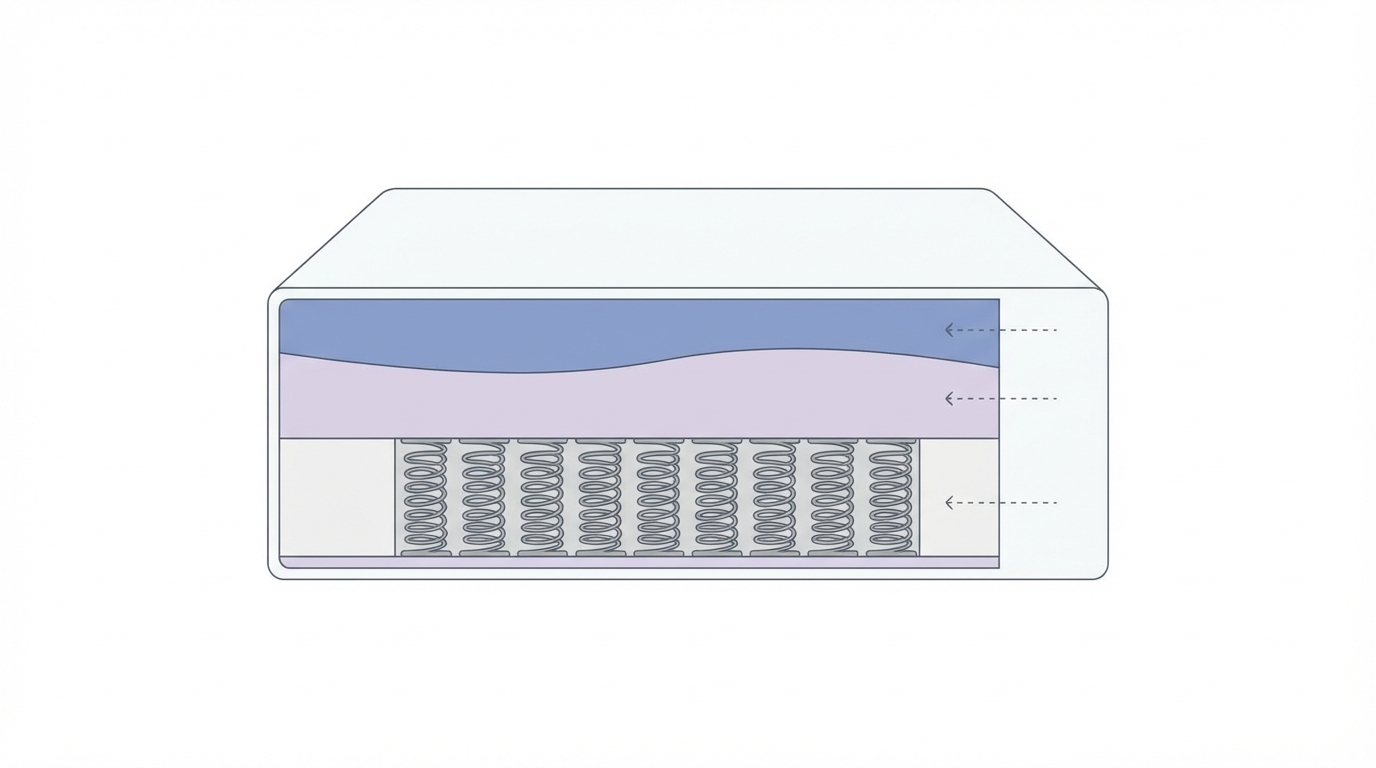
How Mattress Type Changes the Queen Price
Innerspring Queens
Basic innerspring queens start around $400 and climb to about $1,500 as you add more coils, better foams, and thicker pillow tops. Back and stomach sleepers often prefer the firmer pushback from coil systems. At the lower end, expect interconnected coils and thin comfort layers. Mid-range innerspring builds with individually wrapped coils and a decent euro pillow top can perform well for years and often cost less than a comparable hybrid, which is part of their appeal.
Memory Foam Queens
All-foam queens typically run from $500 to about $2,500, with the quality spread tied almost entirely to foam density. Higher density foams resist body impressions longer and hold their shape better across years of use. Side sleepers who need shoulder and hip pressure relief often find all-foam a good fit. The trade-off with lower-priced foam is heat retention, since foam without coil channels for airflow can sleep warmer than a hybrid at the same price point.
Hybrid Queens
Hybrids are the most popular category at Sleepology, and for good reason. Coils provide airflow and a responsive feel. Foam or latex comfort layers add contouring and pressure relief. The combination usually outperforms either type alone for couples with different sleep needs. NapLab's 2026 data puts the average queen hybrid at $1,529. Budget hybrids can start around $900, though the coil systems and foam densities at that price are more basic. The sweet spot for build quality in a hybrid tends to land between $1,200 and $1,900.
Latex and Specialty Queens
Natural latex queens start around $1,500 and commonly exceed $3,000. The cost reflects the raw material and more labor-intensive construction. Latex is more responsive and naturally breathable than memory foam, and well-made latex beds hold their shape longer than most foam builds. Sleepopolis put the typical queen latex range at $1,000 to $2,195 for the midtier. If natural materials and long-term durability are priorities, the premium can make sense. For most everyday shoppers, a well-built hybrid delivers comparable performance at a lower entry cost.
How Sleepology Handles Every Price Tier
Most retail environments make it difficult to compare queen mattress value honestly. Perpetual "50% off" pricing, vague specs, and commission-driven sales staff all work against you. Sleepology is structured differently. Every model on the floor can be tested in person, every price is clearly stated, and the Sleepologists are paid to find your best fit, not the highest-margin item.
| What to Evaluate | Typical General Retailer | Sleepology |
|---|---|---|
| Price transparency | Frequent "sale" markups that inflate original prices | Straightforward per-tier pricing with no artificial markdowns |
| In-store testing | Varies by location and format | Every model on the floor is available to test |
| Expert guidance | Commission-based sales staff with varying product knowledge | Certified Sleepologists, no pressure, matched to your sleep needs |
| Trial period | 90 to 365 nights, often with fine print | Brand-standard trial terms explained clearly before purchase |
| Return and pickup fees | $100 to $400 pickup fees common, often disclosed late | Fees disclosed upfront, no surprises at return time |
| Warranty support | Claims handled through manufacturer directly | Sleepology assists with manufacturer warranty processes |
| Post-purchase support | Usually none after delivery | Ongoing sleep guidance from your Sleepologist |
"We originally went in asking about latex because we heard it was the best. Mia walked us back and showed us a hybrid that checked all our boxes at a lower price. I appreciated that she never pushed the most expensive thing just because she could." – Daniel P., verified customer
6 Queen Mattresses Worth Looking At
These six span the price tiers in this guide, from the value tier to premium builds. Each is available to test at Sleepology.


What Else Changes the Real Cost of a Queen Mattress
The price on the product page is not the full number. A few additional costs show up at checkout or after delivery, and knowing about them ahead of time makes comparisons more honest.
Foundation and Frame
A queen mattress needs proper support underneath. If your existing foundation has slats that are more than 3 inches apart, or the frame itself is visibly worn, you may need a new base. Platform frames with solid slat support can run $150 to $400. A box spring or bunkie board adds another $200 to $500 depending on the brand. Skipping this step can accelerate mattress wear and may void your warranty.
Mattress Protector
A protector is not optional if you care about the warranty. Most manufacturers will not honor impressions claims on a stained mattress. A quality waterproof protector runs $50 to $150 and extends the effective warranty period by keeping the mattress in claim-eligible condition. At Sleepology, we include protector recommendations with every mattress purchase because of how often this trips people up later.
Delivery, Setup, and Old Mattress Removal
Some retailers roll delivery into the price. Others charge $100 to $300 for in-home delivery and setup, and another $50 to $150 to haul away an old mattress. When you are comparing two queen mattresses that look similarly priced, check what delivery terms are attached to each. A bed that costs $100 more but includes free setup and haul-away can be the better deal.
Return and Pickup Fees
Trial periods sound clean until a return is needed. Some retailers charge $200 to $400 to pick up a returned mattress, which effectively adds that amount of risk to the purchase. Ask about this before buying. Consumer Reports has highlighted hidden return fees as one of the most common ways shoppers feel burned by mattress purchases. Knowing the fee structure upfront is part of evaluating total cost.
Before You Buy: A Checklist for Any Queen Mattress
Use this before committing. It covers what actually matters across any retailer and any price point.
- Does the price match the type and construction? Compare it against the ranges in this guide to see if it is realistic.
- Is the brand established with a track record? Look for warranty claims data, not just marketing language.
- Are the foam densities or coil specifications listed somewhere? Vague specs are a warning sign at any price.
- Is the trial period real? Check the minimum nights required before a return is allowed and whether pickup fees apply.
- Does the warranty specify a sagging threshold? Look for 1 to 1.5 inches, not vague "defects in materials."
- Is delivery and setup included, or priced separately? Factor it into the comparison.
- Can you test it in person? For a purchase you will use 3,000 nights, 15 minutes on a showroom floor is worth the trip.
- Does the retailer have someone who can match the mattress to your sleep position and body type?

Not sure which tier is right for you?
At Sleepology, our Sleepologists match you to the right queen mattress based on how you sleep, your body type, and your budget. No commissions, no pressure. Just an honest conversation about what will actually help you sleep better.
Shop All Mattresses or call 877-631-8383