

How Long Is a Queen Size Mattress, Really? A Complete Guide To Queen Dimensions, Room Fit, And Sleep Comfort
If you are squinting at a tape measure, trying to picture whether a queen mattress will actually fit in your room, you are not alone. I talk to people every week who are torn between full, queen, and king, and most of the anxiety comes down to a very simple question: how long is a queen size mattress and will my space, body, and budget all cooperate. When you are dealing with tight rooms, tall partners, or existing furniture, a couple of inches can feel like a very big deal.
The size of your mattress is more than a technical specification. It affects how well you sleep, how easily you can move around your bedroom, and even how rested you feel at work the next day. According to the Sleep Foundation, most adults need 7 to 9 hours of sleep per night for optimal health, and comfort and space in bed are key parts of getting that sleep consistently. When the mattress is too short or the room feels cramped, you end up sleeping in awkward positions, waking more often, and starting the day already behind.
You are here because you want a clear, confident answer, not a confusing mix of charts and jargon. You want to know the exact length of a queen mattress, how that compares to other sizes, what it means if you or your partner are tall, and how to make a queen work in real bedrooms, not just in glossy showroom photos. You also probably want reassurance that choosing queen is not a compromise on comfort, but a smart, intentional decision.
You are in the right place. We will walk through standard queen dimensions, real world size tolerances, how long a queen works for different heights and sleep styles, and how to lay out your room so everything fits and still feels calm. Along the way, I will point to research from sources like the Sleep Foundation and Mayo Clinic, share what I see every day as a Sleepologist at Sleepology, and help you connect the numbers on a tape measure to the way you actually live and sleep.
Queen Mattress Dimensions: Width, Length, And What “60 x 80” Actually Means
When people ask how long a queen size mattress is, the short, official answer is simple: a standard queen mattress is 80 inches long and 60 inches wide. That translates to roughly 5 feet by 6 feet 8 inches. In centimeters, that is about 152 cm wide by 203 cm long, which is the same basic spec you will see from U.S. manufacturers, most Canadian brands, and major national retailers.
Those measurements are considered the standard for a “queen” label in North America. Industry groups and retailers base bedding, frames, and accessories on that 60 x 80 template because, as market research shows, queen is the most popular mattress size worldwide, accounting for close to half of mattress sales. That popularity only works if the size itself is predictable, so most factories aim as closely as they can at those numbers for foam, hybrid, and innerspring models.
In real bedrooms, though, very few mattresses come in at exactly 60.000 by 80.000 inches. As several manufacturers quietly note in their size charts, there is typically a tolerance of up to about 1 inch in either direction because many parts of the build process are still done by hand. Foam mattresses tend to be more precise, while traditional innersprings can vary a bit more. If you measure a queen on your floor and get 59 by 79 inches, that does not mean it is “wrong.” It is simply at the small end of the normal range.
Another factor shoppers forget to account for is thickness, which can change how long a mattress feels, especially at the foot of the bed. A very thick pillow top can create a slight incline or extra softness that makes taller sleepers slide down in the night, effectively shortening the usable length. On the other hand, a medium profile mattress, such as a Sealy Posturepedic Firm Mattress – Medina II, keeps a more level surface so you use every bit of the 80 inch length without feeling like you are sinking toward the center.
It is also common to ask whether any “queen” might be longer than 80 inches, perhaps to accommodate taller sleepers. The standard queen stays at 80 inches. If you see longer specs, you are usually looking at specialty sizes like “California queen” or an RV short queen, not a regular queen. For most shoppers, focusing on the 60 x 80 footprint, plus a small tolerance, is the best way to plan your room, frame, and bedding without surprises.
“Mia walked me through the difference between what is on the tag and what actually shows up with a tape measure. We were worried our ‘queen’ would be too short, but she explained the tolerances and helped us pick a model that used its full 80 inches. It fits our room and my 6'3" husband perfectly.” – Rachel P., November
How Queen Length Compares To Other Mattress Sizes
Understanding how long a queen mattress is means seeing it in context. That 80 inch length is not unique to queen. It appears in several other sizes, while the true length outlier is actually the California king. Knowing these relationships can help you choose between sizes more confidently, especially if you are debating whether you need to move up to a king for length alone.
Queen vs Full: How Much Longer And Wider?
A full mattress, sometimes called a double, typically measures 54 inches wide by 75 inches long. That means a queen adds 6 inches of width and 5 inches of length. In practical terms, moving from full to queen gives each sleeper roughly 3 extra inches of shoulder room and makes the bed feel less like a “tight fit” for couples.
For height, that extra 5 inches at the foot can make a real difference for sleepers around 6 feet tall. A 75 inch long full technically accommodates someone up to about 6 feet 3 inches, but only if they do not mind their toes being at the very edge. Many people above 5 feet 10 inches find a full too short over time, especially if they prefer sleeping on their back where the body naturally stretches out. With queen’s 80 inch length, there is breathing room for tall and medium height sleepers without needing to jump all the way to a king.
If you are upgrading from a full because you feel cramped, a queen often hits a sweet spot. You can keep a modest bedroom layout, usually without changing your nightstands or blocking doors, while making space for two adults to sleep without constant elbow bumps. That is one reason queen is a go to recommendation for couples moving out of smaller city apartments into a first home.
Queen vs King: Length Twins, Width Siblings
One of the biggest surprises to many shoppers is that a standard king is not longer than a queen. A king mattress is 76 inches wide and 80 inches long, so it shares the same length as a queen and simply adds 16 inches of width. For a pair of sleepers, that translates to about 8 inches of extra space per person, which can feel luxurious if one or both of you tosses and turns.
If you are considering a king purely because you are tall, it may not solve the problem. Someone who finds a queen too short will usually find a standard king too short as well, since the 80 inch dimension is identical. In my work with tall clients, I often see people surprised and a little frustrated when they realize their very expensive new king still leaves their feet close to or hanging off the edge.
Where king shines is for couples who want maximum personal space side by side, families co sleeping with a young child, or pet owners sharing with a large dog. If you often wake because a partner’s movements shake the bed, choosing a supportive, low motion transfer king, such as the Sealy Posturepedic Medium Mattress – Medina II Euro Pillow Top, plus a sturdy frame, can make a noticeable difference without changing the length you are used to.
Queen vs California King: The Real “Long” Mattress
The California king is the size that actually changes the length. At 72 inches wide by 84 inches long, it is 4 inches narrower and 4 inches longer than a standard king. Compared with a queen, you gain 4 inches in length and 12 inches in width. For very tall sleepers, those extra 4 inches at the foot can be the difference between curling the legs all night and finally stretching out.
Sleep research suggests that spinal alignment and neutral joint positioning support better sleep and less morning pain, something the Mayo Clinic and Cleveland Clinic both emphasize in their back pain guidance. For a person over about 6 feet 4 inches, a queen or standard king often forces subtle bending at the knees or ankles. After years of that habit, the strain can add up. A California king can relieve that, especially when paired with a supportive hybrid like the Sealy Posturepedic Elite Medium Mattress – Brenham II Euro Pillow Top that keeps the spine aligned across the whole length.
The tradeoff is room space and bedding availability. California kings require a larger footprint and slightly more specialized sheets and protectors. If your main concern is length for a very tall sleeper, and your room and budget allow, it is the logical step up from queen. If you simply want “more bed,” but are average height, staying with queen or standard king usually meets your needs more simply.
“We were convinced we had to jump to a king, but Mia explained that for our height a queen and king are the same length. We went with a queen hybrid she recommended and used the savings on better sheets. It feels roomy enough for both of us, and we didn’t have to rearrange the whole bedroom.” – Daniel K., October
How Long Is “Long Enough”? Queen Length And Your Height

Once you know a queen mattress is 80 inches long, the next question is very personal: will that length actually work for you and anyone you share the bed with. Height, sleep position, and how close you like to sleep all play a role. What feels perfectly fine for one person can feel cramped for another, even on the exact same mattress.
Matching Queen Length To Your Height
A helpful way to think about mattress length is to give yourself a small buffer beyond your height, rather than matching it exactly. If you are 6 feet tall, which is 72 inches, an 80 inch mattress gives you roughly 8 inches of total extra length to divide between your head and feet. In reality, your head is usually supported by a pillow, not the very top edge, so some of that length is used there. Most sleepers naturally position themselves a little below the headboard line.
For people around 5 feet 4 inches to about 6 feet 2 inches, a queen is generally comfortable in terms of length, assuming a sensible pillow setup. Once you approach 6 feet 3 inches or more, you may notice that your feet get very close to the end, especially if you like to sleep on your back and fully extend your legs. At 6 feet 5 inches or taller, you will likely feel the edges more often and may benefit from either a California king or strategies that effectively give you more head to foot space.
When you shop, it can help to physically lie down in a queen in the position you actually use at home, not just a quick flat back test. Roll to your side, curl slightly if that is your norm, or stretch your legs in that way you do right before drifting off. If your toes already feel close to the end in the showroom, that impression will only increase once you add bedding, pillows, and real nightly use.
Sleep Position, Pillows, And “Effective” Length
Your sleep position changes how much of the 80 inches you use. Side sleepers often tuck their knees, which shortens the body’s footprint and makes a queen feel effectively longer. Back sleepers, especially those who place their arms above their heads, may use more of the total length. Stomach sleepers tend to extend the toes and feet, so they may feel the lower edge more often if the mattress is marginal in length for their height.
Pillow choice also matters. A very high or stacked pillow setup shifts your head down the mattress, which can steal an inch or two from your feet. A more balanced pillow, such as The BodyPillow by Tempur-Pedic for side sleepers or a medium profile ergonomic pillow for back sleepers, keeps your head and neck aligned without pushing you far from the top of the bed. That, in turn, leaves more of the queen’s length available to your legs.
It is also worth considering how much you move. Research on sleep efficiency shows that restless sleepers often migrate within the bed more than they realize, occasionally ending up higher or lower than where they started. If you tend to wake sideways across the bed or with your feet pressed into the footboard, erring on more length, or at least a supportive edge, can help reduce those jarring wake ups.
When A Queen Is Too Short And What To Do
There are genuine cases where a queen’s 80 inch length is not ideal. Very tall individuals, especially those 6 feet 5 inches or above, often feel undersupported on both queen and standard king. Over time, they either curl up more than is comfortable or sleep at a slight diagonal, which steals space from a partner. In these situations, I candidly recommend either a California king or a custom solution, because length is directly connected to spinal alignment and comfort.
External guidance backs this up. The Sleep Foundation notes that taller sleepers often benefit from longer mattress sizes, such as California king, specifically to maintain neutral posture during sleep. Similarly, Cleveland Clinic experts emphasize that the spine should be as neutral as possible overnight, with enough room to extend the legs without forced bending at the knees or hips. For some bodies, a queen simply does not provide that.
If your height is in the “borderline” range, say 6 feet 3 inches to 6 feet 4 inches, and your room cannot accommodate a larger bed, you can still make a queen work more comfortably. Choosing a model that uses its full 80 inches, avoiding overly bulky headboards that consume usable space, and using a slightly lower pillow profile can collectively free up an extra inch or two of functional length. Pairing your queen with an adjustable bed frame also lets you elevate your legs a bit, which changes how your body distributes along the mattress and can reduce that “toes off the edge” sensation.
Room Size, Layout, And Making A Queen Actually Fit
Knowing that a queen mattress is 60 by 80 inches is one thing. Making it coexist with doors, dressers, closets, and real life is another. Room planning is where a lot of stress shows up for shoppers, especially when online photos make every bedroom look as big as a small studio apartment. The good news is that queen is designed to work in average sized rooms, as long as you plan ahead.
Minimum Room Size For A Queen
Most design and sleep experts suggest that a bedroom should be at least 10 by 10 feet to accommodate a queen bed comfortably. That guideline gives you enough space to walk around, open drawers, and make the bed without feeling like a contortionist. A 10 by 12 foot room is even more forgiving, especially if you like having two nightstands and a dresser in the same space.
Room size guidance from mattress brands and interior designers generally all aligns around this range, because once you subtract the 5 feet of bed width from a 10 foot wall, you still have roughly 2 and a half feet of clearance on each side. That 24 to 30 inch walkway is important. The National Sleep Foundation and similar organizations frequently remind people to keep bedrooms clutter free and easy to move in, since your environment shapes how relaxed your brain feels when you lie down.
In slightly smaller rooms, such as 9 by 10 feet, a queen can still work, but you will want to be more careful about furniture choice and placement. Slimmer nightstands, wall mounted lighting, and perhaps a single dresser instead of two can help. If your room is significantly smaller than 9 by 10, it may be worth considering a full, especially if you are sleeping solo, to keep the space airy and calming.
Measuring For Fit: Beyond Just The Floor
One mistake I see often is measuring only the floor area where the mattress will sit, without considering the path it needs to travel to get there. An 80 inch long mattress has to go around corners, up stairs, and through doorways, and some older homes simply do not give you that clean, long straight shot. That is where careful measuring keeps you from heartache on delivery day.
Start with doorways. Standard interior doors in many U.S. homes are between 28 and 32 inches wide, sometimes up to 36 inches. A queen can usually angle through, but if your door is on the narrower side and the hall is tight, you want to know that before the mattress arrives. Then look at staircases and hall turns. Low ceilings at landings or sharp angles can make it harder to maneuver an 80 inch slab of mattress, even if the room itself is large enough.
If your home layout is particularly tight, foam and boxed mattresses that arrive compressed can be a practical solution, since you can carry them in more compact form. At Sleepology, we help customers assess things like turns and ceiling heights before we suggest a specific model, because the nicest mattress in the world is useless if it never makes it to your bedroom. A quick phone call with dimensions can save a lot of frustration later.
Making A Queen Work In Smaller Or Awkward Rooms
Even when the raw numbers say a queen will fit, the layout can still feel cramped if you are not thoughtful. Smaller bedrooms, attic rooms with sloped ceilings, and spaces with multiple doorways or windows benefit from a more deliberate plan. Placing the queen against the longest uninterrupted wall usually works best, central enough to allow access on both sides so one partner is not trapped against a wall.
In particularly narrow rooms, consider swapping a deep dresser for a taller, narrower chest of drawers to free up floor space. Mounting bedside lamps on the wall instead of using bulky table lamps is another trick I often suggest to make a queen feel more at home in a compact room. Choosing a medium profile mattress instead of an ultra tall one can also keep the bed from visually overpowering the space.
It can help to tape out the 60 by 80 inch footprint on the floor before you buy. Use painter’s tape or cardboard boxes to outline where the mattress will sit, then walk around, open doors, pretend to make the bed, and see how it feels. That simple exercise often reassures people that queen is workable, or honestly confirms that stepping down a size is the less stressful choice.
“Our bedroom is just under 10 by 10, and I was terrified a queen would make it feel like a storage unit. Mia had us tape out the space and suggested wall mounted lamps and a slimmer dresser. We went ahead with the queen, and it actually feels more luxurious now, not cramped.” – Lila S., December
Queen Size Variations: Short Queen, Olympic Queen, And Other “Almost” Queens
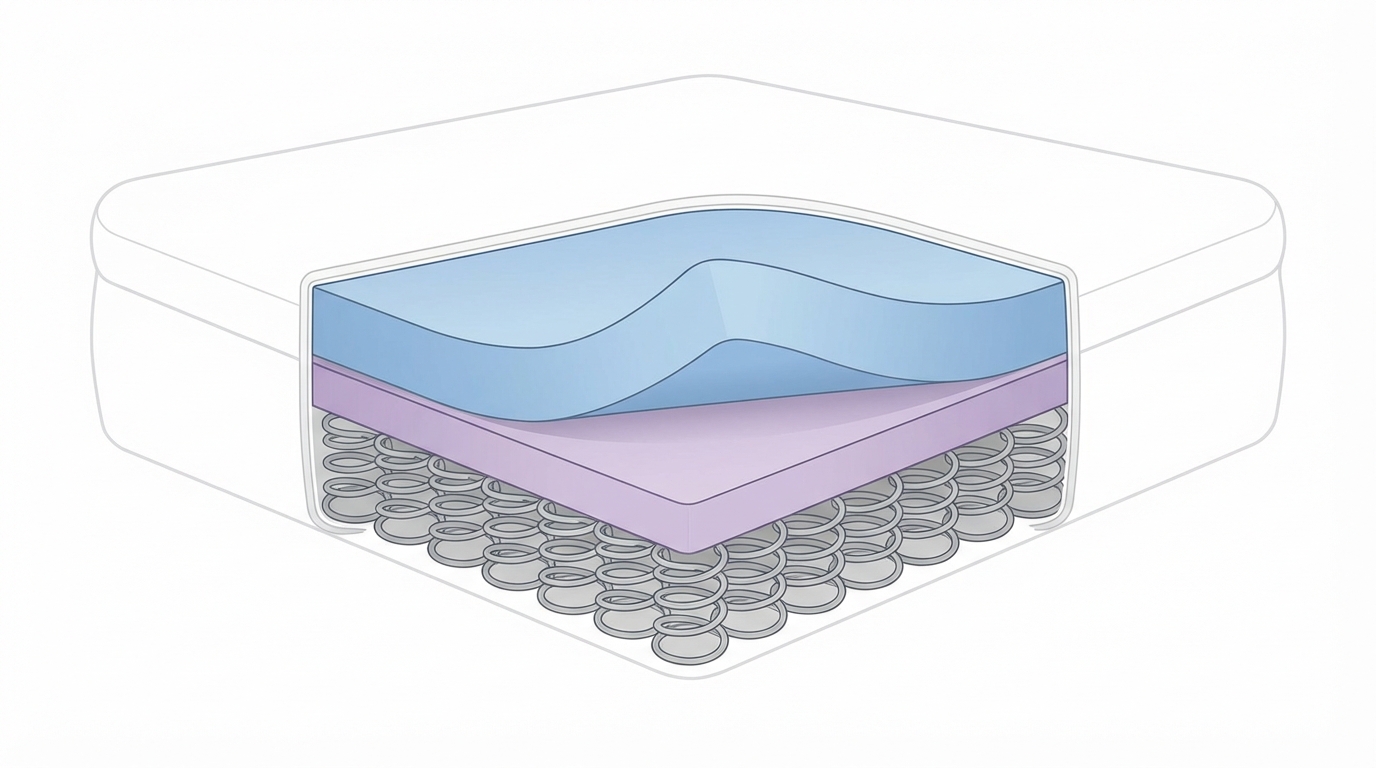
When you start researching how long a queen size mattress is, you may quickly run into other terms that sound similar but behave very differently in real rooms. “Short queen,” “RV queen,” “Olympic queen,” and “California queen” all show up on manufacturer charts. These are not standard sizes, but they do exist, and understanding them can keep you from accidentally ordering sheets that do not fit or a mattress that is 5 inches shorter than you expected.
Short Queen / RV Queen
A short queen, also called an RV queen, usually measures about 60 inches wide by 74 or 75 inches long. The key difference is the length. Compared to a standard queen’s 80 inches, a short queen trims 5 to 6 inches from the foot. RV manufacturers use this size to save space inside smaller floor plans, keeping the width for comfort while cutting length so the mattress does not block cabinets or walkways.
If you are shopping for an RV or a camper, you may need a short queen for that space specifically. For home use, however, a short queen is rarely a good idea unless you are under about 5 feet 7 inches and very tight on length. Most adults find the shorter profile limiting as they age or as they want room to stretch out. If your goal is to improve sleep and you have a normal sized bedroom, sticking with a full length 80 inch queen is usually the better move.
One practical tip: if you see a queen mattress online at an unusually low price and notice the length listed as 74 or 75 inches, pause before buying. You are likely looking at a short queen. Sheets, protectors, and frames for that size are less common, and you will feel the difference in length the first night if you are used to a standard queen.
Olympic Queen And California Queen
An Olympic queen is a less common variation that measures about 66 inches wide by 80 inches long. In this case, the length stays the same as a regular queen, but the width increases by 6 inches. Couples who want more elbow room without going all the way up to a 76 inch wide king sometimes consider Olympic queen as a middle step.
A California queen, depending on the manufacturer, is typically a little longer and sometimes narrower than a standard queen. You might see something like 60 by 84 inches listed. These sizes came out of specific needs, such as waterbed frames or certain furniture designs, rather than mainstream sleep science. They can work nicely in unique spaces, but they come with tradeoffs. Finding mattress protectors, sheet sets, and compatible foundations can be more expensive and limited compared with standard queen sizes.
For most home bedrooms, a standard queen’s 60 by 80 design hits the right balance of comfort and convenience. I usually recommend specialty queen sizes only when there is a clear reason, such as fitting a pre existing antique frame or solving a precise space challenge. For a first main bedroom mattress, standard queen keeps everything simpler and more affordable.
Queen Size Mattress Compared To Other Standard Sizes
At this point, you know a queen is 80 inches long, the same as a standard king and longer than a full. It can still help to see how queen’s footprint compares to other options across both width and length. This is where a quick visual comparison can clarify whether queen is the “just right” choice for your body, room, and budget.
Here is a snapshot of common sizes, focusing on standard North American dimensions (rounded to the nearest inch):
| Mattress Size | Width (inches) | Length (inches) | Typical Best Use |
|---|---|---|---|
| Full / Double | 54 | 75 | Solo adults, guest rooms |
| Queen | 60 | 80 | Couples, solo sleepers wanting space |
| King | 76 | 80 | Couples wanting maximum width |
| California King | 72 | 84 | Very tall sleepers, large master rooms |
Looking at the table, notice that queen, king, and California king all share a similar length band, with queen and king at 80 inches and California king at 84. The real jumps are in width. Moving from queen to king increases total width by 16 inches but leaves length unchanged, while shifting from queen to California king trades some width for extra foot room.
When people stand at a crossroads between full and queen, that extra 6 inches of width and 5 inches of length is usually well worth it if the room can accommodate it. When they are torn between queen and king, the conversation becomes less about length and more about how much space they want between bodies and how large the room feels. This is where your personal sleep habits and the size of your furniture matter more than raw numbers.
Choosing the right size from this table is not just a comfort issue. Long term, it affects your costs for linens, frames, and even how often you decide to rearrange your bedroom. From an investment perspective, many shoppers find that a solid queen mattress, such as the Sealy Posturepedic Pro Soft Mattress – Dupont II Euro Pillow Top, gives them great support now and flexibility later if they move into different homes or repurpose the bed for a guest room down the road.
When Does Queen Length Support Better Sleep?
The goal of all these numbers is not to win a trivia contest about mattress dimensions. It is to help you sleep better. Length and space play very real roles in sleep quality, which in turn connects to everything from mood and focus to immune function. The American Academy of Sleep Medicine and other medical organizations repeatedly highlight that chronic sleep deprivation is tied to higher risks of heart disease, weight gain, and mental health struggles. The right size bed is a surprisingly foundational piece of that puzzle.
Space, Movement, And Nighttime Awakenings
If you often wake up because you are trying to reclaim a bit of space from a partner or edge closer to a less worn part of the mattress, size might be part of the story. A queen’s extra width compared to a full, combined with its 80 inch length, gives two average sized adults enough room to change positions without constant contact. That can lower the number of micro awakenings, even if you do not fully remember them in the morning.
Research on sleep efficiency shows that disturbances, whether from a partner’s movement, noise, or physical constraints, reduce the percentage of time spent in deep and REM sleep. Those are the stages where the brain consolidates memory and the body repairs itself. One of the simplest ways to give your body more opportunity to enter and stay in those stages is to remove obvious physical hindrances. Making sure your mattress is long and wide enough for how you naturally sleep is an easy, one time change with years of nightly benefits.
Spinal Alignment And Pain Prevention
Length also supports posture. If you have to contort to stay within the edges of the bed, your spine, hips, and knees pay the price. Cleveland Clinic’s back pain specialists often emphasize the importance of a mattress that keeps the spine neutral while still cushioning pressure points. That requires enough linear space from head to toe that your body can settle into its natural alignment, not a shortened version adapted to an undersized surface.
For many people up to around 6 feet 2 inches, a queen provides that space, especially when paired with a mattress that balances support and pressure relief. Back sleepers often do well on a medium firm feel that keeps the hips from sinking too far, like those found in our curated collection of mattresses for back sleepers. Stomach sleepers, who are more prone to overarching the lower back, usually benefit from a slightly firmer model, such as those in our best mattresses for stomach sleepers selection, to keep the torso lifted along the whole 80 inch length.
Pain prevention is not just about waking without aches tomorrow. Long term, consistent support and enough room to fully extend your spine can reduce stress on discs, joints, and supporting muscles. For people with emerging back issues or those who sit for long hours at work, giving their body a neutral, uncompressed posture overnight is one of the kindest things they can do for themselves.
Couples, Pets, And Real Life
In the real world, many of us are not just one sleeper on one surface. Partners, kids who climb in after a nightmare, or pets who decide the end of the bed is theirs all influence how much usable length you have on any given night. A queen mattress provides a workable compromise when you have a partner and the occasional visitor but not a nightly mini soccer team.
If your dog regularly sleeps at the foot of the bed and you are tall, it can be worth considering that their body will effectively shorten the length available to your legs. Some families choose to move up to a king or California king in those situations. Others set a clear “no pets on the bed” rule and find that a queen is perfectly adequate once the humans reclaim the full 80 inches.
What matters is being honest about how you actually use your bed, not how you wish you used it. If you share, move, and stretch in ways that make length a recurring pain point, addressing it now can transform your sleep for years to come.
Practical Checklist: Are You A Good Fit For A Queen Length?
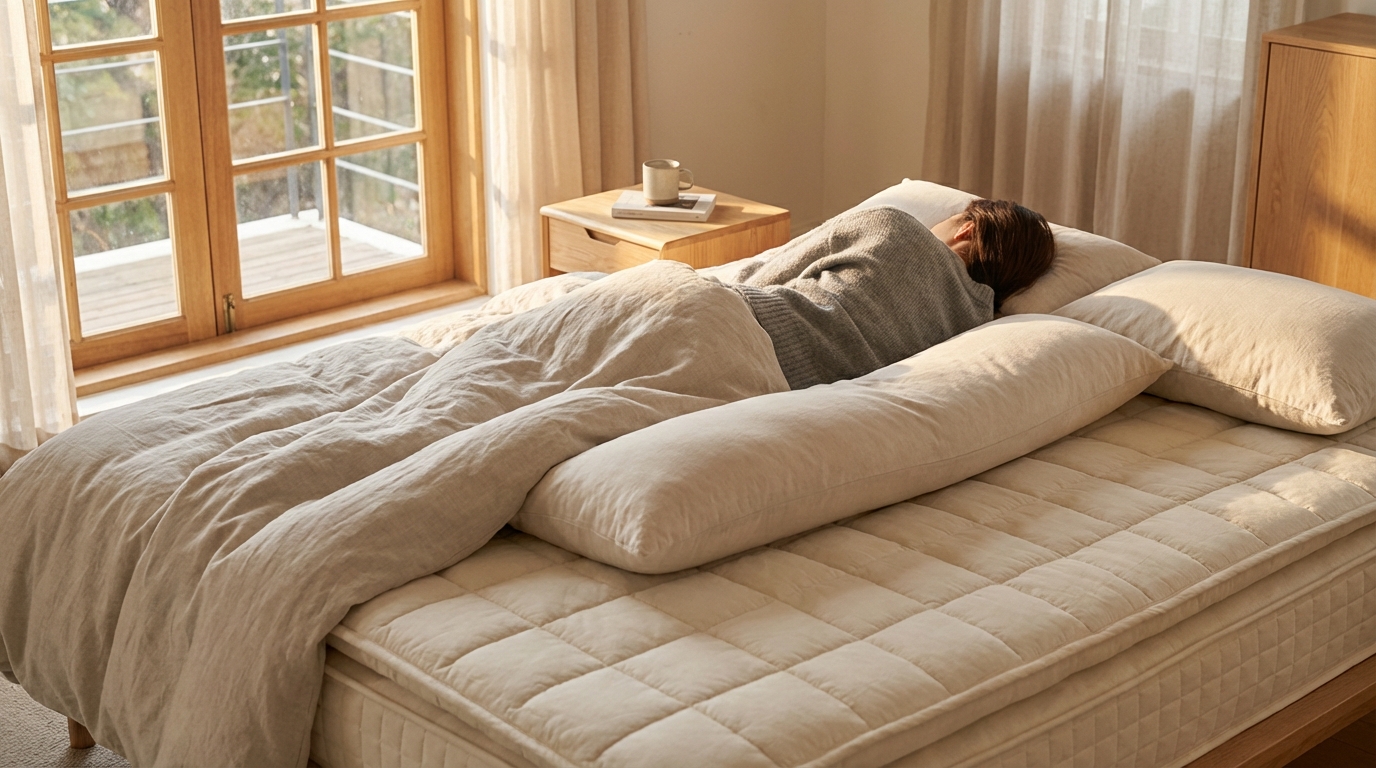
Before we wrap up, it can help to run through a concise, practical filter. Not everyone needs a queen, and not everyone should stay at queen. To keep this grounded and easy to act on, here is a simple checklist you can mentally walk through as you decide.
First, consider your height and your partner’s height. If both of you are under about 6 feet 2 inches and you do not regularly feel cramped on hotel queens or guest beds, standard queen length is likely sufficient. If either of you is above 6 feet 4 inches, think seriously about whether you would benefit from additional length, especially if you tend to sleep fully extended.
Next, assess your current frustrations. Are you waking because your feet hit the footboard, or more because you bump into your partner sideways. If your issues are mostly width related, queen might be the minimum, and king could be worth exploring. If your complaints focus on legroom, a queen and standard king will feel similar, and moving to a longer mattress or adjusting your pillow and headboard setup may help more.
Finally, bring your room into the decision. Measure the wall where the bed will sit, account for door swings and window placements, and be honest about furniture you truly need versus items that could live elsewhere. A queen’s combination of 60 by 80 inches offers a comfortable, versatile middle ground for many households, especially when you want a mattress that can adapt to different rooms and uses over the next decade.
Conclusion: Turning Measurements Into Better Sleep
Choosing a mattress size seems like a small detail until you live with it every night. Knowing that a standard queen size mattress is 60 inches wide and 80 inches long, with a small tolerance either way, gives you a firm foundation for planning. You can map those dimensions onto your room, your body, and your daily routines, instead of guessing or hoping a new bed will magically fit.
You have seen how queen stacks up to full, king, and California king, how a person’s height and sleep style interact with the 80 inch length, and where specialty sizes like short queen or Olympic queen fit into the picture. More importantly, you have a sense of what is at stake beyond the tape measure: your comfort, your spinal health, your partner’s sleep, and the quiet, easy feeling of a bedroom that works with you instead of against you.
If you are leaning toward a queen, the next step is to pair that size with the right feel and construction for your body. A firmer, supportive model from our back sleeper collection, a plusher pillow top like the Sealy Posturepedic Elite Medium Mattress – Brenham II Euro Pillow Top, or a motion isolating surface that works beautifully on an adjustable base can all transform that 60 by 80 inch canvas into a sleep system that genuinely supports you.
If you are unsure, that is normal. You are balancing room size, budget, relationships, and health all at once, and that deserves more than a quick chart. This is exactly the kind of decision we help people with every day at Sleepology. You can bring your room measurements, your height, and even photos, and we will walk through it with you step by step. When you finally stretch out on a bed that fits your life as well as your room, all those inches and numbers turn into something much more important: deep, restorative sleep that supports everything you do when you are awake.
Frequently Asked Questions
How long is a standard queen mattress in inches and centimeters?
A standard queen mattress in North America measures 60 inches wide by 80 inches long, which is approximately 152 centimeters by 203 centimeters. That 80 inch length is the same as a standard king, so moving up to king changes your width, not your length. There is usually a small manufacturing tolerance of up to about an inch in either direction, especially with hand assembled innersprings, so you may see slight variation, but anything near 60 by 80 is considered a proper queen.
Is a queen long enough for someone who is 6 feet 3 inches tall?
For many people around 6 feet 3 inches, a queen can be adequate, especially if they mostly sleep on their side with slightly bent knees. However, it is near the upper comfort limit for back and stomach sleepers who like to fully extend. If you are 6 feet 3 inches and often feel your feet touching the end of hotel queen beds, it might be worth testing a California king at 84 inches long or choosing a queen with a frame and headboard that let you lie as close to the top edge as possible so you gain every bit of the 80 inch length.
Will a queen mattress fit in a 10 by 10 bedroom?
Yes, a queen mattress is generally considered a good fit for a 10 by 10 foot bedroom. In that layout, your 60 inch wide bed leaves about 2 and a half feet of walking space on either side if centered along a wall, which aligns with common design advice to maintain at least 24 inches of clearance for comfortable movement. You will want to be thoughtful about furniture scale, opting for reasonably sized nightstands and a dresser that does not crowd walkways, but most people find a queen perfectly workable in that room size.
What is the difference between a queen and a short queen in length?
The main difference is length. A standard queen is 60 inches wide by 80 inches long, while a short queen, often labeled an RV queen, keeps the same 60 inch width but reduces length to about 74 or 75 inches. That means a short queen is roughly 5 to 6 inches shorter. Short queens are designed primarily for RVs and tight spaces, not typical home bedrooms. If you are above about 5 feet 7 inches or plan to share the bed, a full length queen is usually more comfortable long term.
Do I need a special bed frame for a queen mattress?
You do not need a “special” frame in the sense of a unique or proprietary design, but you do need a frame that is built for queen dimensions and provides adequate support. That means interior measurements of about 60 by 80 inches and, for most modern mattresses, a solid platform or slats that are at least 2 inches wide and no more than about 3 inches apart. If you plan to pair your queen with an adjustable base, choosing a compatible adjustable bed frame ensures the mattress can flex without damage while still supporting its full 80 inch length.
Will my existing full size sheets fit on a queen mattress?
In almost all cases, full size sheets will not properly fit a queen mattress. A full mattress is 54 inches wide by 75 inches long, so queen adds 6 inches of width and 5 inches of length. That extra material means full sheets are simply too small to reach and secure around a queen, especially fitted sheets. You will want sheets specifically labeled “queen” so they are cut for the 60 by 80 profile and have enough depth to accommodate your mattress thickness. Investing in well fitting bedding, such as the Tempur-Pedic TEMPUR Adapt Luxe Egyptian Cotton Sheet Set, helps you actually feel the full comfort of your new mattress.
Is a queen mattress a good choice for a guest room?
A queen mattress is often the best all around choice for a guest room because it can comfortably accommodate both couples and solo visitors without overwhelming the space. The 80 inch length works for most adult heights, and queen size bedding is widely available, so you are not hunting for specialty linens. If your guest room is very small, a full can also work, but if you have the space, choosing a versatile queen, perhaps topped with a quality pillow and travel bundle like the Tempur-Pedic Mattress Topper and Pillow Travel and Guest Bundle, helps your guests genuinely rest instead of just “getting by” for a night or two.