

How Long Does A Memory Foam Mattress Last? A Sleepologist’s Complete Guide
You bought your memory foam mattress for that “ahh” feeling at the end of a long day, not to wake up wondering if your bed is quietly wearing out under you. If you are noticing more tossing and turning, new aches, or that you are suddenly camping on the couch, you are not alone. Many people are unsure whether their mattress is actually “done” or if they just need a tweak like a new pillow or topper. That uncertainty can drag on for months or years, while your sleep quietly gets worse.
Mattress lifespan is about more than comfort. According to the Sleep Foundation, most adults need 7 to 9 hours of quality sleep for healthy mood, metabolism, and immune function, and mattress quality plays a direct role in how efficiently you sleep. When your memory foam starts to sag or lose resilience, your spine has to work overnight to stay aligned. That can mean more pain, less deep sleep, and slower recovery from everyday stress. Over time, the cost of “making do” with a worn out mattress often shows up in your body and your daily energy.
The good news is that memory foam is among the more durable mattress materials when it is well made and well cared for. With a little understanding of foam quality, usage patterns, and maintenance, you can estimate how long your mattress should last, spot the early warning signs that it is time to replace it, and even extend its lifespan by a few extra years. You will also be in a stronger position to invest wisely in your next mattress so you are not repeating the cycle too soon.
As a Sleepologist who has tested and worked with hundreds of beds over 20 years, I will walk you through how long a memory foam mattress realistically lasts, what shortens or extends its life, and how to tell if it is your mattress or something else that is sabotaging your sleep. Along the way you will see real world examples, simple home tests, and options from Sleepology if you decide your current mattress truly has reached the end of the road.
The Real Answer: How Long Does A Memory Foam Mattress Last?
Most well built memory foam mattresses last about 7 to 10 years for the average sleeper, but that range hides a lot of nuance. On the lower end, budget foam beds with lower density, lighter construction, and minimal edge support may feel “tired” after 4 to 6 years of nightly use. On the higher end, premium foam or hybrid designs with denser support layers, sturdy coils, and quality covers can stay comfortable and supportive a full decade or more for many sleepers.
Organizations like Consumer Reports and major sleep brands typically cite 7 to 10 years as the expected lifespan of a quality mattress in general, with memory foam performing at the upper end of that range when density is high and the foam is well engineered. The Mayo Clinic and Cleveland Clinic both highlight that mattress comfort and support change as materials age, even when the surface still looks acceptable, which is why many health professionals recommend evaluating your mattress around the 8 year mark even if it is not visibly sagging.
What that means in everyday life is that you should think in terms of a “comfort window” rather than a single expiration date. For the first several years, your mattress should feel close to how it did when you bought it. Somewhere in the mid life period, you may start to notice subtle changes: a bit less bounce back, deeper body impressions that linger into the morning, or the need for extra pillows to feel aligned. As that accelerates, your sleep and comfort will tell you far more than the calendar alone.
The other important point is that different parts of the mattress age at different speeds. The upper comfort layers of memory foam are responsible for pressure relief and contouring. Those typically show changes first, because they are directly compressed by your body every night. The deeper support core foam or coils tend to last longer. This is one reason why two mattresses of the same age can feel very different: it depends on how those layers were engineered and how heavily they have been stressed.
“I used to assume every mattress was basically a 10 year purchase. Mia explained how my weight, sleep position, and the specific foam density affected our bed. That helped me realize our 6 year old mattress really was at the end of its comfort life, not just in my head.” – Rachel T., November
Key Factors That Affect How Long Your Memory Foam Mattress Lasts
Not all foam beds are created equal. Two mattresses can be the same age but feel worlds apart because of how they were built and used. When I evaluate a customer’s mattress lifespan, I look at four main factors: foam quality, body weight and sleep position, overall usage, and bedroom environment.
Foam Quality And Density
Foam density is one of the biggest predictors of longevity. Density is measured in pounds per cubic foot and essentially describes how much material is packed into a given volume. Higher density memory foam is usually more durable and resists body impressions longer, though it may feel slightly heavier or more substantial to the touch. Lower density foam can feel airy and plush at first but is more prone to early sagging and softening.
In practice, many budget memory foam mattresses use lower density foams in the comfort layers to hit a lower price point. These can be perfectly fine for guest rooms or light use, but for nightly sleepers they often show wear after a few years. Mid range to premium mattresses usually pair medium or high density memory foam with supportive base foams or coils to handle long term compression. When you invest in a higher quality build, you are paying not just for instant comfort but for how that comfort holds up year after year.
Foam formulation and testing standards matter as well. Some manufacturers put their foams through rigorous durability tests that simulate years of use, something brands like Casper have publicized in their quality claims. Independent testing labs and organizations such as CertiPUR US focus more on safety and emissions than durability, but they still give useful signals about manufacturing quality. When you work with a retailer like Sleepology, we can usually tell you which beds consistently hold up in real households and which ones are more of a short term solution.
Body Weight, Sleep Position, And Sharing The Bed
Your body weight and sleep position change how a mattress wears. Heavier bodies place more load on the foam, especially in the hips and shoulders. Over time, that can create deeper impressions and faster softening in those zones. Side sleepers concentrate their weight on a smaller surface area than back or stomach sleepers, so they often see more localized wear in the shoulder and hip regions. Couples place more overall stress on the mattress simply because there is more combined weight and more motion.
If you are a plus size sleeper or share a bed and still want the conforming feel of memory foam, you will usually get better long term results from a denser foam or a hybrid design where coils share the load. For example, a softer hybrid like the Sealy Posturepedic Elite Soft Hybrid Mattress – Brenham II gives you that pressure relieving foam on top while relying on a robust coil system underneath to maintain support year after year. That combination often holds up better for heavier or side sleeping couples than an all foam bed with similar initial softness.
On the other hand, lighter weight sleepers sometimes find that even a mid range all foam mattress still feels quite good after 10 or more years, simply because the materials have not been stressed as heavily. That does not mean everyone should push their mattress past a decade, but it does explain why your friend’s 12 year old foam bed may feel okay while your 7 year old one does not.
Frequency Of Use And Support System
How often your mattress is used also matters. A memory foam bed that gets nightly use from two adults is aging much faster than a guest room mattress that sees occasional weekend visitors. The foam does not “rest” or recover fully between nights; it slowly loses resilience over thousands of compression cycles. That is why even a high quality foam mattress in a primary bedroom has a very different lifespan than the same model in a rarely used room.
The support system underneath your mattress plays a quieter but important role. A sagging box spring, a slatted base with wide gaps, or an adjustable base that is not properly set up can all create flex points that accelerate wear in the foam. The Sleep Foundation and several mattress manufacturers note that using a proper foundation or solid platform is critical for maintaining the integrity of the mattress over time. If you are investing in a new foam bed, pairing it with a sturdy base like an adjustable bed frame and base can both improve comfort and protect the mattress from uneven stress.
Bedroom Environment And Care Habits
Memory foam is sensitive to temperature and moisture. A hot, humid bedroom can cause certain foams to soften more quickly and may promote the growth of mold or mildew if ventilation is poor. Keeping your bedroom at a comfortable, moderate temperature and allowing your mattress to breathe occasionally by stripping the bedding can help extend its life. Good airflow, whether from a well designed cover, breathable sheets, or a slatted platform, allows heat and moisture to dissipate more easily.
Daily habits matter too. A mattress that is protected with a well fitting, waterproof but breathable protector is shielded from sweat, spills, dust mites, and skin oils. Over time, these substances can break down foams and fabrics. Regularly rotating your mattress (if the design allows) can also help distribute wear more evenly, especially for single sleepers who tend to favor one side of the bed. Think of it like rotating your tires to get the most mileage out of them.
“We had our previous memory foam mattress on an old box spring and did not think much about it. When we upgraded to a new hybrid at Sleepology and an adjustable base, Mia pointed out how poorly the old foundation was supporting the bed. It explained the early sagging we saw around year five. Our new setup already feels more solid.” – Jason M., October
How To Tell If Your Memory Foam Mattress Is Worn Out

The calendar is just one clue. Your body, your sleep, and the surface of your bed offer much clearer signals that it may be time to move on from your current mattress. I encourage customers to think in terms of three categories of signs: how your body feels, how the mattress looks and behaves, and how clean and healthy it is.
How Your Body Feels On And After The Mattress
One of the earliest signs of a mattress that is losing its support is how you feel when you wake up compared with how you felt when you went to bed. New or worsening neck, shoulder, hip, or lower back pain that improves as you move around during the morning often points to inadequate nighttime support. When memory foam softens too much over time, it can allow your heavier areas to sink too deeply, which pulls your spine out of neutral alignment.
You might also notice more tossing and turning as you try to find a comfortable position, or that you sleep more soundly in other beds when traveling. If you wake up feeling unrefreshed even when you are in bed long enough, or if your partner complains that you are moving more during the night, your body may be telling you that the pressure relief and support you once had are no longer there. The American Academy of Sleep Medicine emphasizes that persistent, unexplained sleep disturbances can be related to sleep environment, including the mattress, not only stress or medical issues.
Of course, our bodies change over time too. Weight gain or loss, pregnancy, injuries, or the development of arthritis can shift what you need from a mattress. Sometimes a bed that technically has some life left simply no longer matches your body. In those cases, upgrading your mattress may be more about getting the right feel and support for your current needs than about waiting for the foam to fail completely.
Visual And Tactile Changes In The Mattress
Your eyes and hands can pick up clues that your memory foam is aging. The most obvious is sagging, which may look like a visible dip where you normally sleep or a general concave shape in the middle of the bed. While manufacturers often define warranty sagging at depths like 1.5 inches or more, your body will usually feel a problem long before that. Even a 0.75 to 1 inch permanent impression can be enough to alter spinal alignment for some people.
Another tactile sign is slow or incomplete recovery when you get out of bed. Healthy memory foam will contour under your weight and then gradually spring back toward a flat surface. Over time, foam can lose elasticity and stay partially compressed, which feels like your body is falling into a pre existing trench every night. You might also feel lumps, waves, or uneven firmness across different parts of the mattress, especially if the foam layers have shifted or broken down.
The edges of a mattress often tell the story first. If you sit on the edge to get dressed or if you sleep near the perimeter, those zones can soften faster. Many modern designs reinforce edge support, particularly in hybrids like the Sealy Posturepedic Pro Firm Hybrid Mattress – Dupont II. When that reinforcement wears or when an all foam edge loses integrity, you may feel yourself sliding or collapsing toward the side when sitting or lying near it.
Hygiene, Allergies, And Indoor Air Quality
Even if your mattress still feels reasonably supportive, hygiene is another legitimate reason to consider replacement. Over the years, mattresses accumulate dust mites, skin cells, body oils, and environmental allergens. The Cleveland Clinic and other health organizations note that these can trigger or worsen allergies and asthma, especially in sensitive individuals. Memory foam itself does not attract dust more than other materials, but it is not immune to buildup.
If your mattress is 8 to 10 years old and you notice more morning congestion, itchy eyes, or coughing that improves when you sleep elsewhere, your bed may be part of the problem. Regular washing of bedding and using a high quality mattress protector help, but they cannot completely eliminate allergen buildup deep inside older foams. A persistent musty smell or visible staining, despite clean bedding, can also be a sign that your mattress has absorbed moisture or contaminants that are not easily remedied.
Finally, if your mattress has suffered significant spills, pet accidents, or any water damage, its internal environment may be compromised even if the surface looks fine. Moisture can break down adhesives, encourage microbial growth, and weaken foams. In those cases, replacing the mattress is often safer and more effective than trying to restore it fully, especially if there are any hints of mold.
“My husband thought I was being picky, but I kept waking up stuffy and achy. Our mattress was about nine years old. Mia walked us through the signs of wear and even had us check the sag depth. Once we replaced it, my morning congestion dropped within a week and I realized how much support we had lost.” – Denise R., December
How To Test Your Memory Foam Mattress At Home
When you are on the fence about whether your mattress is worn out, a few simple at home tests can give you more objective data. You do not need special tools, just a straightedge, measuring tape, and a few minutes of honest observation. These checks will not replace professional evaluation, but they provide a helpful baseline to pair with how your body feels.
The Sag And Support Check
Start by stripping your mattress of all bedding, toppers, and protectors. Place a long straightedge such as a yardstick or a rigid broom handle across the area where you normally sleep. Look from the side to see if there is a visible gap between the straightedge and the mattress surface. Use a measuring tape or ruler to measure the deepest point of that gap. If you see more than about 1 inch of permanent dip, most people will experience some degree of misalignment, even if the rest of the mattress looks okay.
Next, lie down in your usual sleep position. Have a partner take a photo of your body alignment from the side. Your ears, shoulders, and hips should form a relatively straight line when viewed in profile. If your hips are noticeably dipping toward the mattress or your lower back is arched or twisted, the foam is likely no longer supporting you properly. Try this in two or three spots on the bed to see if the problem is localized or more general.
Also pay attention to how the mattress feels as you roll from side to side or move toward the edge. Excessive “hammocking” in the center or the feeling that you are climbing out of a dip can indicate significant softening or broken down foam, even if your visual measurements are under warranty thresholds. Your nervous system is often more sensitive to these subtleties than your eyes.
The Comfort, Pressure, And Motion Check
Another useful test is to assess pressure points and motion transfer. Lie on your side, as you would normally sleep, with your usual pillow. Close your eyes and tune into your body for a full minute. Do you feel sharp pressure at the shoulder or hip, or does the mattress cradle those areas evenly? If pressure has increased compared with how the mattress felt when it was new, it may be because the comfort layers have thinned or compacted over time.
Then lie on your back and have your partner roll, change positions, or get into and out of bed. Memory foam is known for strong motion isolation, but as foam ages and loses resilience, it can sometimes feel bouncier or transmit more movement. If you are feeling more of your partner’s motion now than you did in the early years, that can be another clue that the foam structure is changing.
Finally, pay attention to how you feel after a dedicated test night where you intentionally assess your comfort. Compared with a typical night, do you notice more stiffness, more numbness in the arms or legs, or more restlessness? Journaling those sensations for a few nights can help separate temporary factors like stress or illness from consistent mattress related issues.
Can You Extend The Life Of A Memory Foam Mattress?
While no mattress will last forever, thoughtful care and a few strategic accessories can absolutely stretch the lifespan of a quality memory foam bed. This is especially worthwhile if your mattress is still relatively young but starting to show mild signs of wear, or if you are not ready to invest in a full replacement yet. The key is to be realistic: maintenance can slow the aging process and restore some comfort, but it cannot turn a significantly worn out mattress back into a new one.
Foundational Habits That Protect Your Mattress
The single best insurance policy for any mattress is a good protector. A breathable, waterproof protector shields your mattress from sweat, oils, spills, and allergens that can gradually break down foams and fibers. It is easier to wash a protector weekly than to deep clean a mattress. Many customers are surprised at how much better their mattress smells and feels after they start using a quality protector consistently.
Rotating your mattress, if the design allows, can also distribute wear. Most modern memory foam mattresses are one sided, so you are not meant to flip them, but you can rotate them head to foot. Every three to six months, rotate your mattress 180 degrees so the area that supported your shoulders and hips now sits under your feet. This is particularly helpful for single sleepers who favor one side or for couples with a noticeable weight difference.
Supporting your mattress properly is another foundational step. Make sure your bed frame and foundation meet the manufacturer’s requirements for slat spacing or solid support. Upgrading to a sturdy foundation or to an adjustable bed frame and base can prevent sagging and allow you to fine tune your sleep position. Adjustable bases are especially helpful if you deal with back pain or reflux, since a slight elevation of the upper body takes some pressure off the lumbar region and may make a supportive mattress feel even better.
When A Mattress Topper Helps And When It Does Not
A well chosen mattress topper can give an aging bed a second wind, but it is important to understand what a topper can and cannot do. Toppers add cushioning or change the feel of the surface; they do not rebuild a collapsed support core. If your mattress is generally supportive but a bit too firm or slightly uneven, a topper can smooth out minor imperfections and improve pressure relief.
For example, if a mid life mattress is still structurally sound but feels a bit unforgiving to your shoulders as a side sleeper, adding a quality foam topper can ease that pressure without replacing the entire bed. A product like the Tempur-Pedic Mattress Topper – Pillow Travel and Guest Bundle can also be handy as a portable comfort layer when you travel or sleep on guest beds, so your body experiences a more consistent surface night after night.
If, however, your mattress has deep sagging, broken down foam, or a failing support core, a topper will only follow the same contours and may even amplify alignment issues. In those cases, it is better to allocate those dollars toward a new mattress rather than layering foam on top of a failing base. As a general guideline, if your sag depth is more than about 1 to 1.5 inches or you have persistent pain clearly linked to the bed, a topper is unlikely to fix the problem.
Memory Foam Vs Hybrid Vs Innerspring: Which Lasts Longer?
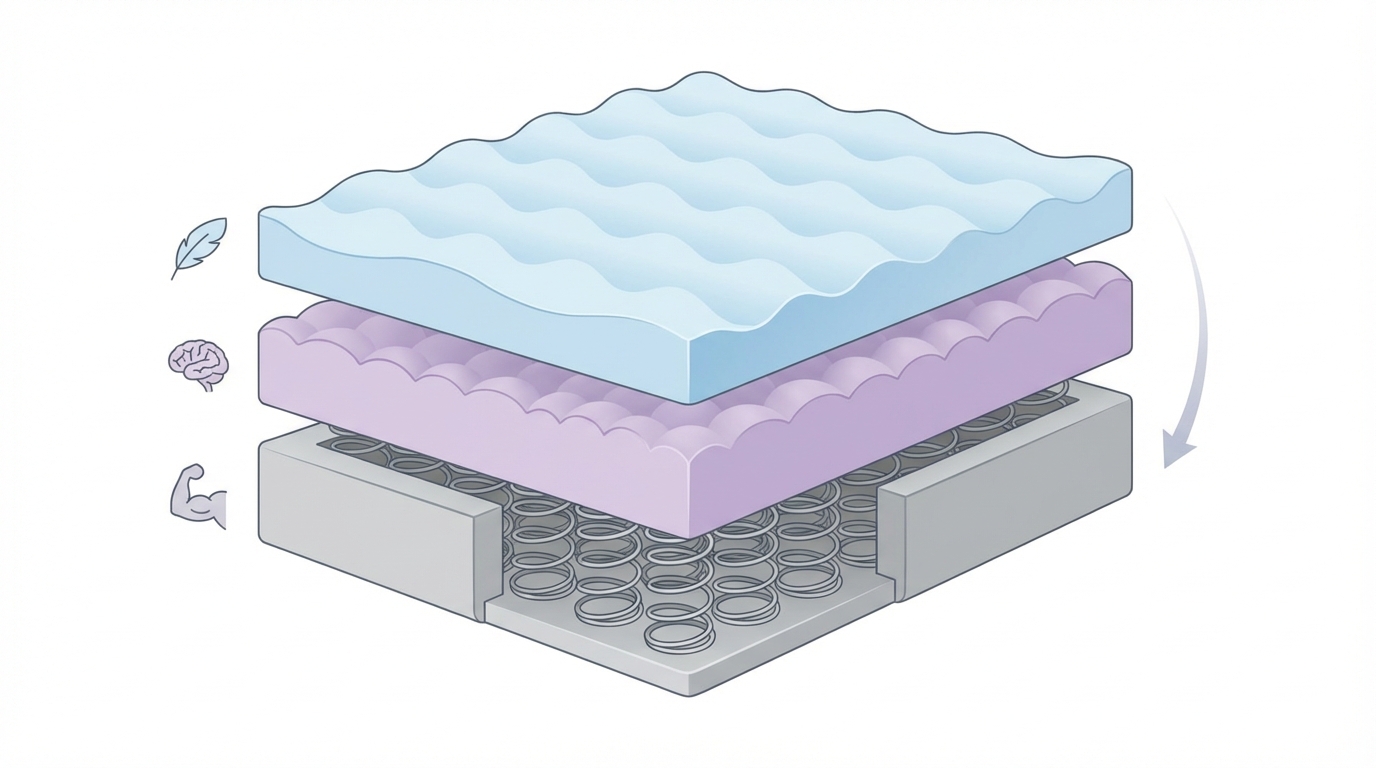
When customers start asking how long memory foam lasts, they are often also wondering whether they should stay with foam or switch to a different type for their next mattress. Each construction type has its own strengths, and longevity depends on how those materials are combined. A high quality hybrid can easily outlast a low quality all foam bed, and vice versa.
To make the comparison clearer, here is a simplified table looking at typical lifespan, feel, and durability considerations for the main mattress categories.
| Mattress Type | Typical Lifespan Range | Feel & Support Notes | Durability Considerations |
|---|---|---|---|
| All Memory Foam | 7 to 10 years | Closely contouring, strong motion isolation | Density of foam, thickness of comfort and support layers |
| Hybrid (Foam + Coils) | 8 to 12 years | Balanced contouring with a bit more bounce and airflow | Coil quality, edge support, quality of foam comfort layers |
| Traditional Innerspring | 6 to 8 years | Bouncier, less contouring, more motion transfer | Coil gauge, coil count, quality of thin comfort layers |
Memory foam tends to shine for pressure relief and motion isolation, especially for side sleepers and couples. Hybrids combine that contouring with the deep support and breathability of coils, which often yields longer functional lifespans for many body types. Innersprings rely heavily on the quality of the coils and the thin top padding; once the top layers compress or the coils fatigue, comfort can degrade relatively quickly.
At Sleepology, we see some of the best long term satisfaction from thoughtfully engineered hybrids. For example, the Sealy Posturepedic Plus Medium Mattress – Paterson II Euro Pillow Top combines targeted coils with cushioning foams, giving you both resilience and contouring. Similarly, the Sealy Posturepedic Pro Medium Mattress – Dupont II Euro Pillow Top offers a medium feel that works for many couples who want durable support without sacrificing pressure relief.
The important takeaway is that “memory foam” is only part of the story. Pay attention to how the mattress is constructed overall, whether it is all foam or hybrid, and how well it aligns with your body size, sleep position, and comfort preferences. A well matched mattress will not only last longer but will feel better throughout its life, rather than being technically intact yet functionally uncomfortable.
How Often Should You Replace A Memory Foam Mattress?
Knowing the average lifespan is helpful, but you still need to decide when to act. Most people fall into one of three timing patterns: replacing too early out of frustration without really diagnosing the problem, hanging on far too long to an obviously worn out bed, or aiming for a proactive, planned replacement window.
The Typical Replacement Window
For a quality memory foam or hybrid mattress in a primary bedroom, a realistic replacement window is roughly every 8 to 10 years. The Sleep Foundation and several major mattress brands highlight this range as when most mattresses will show meaningful changes in comfort and support, even if the structure has not failed catastrophically. Heavier sleepers, side sleepers, and couples may need to shorten that window by a year or two because their beds accumulate “wear miles” faster.
Guest room mattresses, lightly used beds, or beds for young children may stretch beyond 10 years if the materials are good and there are no signs of significant wear or hygiene issues. However, by the time a mattress approaches the decade mark, it is wise to evaluate it critically rather than assuming it is fine simply because you do not sleep on it often. Foams and fibers age with time as well as use.
A practical approach is to start actively evaluating your mattress around year 7, using the tests and symptom checks we discussed earlier. If everything still looks and feels solid at year 8, you might plan for replacement within the next 2 to 3 years. If you are already noticing discomfort or sagging around year 6, you may want to move replacement up in your budget planning.
Matching Replacement Timing To Life Changes
Life changes can be just as important as mattress age when deciding whether to replace your memory foam bed. If your weight has significantly changed, you have gone through pregnancy, developed new joint or back issues, or you are entering a new life stage such as menopause, your body’s needs at night may be very different from when you originally purchased your mattress. A mattress that once felt perfect may now feel too firm, too soft, or poorly supportive in specific areas.
Additionally, changes in who is using the bed matter. If you originally purchased a mattress as a single sleeper and now share it with a partner, particularly if you have different body types or sleep positions, you might benefit from a new mattress that better balances both of your needs. In those cases, consider your current couple profile rather than the original purchase situation.
Sometimes, it also makes sense to adjust your entire sleep system at once. If you are upgrading to an adjustable base, for example, that can be an ideal moment to replace an aging mattress so everything works together optimally. Coordinating those updates can also simplify warranties and reduce the chance of prematurely wearing a new mattress on an old or incompatible foundation.
When Repairs And Workarounds Are Not Enough
It is natural to want to get every bit of value out of a big purchase like a mattress. Toppers, protectors, and creative pillow arrangements can help for a while, but there comes a point where these workarounds start to feel like you are propping up a tired system rather than sleeping comfortably. Knowing when to stop patching and start fresh is part of taking good care of your long term sleep health.
If your mattress has notable sagging, persistent pain linked clearly to the bed, or hygiene issues that you cannot fully resolve, replacement is usually the most responsible choice. In many cases, once customers finally sleep on a well matched new mattress, they realize how much comfort and support they had slowly adapted away from over the years. That “I had no idea how bad the old one was until it was gone” moment is extremely common in the showroom.
When you do decide to replace, it can be helpful to reflect on what your current mattress did well and where it fell short. Maybe you loved the pressure relief but want more edge support, or you appreciated cooling features but need a different firmness. This reflection helps you and your Sleepology guide zero in on options that build on what worked while correcting what did not, rather than starting from scratch.
Choosing A Longer Lasting Memory Foam Or Hybrid Mattress
If your current memory foam mattress is nearing retirement, choosing a replacement with longevity in mind will pay off over the next decade. That means looking beyond label buzzwords and focusing on a few core elements: materials, support design, firmness fit, and overall system.
Materials And Support Design
When evaluating new mattresses, ask about the density of the primary foam layers, the type of support core, and any reinforcement features. Mid to high density memory foam in the comfort layers is a good sign for durability. In hybrids, look for targeted zones of stronger coils under the hips and lumbar area, which help maintain alignment for the long haul. Reinforced edges are also valuable if you sit or sleep near the perimeter.
Mattresses in the Sealy Posturepedic family, for example, are engineered with zoned support and quality foams that have a strong track record for durability in real households. A model like the Sealy Posturepedic Elite Medium Mattress – Brenham II Euro Pillow Top pairs responsive coils with conforming foam, providing a combination of resilience and comfort that often ages gracefully for couples and combination sleepers.
Consider whether you want all foam or hybrid. All foam will generally give you the deepest contouring and lowest motion transfer, while hybrids tend to offer more airflow and robust edge support. In , hybrids continue to be a popular choice for people who want the comfort of foam and the structure of coils, especially for heavier sleepers or those who like to sit on the edge of the bed.
Firmness Fit And Future Proofing
A mattress that fits your body well today is more likely to continue feeling good as it ages. If you buy something much softer than you need for spinal alignment, it may feel heavenly at first but lose functional support sooner as the foams relax. If you buy something excessively firm just to “make it last,” you may never truly get comfortable and could end up adding toppers that change the intended feel.
Leaning into a balanced medium or appropriately plush feel often gives you the widest comfort window. Side sleepers with sensitive shoulders might lean toward something like the Sealy Posturepedic Elite Soft Mattress – Albany II Euro Pillow Top, which delivers deep cushioning without sacrificing core support. Back sleepers or couples with mixed positions might do better with a medium model such as the Sealy Posturepedic Pro Soft Mattress – Dupont II Euro Pillow Top if they want a slightly softer top with consistent support underneath.
Think about how your body and life may change over the next decade. If you are planning a family, approaching a stage of life where joint issues are common, or you anticipate weight changes, choosing a mattress with a supportive core and a bit of forgiveness on top can help it adapt better. Pairing that with adjustable pillows, such as options from Sleepology’s pillows, sheets, toppers, and protectors collection, allows you to fine tune your setup over time without replacing the whole mattress prematurely.
Simple Maintenance Checklist To Maximize Mattress Lifespan
To bring all the care recommendations together, here is a quick reference checklist you can follow throughout the life of your memory foam or hybrid mattress. These small habits, consistently applied, can add meaningful years of comfortable use.
- Use a breathable, waterproof mattress protector from day one to guard against sweat, spills, and allergens.
- Rotate the mattress head to foot every 3 to 6 months if the manufacturer allows rotation.
- Keep your mattress on a supportive base or compatible adjustable frame with proper slat spacing or solid support.
- Wash sheets and bedding weekly and your protector at least monthly to minimize buildup on the surface.
- Allow the mattress to air out occasionally by stripping bedding for a few hours on a dry, well ventilated day.
- Keep bedroom temperature and humidity in a comfortable range to avoid excessive heat or moisture around the foam.
- Reassess comfort and sag depth yearly after about year 5 so you can plan proactively for replacement rather than react in crisis.
Following this checklist will not freeze your mattress in time, but it will slow the gradual drift from “wonderful” to “worn” and help you notice changes earlier. When customers keep up with these small steps, we often see their mattresses aging more predictably and delivering better long term value.
After you have established good care habits, remember that your mattress is one part of a larger sleep ecosystem. Quality pillows, breathable sheets, and a supportive base all work together. If your mattress is relatively young but you are uncomfortable, it is worth evaluating these other components too. Sometimes a tailored pillow or a subtle base adjustment is all you need, and sometimes your mattress really has earned its retirement.
Conclusion: Listening To Your Mattress, And Your Body
Memory foam mattresses do not come with a clear expiration date stamped on the side, which makes it easy to either replace them too soon or hold onto them long after they have quietly stopped serving you. The reality is that most well made memory foam and hybrid beds will give you roughly 7 to 10 years of good, supportive sleep, with variations based on foam quality, body type, sleep position, and how you care for them. Within that range, your body’s comfort, the visual condition of the mattress, and the hygiene of its internal environment are your best guides.
If you wake up stiff and sore, see permanent dips, or notice more allergies and restlessness, those are not just annoyances to push through. They are signals that your mattress may have reached or is approaching the end of its comfort life. Addressing those signals proactively can improve your sleep quality, daytime energy, and long term health more than any single supplement or gadget. According to sleep medicine research, even modest improvements in sleep quality can positively affect mood, pain perception, and cognitive performance.
When you are ready to replace your mattress, choosing a model with durable materials, appropriate firmness, and a solid support system will help your next bed last longer and feel better throughout its life. Whether you gravitate toward an all foam design or a well engineered hybrid, pairing it with thoughtful care and the right accessories will stretch its comfort window as far as realistically possible.
If you are unsure where your current mattress stands, or which models will best match your body and sleep style for the long run, the team at Sleepology is here to help. We live and breathe this stuff so you do not have to, and we are always happy to translate the science and the specs into simple, practical guidance you can feel confident about.
Frequently Asked Questions
How long does a memory foam mattress really last for side sleepers?
Most side sleepers can expect a good quality memory foam mattress to stay comfortable for about 7 to 9 years, slightly shorter than the upper end of the general 7 to 10 year range. Side sleepers put more concentrated pressure on the shoulders and hips, so the comfort layers in those zones experience more intense compression. Over time, that can lead to deeper body impressions and softening, even if the deeper support core is still intact. If you are a side sleeper, choosing a mattress with slightly denser foam or a hybrid design and keeping an eye on sag depth around the shoulder and hip areas will help you decide when to replace.
Do heavier people wear out memory foam mattresses faster?
Yes, heavier individuals typically place more stress on the foam layers, which can shorten the practical lifespan of a mattress by one to two years compared with lighter sleepers. The extra load compresses the foam more deeply each night, which accelerates the breakdown of cell structure and the development of permanent impressions. Heavier sleepers usually do best on memory foam mattresses or hybrids engineered with higher density foams, robust support cores, and reinforced edge support. Selecting a mattress from a curated collection like Sleepology’s best hybrid mattresses can be a smart way to find options designed with this in mind.
Is it safe to keep a memory foam mattress longer than 10 years?
“Safe” is a nuanced word here. From a structural standpoint, a well made mattress may still be physically intact after 10 years, but comfort and hygiene often become concerns by that point. Over a decade, mattresses accumulate dust mites, skin cells, and allergens that can contribute to respiratory symptoms, even with good bedding hygiene. Foam may also off gas small amounts of residual compounds more readily when it breaks down. For most people, replacing a primary bedroom mattress somewhere around the 8 to 10 year mark is a reasonable balance between value and health, even if the bed has not completely failed.
Can flipping or rotating a memory foam mattress make it last longer?
Rotating a one sided memory foam mattress head to foot can help distribute wear and may extend its comfortable life by a year or more, especially for single sleepers or couples with different body weights. Flipping, however, is not advisable for most modern one sided foam or hybrid mattresses because the bottom side is not designed as a sleep surface. Always check the manufacturer’s recommendations. If rotation is allowed, doing it every 3 to 6 months is a simple, effective maintenance habit. Pairing rotation with a quality protector and a supportive base creates a solid foundation for longevity.
How do I know if I should replace my mattress or just add a topper?
If your mattress is generally level, under about 7 years old, and your main complaint is that it feels a bit too firm or slightly uneven, a topper can be an excellent solution. A well made foam topper can improve pressure relief and smooth out minor inconsistencies, often buying you a few more comfortable years. However, if your mattress shows measurable sagging, causes persistent pain clearly linked to the sleeping surface, or has hygiene issues like musty odors or stains you cannot remove, a topper is unlikely to solve the underlying problem. In that case, it is usually wiser to invest in a replacement and use a topper for fine tuning rather than rescue.
How does a hybrid mattress’s lifespan compare to a memory foam mattress?
A thoughtfully engineered hybrid mattress often has a slightly longer functional lifespan than a comparable all foam bed, typically in the range of 8 to 12 years. The coil system in a hybrid shares the load with the foam and can maintain support longer, especially in the center third of the mattress where most of your body weight rests. The foam comfort layers will still show wear over time, but the underlying support is less likely to collapse suddenly. Many sleepers who love the feel of foam but want extra durability and edge support gravitate toward hybrids like those featured in Sleepology’s best foam mattresses and hybrid collections, which are curated with long term performance in mind.
Does sleeping on an adjustable base affect how long a memory foam mattress lasts?
Used correctly, an adjustable base can actually help a memory foam or hybrid mattress age more gracefully by supporting it evenly and allowing you to find positions that reduce pressure points. The key is ensuring that the mattress is compatible with adjustable bases and that the base provides consistent support across its surface. When the head or foot is elevated, the mattress flexes, but quality foams and coils are designed to handle that movement. Many people also find that by using an adjustable base to relieve back pain or joint stress, they can choose a slightly more durable medium feel mattress rather than an ultra soft one that might wear out sooner.