

How Big Is A Twin Size Mattress? A Clear Guide From A Sleep Expert
Choosing the right mattress size sounds simple until you have to actually measure your space, factor in who is sleeping where, and figure out what fits your budget. If you are looking at twins, you might be wondering whether a twin will feel cozy or cramped, whether it works for a growing child or a small guest room, and how it compares to the other sizes on the market. It is completely normal to feel a little stuck here, because the wrong size can feel like a daily frustration you are reminded of every single night.
Mattress size is more than a set of numbers on a chart. The dimensions of your bed affect how easily you fall asleep, how often you wake up from feeling crowded, and even how safe and supported your kids feel as they grow. According to the Sleep Foundation, most adults need 7 to 9 hours of sleep each night, and comfort and support from your mattress are key pieces of that puzzle. When your bed is too short for your legs or too narrow for how you like to sleep, you end up tossing, curling, and contorting instead of resting.
You are in the right place if you are asking very specific questions like “How big is a twin size mattress in inches,” “Is a twin big enough for my teenager,” or “Will two twins fill my small guest room without making it feel crowded.” Here, we will walk through the exact twin dimensions, how those compare with twin XL, full, and queen, and how to match a twin to real life situations like bunk beds, kids rooms, dorms, studio apartments, and guest spaces. You will also learn how to measure your room, how to plan around future growth, and how to choose a twin that actually supports healthy sleep, not just fits the corner.
By the end, my goal is that you feel genuinely confident about whether a twin size mattress is the right fit, and if it is, which type and setup will give you the best comfort for your budget and your space. You will also see where a twin is simply too small, so you can avoid an expensive mistake and move straight toward a size and style that works for your body and your home.
Twin Size Mattress Dimensions: The Simple Answer With Real World Context
Most shoppers start with the basic question, how big is a twin size mattress. A standard twin size mattress in the United States is typically 38 inches wide and 75 inches long. Some brands may vary by about an inch in width, for example 39 inches by 75 inches, but 38 by 75 is the accepted standard for fitted sheets, frames, and accessories. That makes a twin the smallest standard mattress size meant for children, teens, and adults, larger than a crib or toddler mattress but smaller than every other standard adult size.
On paper, that might look straightforward, but it helps to translate those numbers into how a twin actually feels. At 38 inches wide, each sleeper gets just over 3 feet of width, which is comparable to a cozy armchair turned into a lying surface. For a child or smaller teen who tends to stay in one place, this is usually plenty of room. For a restless adult who sprawls or changes positions frequently, that same width can start to feel a little narrow over the course of the night, especially if you are used to a wider size like a full or queen.
The length is where many people underestimate or misjudge a twin. At 75 inches long, a twin technically accommodates sleepers up to about 6 feet tall if they are comfortable with their toes near the end of the bed. In practice, most adults who are 5 feet 10 inches or taller feel more relaxed on a longer bed, especially if they sleep on their back or stomach, where the body naturally stretches out. That is where the twin XL comparison becomes important, since twin XL adds 5 inches of length and can make a big difference for taller sleepers.
Cost is another place where twin size matters. Because a twin uses the least material, it is usually the lowest priced option in a mattress line, which is one reason parents and budget conscious shoppers gravitate to it. In , industry data and pricing trends still show twin mattresses as the entry point for many premium technologies like pressure relieving foams and pocketed coils at a more accessible price. When you are planning for kids, guests, or small spaces, a twin can be an efficient way to get good support without overbuying on size.
Twin vs Twin XL: The Five Inches That Really Matter
Because twin and twin XL share the same width, many people assume they are essentially interchangeable. In reality, that extra 5 inches in length changes how well the mattress supports certain heights, sleeping positions, and life stages. A twin XL typically measures 38 inches wide by 80 inches long, so the width stays compact, while the bed becomes as long as a queen or king. According to the Sleep Foundation, that additional length makes twin XL a better fit for many teenagers and adults who are close to or above 6 feet tall.
For growing kids, the distinction between twin and twin XL comes down to how long you want the mattress to last before it feels too short. A twin can be perfect for a toddler graduating from a crib and can often carry them comfortably into later childhood. However, if you have a middle schooler who is already tall for their age, it can be worth considering a twin XL so you are not shopping again a couple of years later. Many parents I work with prefer to buy once and keep the same mattress through high school, especially when they invest in better quality materials.
College dorms are another place where twin XL is nearly universal. Most universities use twin XL beds to accommodate a wide range of student heights while keeping room layouts manageable. If you are buying a mattress for a dorm or off campus apartment where the frame is already twin XL, a standard twin simply will not fit correctly. You will also want to match sheets, toppers, and protectors to that XL length so they stay secure and do not pop off during the night.
For adults in apartments or shared housing, the choice between twin and twin XL usually comes down to ceiling height, room length, and how much you prioritize legroom. If you are under about 5 feet 9 inches and tend to curl your legs when you sleep, a standard twin can feel completely adequate, especially in a very small room. If you are closer to 6 feet tall or love to sleep stretched out on your back, the extra 5 inches of a twin XL often pays off with fewer nights of feeling cramped or waking up because your feet hit the end of the bed.
“We switched our son from a basic twin to a twin XL when he hit 5 foot 10 and kept complaining that his feet were hanging off. Spending a little more on the longer size at Sleepology saved us from having to buy an entirely new setup again a year later.” – Daniel R., November
How A Twin Compares To Other Mattress Sizes

Even when you know the exact dimensions of a twin, it helps to see how it stacks up to other common sizes. This is often where the real decision gets made, because you can picture how much extra space you would gain by sizing up, or how much floor area you would save by staying with a twin.
A full mattress, also called a double, typically measures 53 inches wide by 75 inches long. That means a full keeps the same length as a twin but adds about 15 inches of width. For a single adult who wants more space to roll over, tuck a pillow between the knees, or share the bed occasionally with a child or pet, that extra width can feel luxurious. At the same time, a full will take up more of your room and usually costs more for the mattress and all the bedding that goes with it.
A queen mattress, the most popular size for adults in the United States according to consumer surveys referenced by organizations like Sleep Foundation and Consumer Reports, measures around 60 inches wide by 80 inches long. That adds both width and length compared to a twin, making it a flexible size for couples, solo sleepers who like to spread out, and anyone planning to share the bed with a partner, child, or pet. When you look at total surface area, a queen gives you more than double the space of a twin, which is why it feels dramatically roomier.
King and California king sizes live in a different category altogether from twins. A standard king is typically 76 inches wide by 80 inches long, so it has the same length as a queen or twin XL, but with enough width for two adults to each get roughly the width of a twin to themselves. Some adjustable bases use two twin XL mattresses side by side to create a split king, allowing each partner to customize their position. At Sleepology, many couples choose this setup when they want individualized support while still sharing one big bed.
Although the names and numbers can blur together on a chart, the key takeaway is that a twin offers a compact footprint that is ideal for one sleeper in a small space, while full, queen, and king sizes trade floor space and budget for more personal sleeping area. When you are deciding what to buy, it helps to work backward from who will use the bed, how long you want it to last, and how much extra room you want for nighttime movement.
Comparison Table: Twin vs Twin XL vs Full vs Queen
To make the differences clearer at a glance, here is a simple comparison of the most common sizes used as alternatives to a twin. Dimensions are approximate and may vary slightly by manufacturer.
| Mattress Size | Typical Dimensions (W x L) | Best For | Room Size Comfort Range |
|---|---|---|---|
| Twin | 38" x 75" | Kids, smaller teens, single adults in very small rooms, bunk beds | Around 7' x 10' or larger |
| Twin XL | 38" x 80" | Taller teens, college students, single adults up to about 6'6" | Around 8' x 10' or longer rooms |
| Full | 53" x 75" | Single adults who want more width, occasional couples, guest rooms | Around 10' x 10' or larger |
| Queen | 60" x 80" | Most couples, single adults who like extra space, main bedrooms | Around 10' x 10' or larger |
Seeing these sizes side by side can help you quickly rule out options that are too large for your room or not long enough for your height. For example, if you have a narrow 8 by 10 foot room and you are 6 feet tall, a twin XL might be the sweet spot where you get the length you need without overwhelming the layout. On the other hand, if you are furnishing a guest room that might occasionally host a couple, it may be worth stepping up from a twin to a full or queen so guests feel more comfortable.
When A Twin Size Mattress Is The Right Choice
Knowing the numbers is one thing, knowing when a twin actually makes sense is another. In , many households are trying to balance limited square footage with flexible sleeping arrangements for kids, guests, and even work from home setups that need to share space with a bed. A twin can be a smart answer in more scenarios than you might think, as long as you match it carefully to who will use it and for how long.
Twin mattresses are extremely popular for kids rooms, from the first big kid bed after a crib or toddler bed through the elementary school years. The size feels cozy and secure to small bodies, and it frees up floor space for play, desks, and storage. Research on child sleep from organizations like the American Academy of Pediatrics emphasizes the importance of a consistent, comfortable sleep environment, and an appropriately sized bed is part of that picture. When your child can climb in and out independently and still feel snug, bedtime routines tend to go more smoothly.
Bunk beds and trundle beds are another classic home for twin mattresses. Because twins are narrow and relatively light, they work well in stacked configurations or slide out designs. If you are outfitting a shared kids room or a vacation home with extra sleeping capacity, multiple twins often make more sense than trying to squeeze in larger beds. The narrower footprint makes walking paths safer, especially at night, and leaves more breathing room around dressers and doors.
Small guest rooms, home offices that sometimes host overnight visitors, and studio apartments can also benefit from a twin. If your main priority is preserving daytime space, a twin on a platform, daybed frame, or adjustable base that can sit up like a lounge chair can double as a seating area during the day and a sleeping surface at night. In these multipurpose rooms, the twin’s modest 38 inch width often allows you to keep a proper walking path and workspace instead of sacrificing function for a larger bed.
Finally, twins can be useful for adults who choose separate beds for better sleep, sometimes called a “sleep divorce,” particularly in small homes or apartments. Two twins in separate corners of a room or separate rooms entirely can provide individualized comfort without the cost or footprint of multiple queens or kings. In that case, it becomes even more important to choose a supportive twin mattress, not just the cheapest option, so your body is properly aligned nightly.
“I was convinced we needed a full size in our guest room, but Mia walked me through the measurements and how often we actually host couples. We ended up with a quality twin setup from Sleepology and gained space for a small desk. Our guests still say it is the most comfortable ‘small’ bed they have slept on.” – Lauren M., October
When A Twin Is Too Small: Knowing The Limits
Even though a twin is quite versatile, there are clear situations where it is simply not the right choice. Recognizing these boundaries can save you from an expensive replacement a year or two down the road. As someone who has spent two decades fitting people to beds, I can tell you that buying too small “for now” is one of the most common regrets I hear, especially with fast growing teens and couples on a budget.
The first clear limit is adult couples. Two adults sharing one twin mattress have only 19 inches of width each, which is significantly narrower than an airline economy seat and a fraction of the personal space a queen or king provides. Studies on sleep disturbance from partners, such as those cited by the Mayo Clinic, show that crowding and unwanted contact during the night can increase awakenings and reduce overall sleep quality. Even very small couples usually do better in at least a full, and often a queen, for nightly use.
Height is another boundary. While a twin technically can sleep someone up to about 6 feet tall, in reality that leaves almost no extra length for pillows, shifting positions, or stretching out. Tall back sleepers and stomach sleepers in particular tend to feel constrained on a 75 inch long mattress. For teens and adults above about 5 foot 10, I often recommend at least a twin XL, and for very tall sleepers, potentially a queen or California king if the room allows. Oversized sleepers also benefit from more width to keep joints aligned and supported.
Long term planning matters as well. If you are buying a mattress you hope to keep for close to a decade, which is the average guideline many experts give for mattress lifespan, you want to think beyond current size and sleep patterns. A ten year old who is already on the tall side and starting to sprawl may outgrow a twin long before the mattress wears out. Similarly, if you are a single adult today but expect to move in with a partner in the next few years, investing in a twin as your “forever” mattress probably does not make sense.
Room aesthetics can even be a reason to skip a twin. In a large primary bedroom, a single twin bed can sometimes look visually out of scale, leaving too much empty space and making the room feel unfinished. In those cases, sizing up to a queen or pairing two twins side by side as a daybed arrangement can create a more balanced, inviting look. Since your bedroom environment influences how relaxed you feel, it is reasonable to factor design into the decision along with pure dimensions.
How To Measure Your Space For A Twin Mattress
Once you know a twin might be right, the next step is making sure it will truly fit your room layout, not just in theory, but in the way you live every day. That means going beyond “will it squeeze between the walls” and thinking through doors, windows, closets, nightstands, and walking paths. Good measuring on the front end prevents headaches on delivery day and makes sure your mattress size supports your lifestyle instead of fighting it.
Start by clearing a bit of floor space and grabbing a tape measure. Measure the length and width of your room from wall to wall, but also note anything that intrudes into that space, such as baseboard heaters, deep window sills, or radiators. Many designers suggest leaving at least 24 to 36 inches of clear walking space around the side of a bed when possible, so you are not shimmying sideways or bumping into corners during nighttime bathroom trips. For a twin, that means you ideally want at least about 7 by 10 feet of usable floor space if the bed will be centered on one wall.
Next, sketch a simple floor plan on paper and draw a 38 by 75 inch rectangle where you think the twin will go. Add in the frame dimensions if you are using a bulky bed frame or headboard. Then draw in key furniture like dressers, desks, and nightstands. This visual can be very helpful for spotting tight spots, such as a closet door that will not fully open or a window that gets blocked. It also lets you consider placing the twin lengthwise against a wall like a daybed, which can open up more central floor space in smaller rooms.
Do not forget to think vertically. Bunk beds, loft beds, and thicker mattresses on tall foundations can bring you closer to the ceiling or to low hanging fixtures. If you are considering a twin on a higher box spring foundation plus mattress, or on an adjustable base, measure from floor to anticipated top of mattress to make sure sitting up will be comfortable for the tallest person using the bed. Low profile foundations, such as a 5 inch Sealy low profile base, can keep overall height more manageable while still supporting your mattress correctly.
Finally, consider how the bed will enter the room. Measure stairways, hallways, tight corners, and the bedroom door itself to confirm that a twin mattress and any rigid parts of the frame can get through without forcing or bending. Twins are much easier to maneuver than larger sizes, which is one of their great advantages, but older homes with narrow stairs can still pose a challenge. Planning ahead here prevents the frustration of a beautiful new mattress that simply cannot make the turn into your chosen room.
Matching A Twin To Age, Height, And Sleep Style
A twin mattress is only as good as how well it matches the sleeper who uses it every night. That means thinking about age and growth, current and future height, and how the person naturally likes to sleep. According to Sleep Foundation and other sleep research groups, factors like sleep position and body type have a direct impact on the type of mattress and support that will feel comfortable and keep the spine aligned.
For toddlers and younger children transitioning out of a crib, a twin is often a perfect next step. The width feels generous to a small body, but not so big that the bed feels vast or intimidating. Parents often appreciate that a twin allows an adult to sit or lie next to the child during story time or when a little extra comfort is needed. At this age, planning for growth is smart, but comfort and nighttime security are usually the bigger priorities. A quality twin can carry a child into the preteen years with no issue.
Teenagers are where decisions get more complex. Early teens who are still shorter and sleep curled on their sides may be perfectly happy on a standard twin, especially in smaller bedrooms. Taller teens who sleep on their back or stomach, or who are involved in sports and need more room to stretch out and recover, might feel cramped. As teens approach or pass 5 feet 9 or 5 feet 10, I usually encourage parents to consider either a twin XL for the extra length or stepping up to a full if the room and budget allow, so they do not feel confined during a time when quality sleep is critical for growth and learning.
Adult single sleepers can thrive on a twin if certain boxes are checked. If you are under about 5 feet 8, sleep mostly on your side or curled position, and live in a small space where every inch counts, a twin can absolutely be enough bed for nightly use, especially if you choose a supportive, pressure relieving model. Back sleepers and stomach sleepers, or anyone who changes positions frequently, often feel more relaxed on something at least as wide as a full. The Cleveland Clinic and similar health organizations regularly note that sleep comfort and spine alignment are critical for preventing chronic pain, so it is worth prioritizing enough space to find your natural position.
Sleep habits and nighttime routines matter as much as height. Someone who shares their bed with a pet, piles of pillows, or who likes to spread out a laptop or books in bed may need more space even if they are not very tall. On the other hand, a minimalist sleeper who uses one pillow and likes a more tucked in feel may enjoy the contained comfort of a twin. When I work with clients one on one, I often ask them to consider how much of their current mattress they actually use, and whether they ever feel themselves edging away from the sides. That honest self observation is a better guide than any chart alone.
Comfort, Support, And Materials In A Twin Mattress
Once you are confident that a twin is the right size, the next big choice is what the mattress is actually made of. The size of the bed tells you how much space you have, but the materials, construction, and firmness tell you how your body is going to feel at 2 a.m. The mistake I see often is shoppers putting all their attention on size and price, then grabbing the cheapest twin they can find, only to discover it sags, traps heat, or aggravates pressure points.
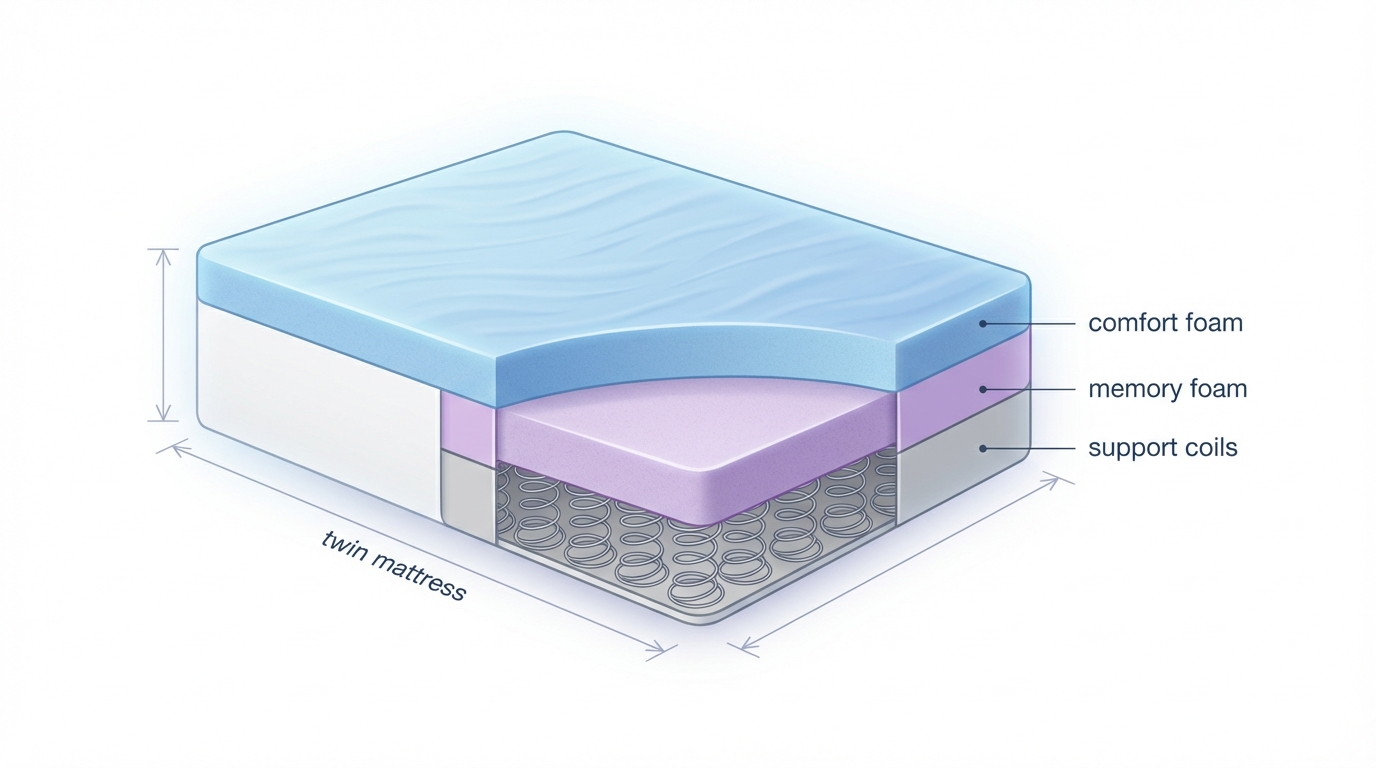
Most twin mattresses today fall into four main categories: innerspring, memory foam, latex, and hybrid. Innerspring mattresses use a coil support system as the core, often with layers of quilted foam or fiber on top. These models can feel more buoyant, with easier movement and stronger edge support, which is helpful if you are sitting on the side to tie shoes or helping a child in and out of bed. Memory foam mattresses use layers of contouring foam that respond to body heat and pressure, which can be very comforting for side sleepers or those with sensitive joints.
Latex mattresses, whether natural or synthetic, tend to offer a more responsive, bouncy feel with good durability and natural cooling properties. Hybrids combine a coil support core with comfort layers of foam or latex, aiming to deliver the best of both worlds, pressure relief on top with strong underlying support. According to independent testing cited by Consumer Reports and other review organizations, hybrids have become increasingly popular in recent years because they adapt well to different body types and sleeping positions.
For many sleepers who want a high quality twin, a hybrid option like the Sealy Posturepedic Elite Soft Hybrid Mattress – Brenham II can be a great middle ground. It combines targeted coil support, which keeps the spine from sagging, with plush comfort foams that cushion shoulders and hips. In my experience, that kind of construction works particularly well for side sleepers and growing teens who need both structure and softness. For those who prefer a slightly firmer but still cushioned feel, a pillow top hybrid such as the Sealy Posturepedic Elite Medium Brenham II Euro Pillow Top can strike a nice balance.
Firmness is another piece of the comfort equation. There is no single “correct” firmness for twins. Lighter weight sleepers, especially children, often do better on medium to softer feels because their bodies do not sink as deeply, so they need more give to get pressure relief. Heavier sleepers often need a slightly firmer feel so they do not bottom out and create awkward angles in their spine. Research on back pain and mattress firmness, including studies referenced by the Mayo Clinic, suggests that medium firm models tend to work well for many adults, though individual preference still matters greatly.
“We started with a very basic twin mattress that came in a bundle with the frame, and my daughter kept waking up with sore hips. After talking with Mia at Sleepology, we upgraded to a Sealy Posturepedic pillow top in twin size. She noticed the difference the first week and is actually sleeping through the night now.” – Heather S., December
Bedding, Pillows, And Foundations For A Twin
A twin mattress is only one piece of the sleep system. The foundation, pillows, and bedding you pair with it can either support or undermine the comfort you just invested in. When they are matched correctly, everything works together so the mattress can do its job. When they are mismatched, you might blame the mattress for problems that really come from what is above or below it.
Let us start with foundations and bases. Most twin mattresses are designed to sit on either a solid platform, a compatible box spring, or a slatted base that meets the manufacturer’s spacing recommendations. A sturdy foundation like the standard height Sealy mattress base keeps the mattress from sagging between slats and helps maintain the warranty. In rooms with low ceilings or for children who are climbing in and out of bed themselves, a low profile 5 inch base can keep the sleep surface at a more comfortable and safer height without sacrificing support.
Pillows are equally important in a twin setup, because they directly affect neck and upper spine alignment. Side sleepers often need a thicker, more supportive pillow to fill the space between the head and shoulder, while back and stomach sleepers usually do better with a slimmer profile so the neck is not pushed forward. A versatile option like The BodyPillow by Tempur-Pedic can be especially helpful for side sleepers on a twin, because it supports the knees, hips, and shoulders along the length of the body, reducing pressure points even on a narrower mattress.
Sheets, protectors, and blankets should match the mattress size precisely. Twin and twin XL are different lengths, so fitted sheets and mattress protectors are not interchangeable between those two. If your mattress is on the thicker side, which is very common with modern hybrids and pillow tops, check the pocket depth on fitted sheets and make sure it is designed to accommodate the full height of the mattress. A waterproof but breathable protector helps guard against spills and allergens without drastically changing the feel of the bed, which is especially important for kids and guest rooms.
Accessories like toppers, quilts, and throws can then be layered based on personal preference and season. Some sleepers love the enveloping feel of a plush topper, while others prefer a more direct connection to the mattress surface. If you are outfitting a twin for a hot sleeper, consider lighter breathable sheets and lighter comforters, since narrow beds can feel warmer when body heat is more concentrated. Sleep hygiene experts often highlight temperature regulation as a key element of good sleep, so it is worth fine tuning bedding choices to avoid overheating at night.
A Quick Checklist Before You Commit To A Twin
Before you click “buy” on a twin size mattress, it can be helpful to run through a simple checklist to make sure you have covered the essentials. These few minutes of review can protect you from overlooked details that many shoppers only notice once the bed is already in their home. Think of it as a final alignment between your real life and the idea of a twin you have been considering.
Use this short checklist to confirm whether a twin truly fits your needs right now and for the next several years:
- Measure your room and confirm a 38 inch by 75 inch footprint leaves at least one safe, comfortable walking path.
- Confirm the primary sleeper’s current height and estimate future growth if this is for a child or teen.
- Consider sleep position and movement, such as side sleeping, stomach sleeping, or frequent turning, and whether the width will feel restrictive.
- Think through who else might share the bed, for example pets or a child crawling in at night, and whether the twin will still feel comfortable.
- Decide on a support system, including a compatible foundation or adjustable base, and check total height from floor to top of mattress.
- Plan your bedding, making sure you know whether you need standard twin or twin XL sheets, protector, and topper.
- Look at your medium term plans, such as kids heading off to college or moving in with a partner, and decide whether this mattress will be repurposed or replaced.
If you can walk through each of these points and still feel good about a twin, that is a strong sign you are making a thoughtful choice rather than a rushed one. If any item gives you pause, it may be worth either stepping up to a larger size or choosing a twin XL so the mattress fits your future as well as your present. A well chosen twin can move with you through different rooms and roles over many years, from kids bedroom to guest room or home office, if you plan a bit up front.
How Sleepology Twins Fit Into Real Homes
At Sleepology, I often see the same story play out in different homes. A family needs to optimize space, or a student is setting up a first apartment, or a single professional is trying to turn a small room into both an office and a bedroom. In each case, a twin mattress is not just a rectangle, it is one of the main pieces that either unlocks flexibility or makes a room feel tight and frustrating.
For kids and teens, we lean heavily on support and durability, because their bodies are still growing and their mattresses often double as reading nooks and hangout spots. Twin versions of reliable models like the Sealy Posturepedic Elite Soft Mattress – Albany II Euro Pillow Top or the Sealy Posturepedic Pro Medium Dupont II Euro Pillow Top offer the same zoning and foam quality as their larger counterparts, just in a more compact footprint. That means kids and teens get proper back support and pressure relief, not just a thin, bouncy surface that wears out quickly.
For adults and guest setups, we often pair twin mattresses with thoughtful bedding and accessories to create a more premium experience. Soft but supportive pillows, breathable sheets, and perhaps a full length body pillow can make even a narrow bed feel indulgent rather than sparse. Our pillows, sheets, toppers, and protectors collection includes options at different price points that still respect the fundamentals of good sleep, such as temperature regulation and proper alignment.
When someone comes in considering a twin for themselves but is on the fence, I often invite them to compare that twin to a full or queen from a comfort perspective, not just size. For back sleepers, our curated collection of mattresses for back sleepers in twin and larger sizes makes it easier to feel the difference that proper support can make, regardless of width. That way, the final decision is not only about how much space you have in your room, but also about how your body feels when you lie down.
Even in larger rooms, twins have their place. Some couples choose to keep a twin in a separate room for nights when one partner is sick, recovering from surgery, or simply needs a little extra space. Others combine two twins in creative layouts to create flexible guest spaces for kids sleepovers and visiting family. Because twin sizes are so common, they are also easier to move from room to room as your life shifts, which gives you more value over the mattress lifespan.
Conclusion: Is A Twin Size Mattress Big Enough For You?
How big is a twin size mattress. On paper, it is 38 inches by 75 inches, the smallest standard mattress meant for older children, teens, and adults. In real life, that size can feel just right, or it can feel like a squeeze, depending on your height, how you sleep, how many creatures end up sharing your bed, and what your room is like. When you look beyond the numbers and into your actual habits, space, and plans for the next several years, the right answer becomes much clearer.
A twin shines in kids rooms, bunk and trundle setups, small guest rooms, and tight apartments where every inch counts. It can also be perfectly comfortable for many adults who sleep alone, are not very tall, and prefer a simpler bedtime routine. Where it struggles is with adult couples, very tall sleepers on their back or stomach, and situations where you expect your body or family to grow into a larger footprint soon. In those cases, a twin XL, full, queen, or even king may be a smarter long term investment.
If a twin does fit your life, the next step is to choose one that is worth sleeping on, not just one that fits your budget number on a screen. Prioritize support, pressure relief, and reputable materials, and pair it with a compatible foundation, thoughtful pillows, and correctly sized bedding. When all of those elements work together, even a smaller mattress can deliver deeply restful, pain free nights.
If you are still unsure, you do not have to figure this out alone. At Sleepology, we help people lay out room dimensions, talk through growth and life changes, and compare twin options side by side with larger sizes so the choice feels grounded, not guessed. Whether you end up in a twin, a twin XL, or move up to a queen or king, the goal is the same: a sleep setup that truly fits your body, your space, and your life, so you can stop worrying about measurements and start enjoying your nights.
Frequently Asked Questions
How big is a twin size mattress in inches and centimeters?
A standard twin size mattress is typically 38 inches wide and 75 inches long. In centimeters, that is roughly 96.5 centimeters wide by 190.5 centimeters long. Some manufacturers may round slightly, so you might see 39 by 75 inches listed, but most bedding, protectors, and frames in the United States are designed around the 38 by 75 standard. Always check your specific mattress details if you need a very precise fit for a custom frame or tight space.
Is a twin mattress big enough for an adult to sleep on every night?
A twin can be big enough for an adult if certain conditions are met. Generally, it works best for adults under about 5 feet 8 or 5 feet 9 who sleep mostly on their side or in a curled position and do not share the bed with a partner or large pet. If you are taller, sleep on your back or stomach, or like to spread out, the 38 inch width and 75 inch length may feel restrictive over time. In that case, a twin XL, full, or queen often provides a more comfortable and sustainable sleep surface.
What is the difference between a twin and a twin XL mattress?
The difference between a twin and a twin XL is length, not width. Both sizes are typically 38 inches wide, but a twin is about 75 inches long, while a twin XL is about 80 inches long. Those extra 5 inches can make a noticeable difference for taller sleepers, especially teens and adults who are around or above 6 feet. Because they share the same width, both sizes work well in narrow rooms, but you will need twin XL specific sheets and protectors if you choose the longer size.
Can two people sleep on a twin mattress comfortably?
For most adult couples, a twin mattress is too small for comfortable nightly use. Two adults would have only 19 inches of width each, which is significantly narrower than a seat on a plane and far less than the personal space provided by a full, queen, or king. While two small children can sometimes share a twin for short periods, such as sleepovers, long term sharing is not ideal. Couples who want to save space often do better with at least a full size, and more commonly a queen, which both offer more width and, in the case of queen, more length.
How much bigger is a full mattress than a twin?
A full mattress is wider than a twin but the same length. The typical full size is 53 inches wide by 75 inches long, compared to a twin at 38 inches wide by 75 inches long. That means you gain about 15 inches of extra width with a full. For a single sleeper, that can feel like a significant upgrade in space to roll over or sleep in different positions. For couples, a full is still fairly cozy, with about 26.5 inches of space per person, but it is a clear step up from a twin in terms of personal room.
What size room do I need for a twin bed?
A twin bed fits comfortably in many smaller rooms, but there are still some guidelines to keep it practical. As a baseline, a room that is around 7 by 10 feet or larger can usually handle a twin with at least one clear walking path. If you want space for additional furniture like a desk, dresser, or bookcase, or if you prefer walking space on both sides of the bed, an 8 by 10 or larger room is often more comfortable. Always measure your specific room and sketch out furniture placements before you commit.
Do twin mattresses come in the same quality levels as queen and king sizes?
Yes, twin mattresses are offered in the same quality levels and technologies as larger sizes in most modern mattress lines. You can find basic budget friendly twin innerspring mattresses, as well as premium twin hybrids, memory foam, and latex models with advanced cooling and zoning features. Brands simply scale the dimensions down, not the construction quality, so you can absolutely invest in a supportive, long lasting twin. When cost is a concern, a twin can be a smart way to access higher quality materials at a lower total price than a larger size.